The Day the Kaiser Lost Two Thrones
On November 9, 1918, Kaiser Wilhelm II's abdication was announced without his consent, and two rival republics were proclaimed in Berlin the same afternoon.
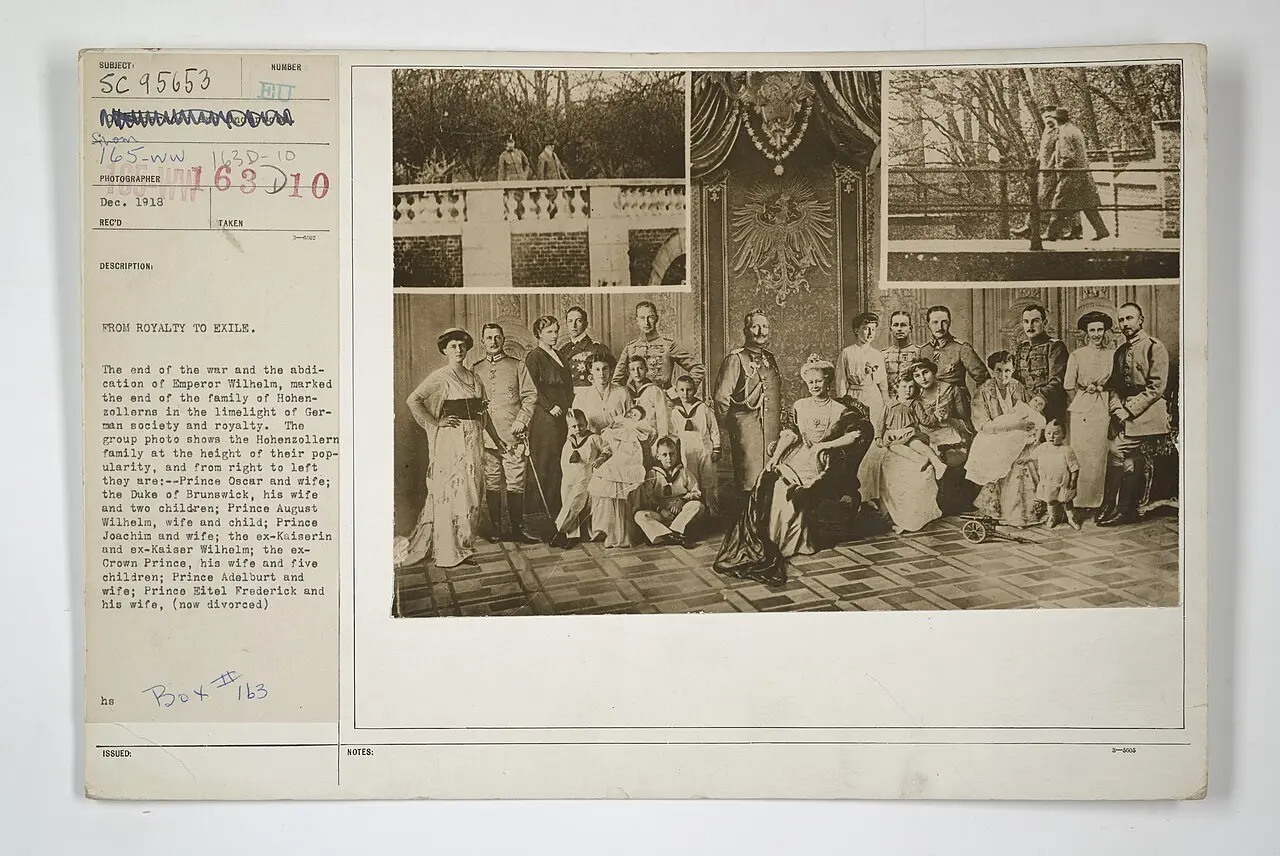
The telegram from Berlin never got a straight answer. Kaiser Wilhelm II, waiting at army headquarters in Spa, Belgium, could not decide whether to abdicate as the German Revolution swept his country — mutinies in the navy, uprisings in the cities, and on November 9 his own generals, Paul von Hindenburg and Wilhelm Groener, informed him bluntly that the army no longer stood behind him. He was willing, he said, to give up the imperial crown — but hoped to keep the Prussian kingship, as if the two thrones could be separated.
They could not, and Berlin would not wait. On November 7, Ebert's Social Democrats had issued the government an ultimatum: abdicate within 24 hours. When Wilhelm still hesitated, Chancellor Prince Max of Baden, desperate to calm the revolutionary crowds and preserve some order, simply announced the Kaiser's abdication of both the German and Prussian thrones on the morning of November 9, 1918 — without Wilhelm's authorization. It was an unconstitutional act, and it worked: the monarchy that had defined Germany since 1871 ended with a press release. Max himself resigned hours later, handing the chancellorship to Friedrich Ebert, leader of the Social Democrats, whose first statement announced a new "people's government" and ended with a plea to the streets: "Leave the streets! Keep order and peace!"
What followed that afternoon was political theater at double speed. At 2 p.m., Philipp Scheidemann proclaimed the German Republic from a window of the Reichstag, hoping to preempt the radicals. At 4 p.m., Karl Liebknecht of the Spartacus League proclaimed a rival Free Socialist Republic from a balcony of the royal palace. Two republics, two hours apart, two visions of Germany's future — and the split between them would poison the new republic's short life.
Wilhelm fled across the border to the neutral Netherlands, where he lived in quiet exile at Haus Doorn until his death in 1941. Two days after his fall, the guns of World War I fell silent. November 9 would become Germany's Schicksalstag — its "day of fate" — the same date that later marked the 1923 Beer Hall Putsch, Kristallnacht in 1938, and the fall of the Berlin Wall in 1989. But it started here: with a chancellor who couldn't reach his emperor, an emperor who wouldn't decide, and a republic born in an afternoon.
Photo: U.S. Army Signal Corps, public domain (via Wikimedia Commons; U.S. National Archives).