The Fire That Boston's Sick Horses Couldn't Outrun
On November 9, 1872, a basement fire in downtown Boston exploded into a two-day inferno that destroyed 776 buildings — while the fire horses were too sick to pull the engines.
It started, as city-destroying fires so often do, in a basement. At about 7 p.m. on Saturday, November 9, 1872, flames broke out in the basement of a dry-goods warehouse at the corner of Kingston and Summer Streets in Boston's commercial district. The alarm sounded at 7:24; by 8 p.m., all twenty-one of the city's engine companies were on the scene. It made no difference. Within hours the fire was consuming a three-block radius, and by dawn it was roaring through the center of downtown.
Boston, as one historian later put it, "was built to burn." The district's fashionable wooden mansard roofs caught fire and carried the flames from rooftop to rooftop; narrow streets let the blaze leap building to building; gas mains fed it; and the water pressure from the hydrants was too weak to reach the upper floors. Firefighters blew up buildings with black powder in a desperate bid to create firebreaks. The glow was so bright that sailors logged it from ships off the coast of Maine.
And then there were the horses. The entire Northeast was suffering an epizootic — an equine influenza — that had weakened nearly every fire horse in Boston. Fire Chief John Damrell had foreseen the crisis and hired 500 extra men to haul the engines by hand; outside towns dragged their apparatus for miles. (A later commission concluded the missing horsepower delayed the response by only minutes — the city's wooden bones were the real problem.) Thirteen months earlier, Damrell had traveled to Chicago after its great fire to study what went wrong, and had begged Boston's officials to fix the same flaws. They hadn't. The heat grew so intense that stone facades shattered; the fire pushed south to the waterfront, incinerating docked vessels and wharves.
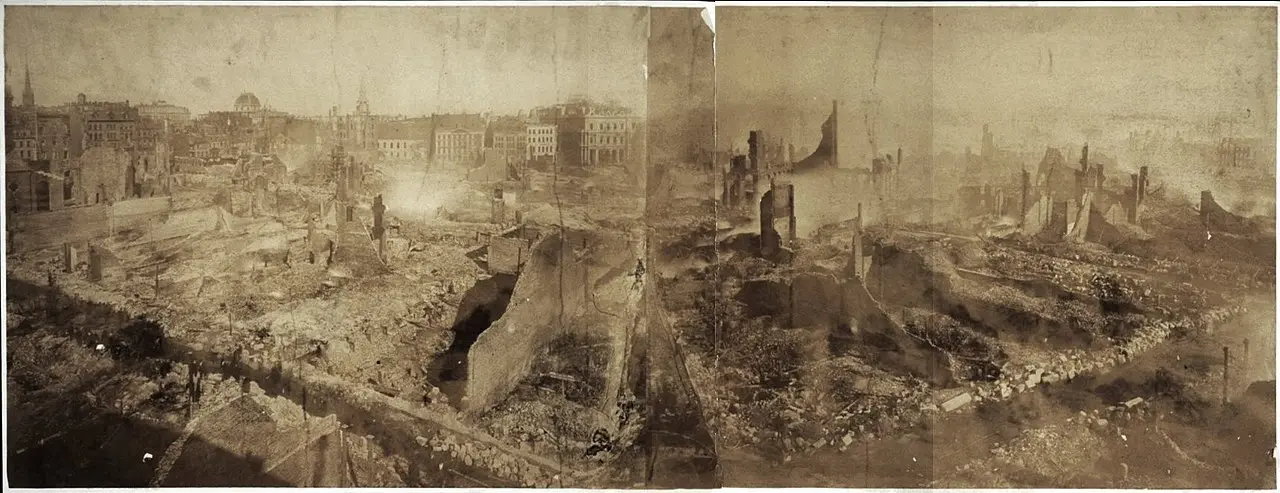
When the inferno was finally contained around midday, the toll was staggering: 776 buildings across 65 acres of the financial district — the "burnt district" — lay in ruins, more than 20 people were dead, including eleven firefighters, and property losses topped $70 million, roughly $1.6 billion in today's dollars by one historian's estimate. "It burned from downtown crossing to the wharf," historian Stephanie Schorow has written. "If there hadn't been an ocean there, it would have kept going." Boston rebuilt grander and safer, with stricter building codes and better waterworks — the hard lesson its fire chief had tried to teach before the flames did.
Photo: attributed to Joshua Smith, public domain (via Wikimedia Commons).