The Day the BBC Was Born
On October 18, 1922, a group of radio manufacturers formed the British Broadcasting Company — the seed of the world's oldest national broadcaster.
On October 18, 1922, in a small office in London, a new company was formed. It had no studios, no transmitters of its own, no audience to speak of — just a licence from the Post Office and a consortium of radio manufacturers behind it. Its name was the British Broadcasting Company.
Within a lifetime, those three letters — BBC — would become the most trusted name in broadcasting on earth.
The BBC was born out of a very British fear of chaos. Radio was exploding. In 1920, a famous soprano, Dame Nellie Melba, had sung into a microphone at Marconi's factory in Chelmsford in Britain's first live public broadcast, and the public went wild for it. Amateurs were building their own transmitters; nearly a hundred groups applied for broadcast licences. The General Post Office, which controlled the airwaves, looked across the Atlantic at America's free-for-all of competing stations and shuddered. Britain would do this differently: one licence, one company, owned jointly by the big wireless manufacturers — Marconi, General Electric, Metropolitan-Vickers, and others — so the airwaves would stay orderly.
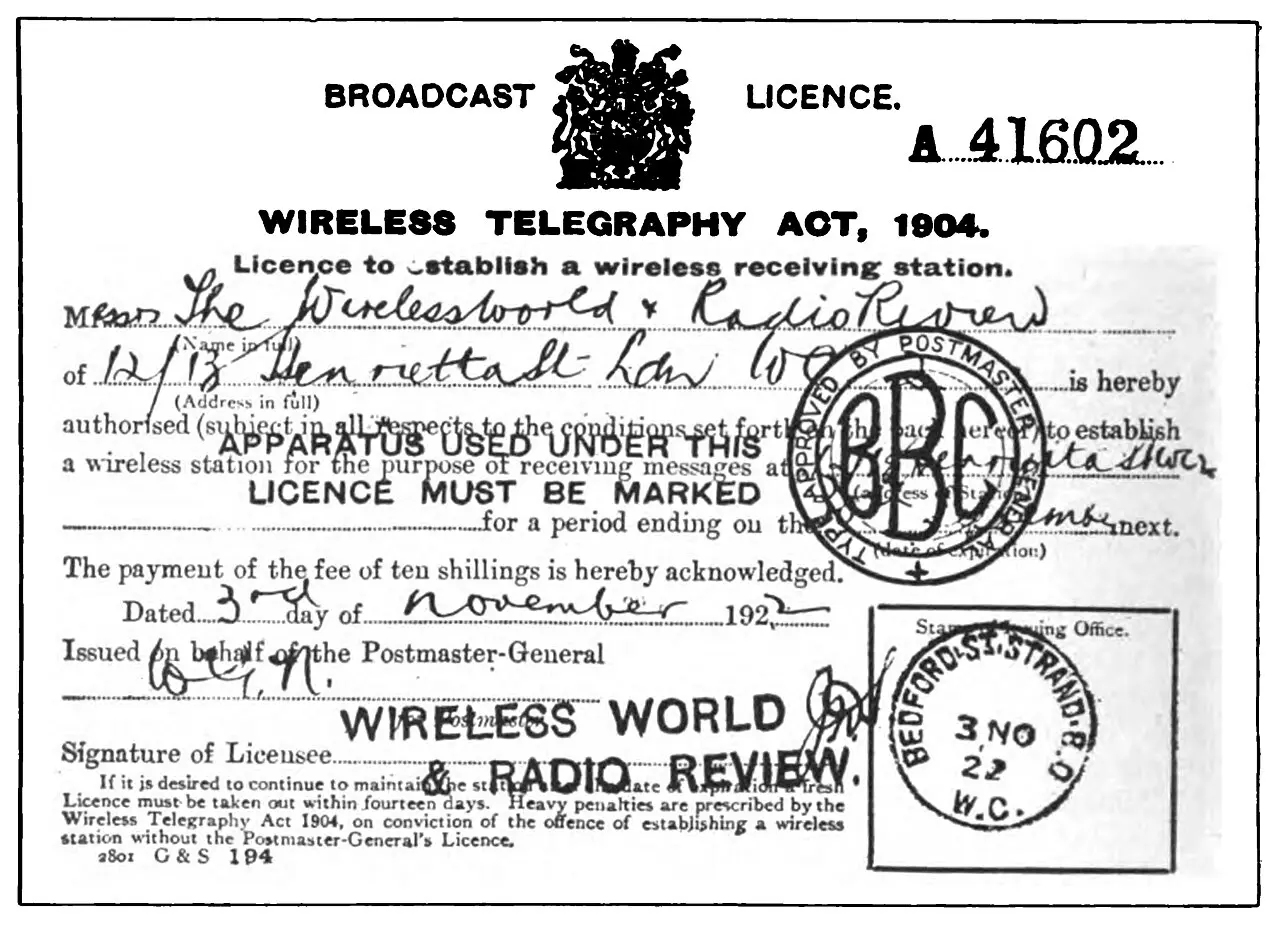
So on October 18, 1922, the British Broadcasting Company Ltd. came into existence. Less than a month later, on November 14, it made its first official broadcast: a news bulletin read from a tiny studio called 2LO on the seventh floor of Marconi House in London. The audience was anyone with a crystal set and a ten-shilling receiving licence — like the one in the photograph above, stamped and issued that very autumn. The company was funded by a royalty on every BBC-approved radio set sold, plus those licence fees: the public would pay for broadcasting, and in return broadcasting would serve the public.
Then came the man who defined it all. In December 1922, a 33-year-old Scotsman named John Reith answered the advertisement for general manager. Reith was a Calvinist moralist with an almost missionary sense of purpose, and he stamped the young company with a creed it carries to this day: broadcasting should "inform, educate, and entertain." Under Reith, the BBC refused to chase the cheapest audience. It played classical music when the public wanted dance bands. It read the news in dinner jackets.
The BBC's coming-of-age arrived in 1926, during the General Strike, when the newspapers stopped printing and the BBC became, for nine days, the nation's only source of news. Millions who had thought of radio as a novelty suddenly understood it as a necessity. The following year, the private company was dissolved and reborn under a Royal Charter as the British Broadcasting Corporation — a public institution, independent of both government and advertisers, funded by the licence fee.
From there the story is familiar: the Empire Service in 1932 (the seed of the World Service), the world's first regular television service in 1936, the wartime broadcasts that made the BBC the voice of free Europe, and the slow growth into the largest broadcaster on the planet, reaching hundreds of millions of people every week.
It all traces back to that October day in 1922 — a roomful of radio manufacturers, a Post Office licence, and a gamble that broadcasting could be something better than a scramble for ears. A century later, every debate about the BBC — what it's for, who it serves, whether it's worth the fee — is really a debate about the idea born that day: that the airwaves belong to everyone.
Photo: unknown author, public domain (via Wikimedia Commons) — a British wireless receiving licence issued on November 3, 1922, weeks after the BBC's founding, costing ten shillings.