Expelled for a Raised Fist
On October 18, 1968, the United States Olympic Committee expelled Tommie Smith and John Carlos for their silent protest against racism on the medal podium.
Two days earlier, they had stood on the Olympic podium and made the most famous silent statement in sports history. Now, on October 18, 1968, the United States Olympic Committee made its answer: Tommie Smith and John Carlos were expelled from the Games, stripped of their credentials, and ordered out of the Olympic Village.
Their crime had taken about ninety seconds. On October 16, Smith had won the gold medal in the 200-meter dash in Mexico City in a world-record 19.83 seconds, with fellow American John Carlos taking the bronze. As the American national anthem played during the medal ceremony, the two men bowed their heads and raised black-gloved fists to the sky — Smith his right, Carlos his left. They wore black socks and no shoes, to symbolize Black poverty. On their jackets they wore badges of the Olympic Project for Human Rights. The silver medalist, Australian Peter Norman, wore one of the badges too, in solidarity.
It was 1968, the most convulsive year in modern American history. Martin Luther King Jr. and Robert F. Kennedy had been assassinated months apart. Cities had burned. In that atmosphere, two young runners from San Jose State University — Smith the quiet son of sharecroppers, Carlos the outspoken kid from Harlem — decided that the world's biggest stage was the place to say that all was not well in America.
The reaction was immediate and ferocious. The International Olympic Committee, led by the authoritarian Avery Brundage, demanded punishment, warning of "racial dissension" spreading through the Games. The U.S. committee, which had first issued only a warning, caved to the pressure. On October 18 it voted to suspend Smith and Carlos from the team and send them home, releasing a statement expressing its "profound regrets" to the IOC, the Mexican organizers, and the people of Mexico for the athletes' "discourtesy."
What followed was the slow destruction of two careers. At home, Smith and Carlos received death threats. The FBI labeled them troublemakers and monitored them. Banned from international track, both men — among the fastest humans alive — found doors closed everywhere. Carlos, who had once held world records, washed out of professional football tryouts; Smith struggled to find coaching work. For years, mainstream America treated them not as heroes but as disgraceful ingrates who had insulted their country.
But history has a way of revisiting its verdicts. Slowly, then all at once, the gesture was re-examined — and redeemed. In 2005, their alma mater, San Jose State, unveiled a 22-foot statue of the protest on campus and awarded both men honorary doctorates. In 2008, ESPN gave them the Arthur Ashe Courage Award. In 2016, President Barack Obama welcomed them to the White House alongside that year's Olympic team — the honor their own Olympic committee had denied them in 1968.
Today the image of those raised fists is taught in classrooms, printed on posters, and invoked by every athlete who has ever knelt, sat, or spoken out. Smith himself later explained that the gesture was never about hatred — it was a cry for human rights, for dignity, for the simple proposition that a medal doesn't shield you from injustice back home.
October 18, 1968, was meant to be the day the establishment erased Tommie Smith and John Carlos. Instead, it became the day that proved some statements can't be unsaid — and some punishments only make the point louder.
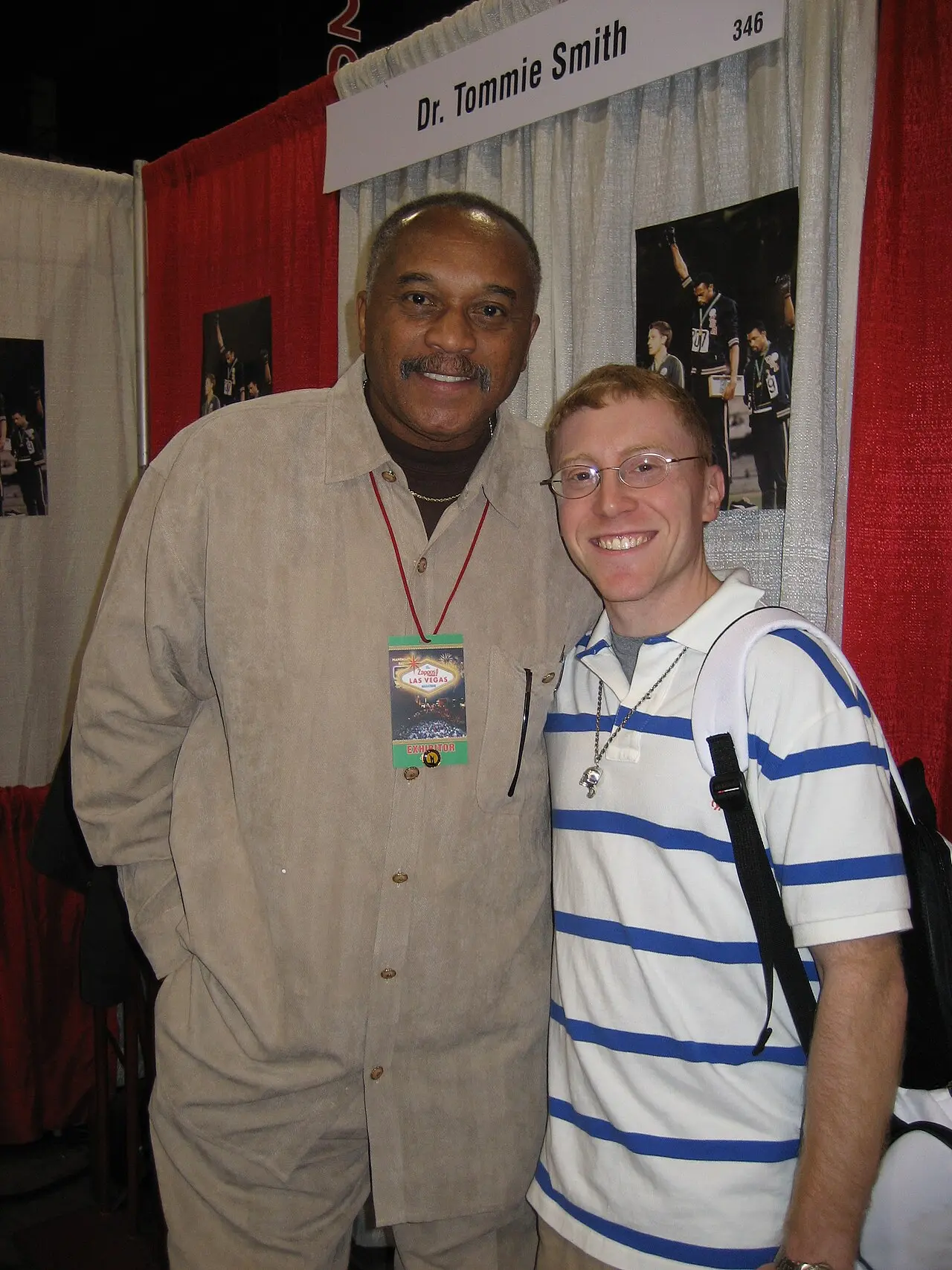
Photo: "Chamber of Fear," CC BY-SA 2.0 (via Wikimedia Commons) — Tommie Smith photographed at a 2007 marathon expo, with a display of the famous 1968 podium protest visible behind him.