The Chip That Started Everything: Intel's 4004
On November 15, 1971, Intel unveiled the 4004 — a 'micro-programmable computer on a chip' smaller than a fingernail that launched the digital age.
The advertisement promised “a new era of integrated electronics.” For once, the ad copy was telling the truth.
It began in 1969, when the Japanese calculator company Busicom asked a young Intel to design chips for a new printing calculator. Busicom's engineers had drawn up plans for a whole family of custom chips — complicated, expensive, inflexible. Then Intel engineer Ted Hoff proposed something radical: instead of hard-wiring the calculator's logic into a set of custom circuits, store the data in memory and build one general-purpose processor that could be told what to do by software. One chip to run them all.
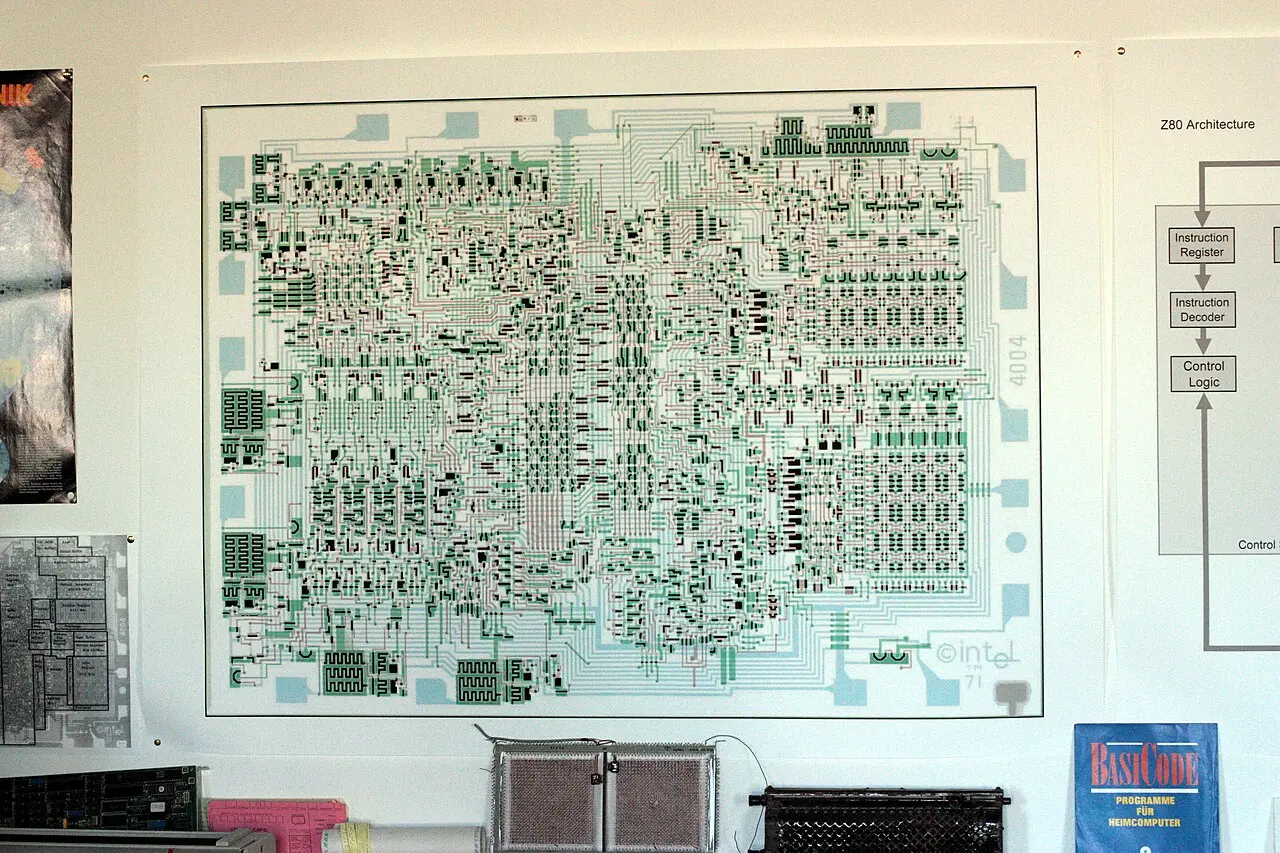
Turning that idea into silicon fell to a small team: with Hoff reassigned elsewhere, newly hired Federico Faggin took over the chip design, assisted by Busicom's Masatoshi Shima, with Stan Mazor refining the architecture. Design work began in April 1970, and the team used a cutting-edge manufacturing method — silicon gate technology — that doubled transistor density and quintupled operating speed over what had come before. They squeezed an entire central processing unit onto a piece of silicon smaller than a fingernail. The first working chip was delivered in March 1971 and went straight into Busicom's 141-PF calculator.

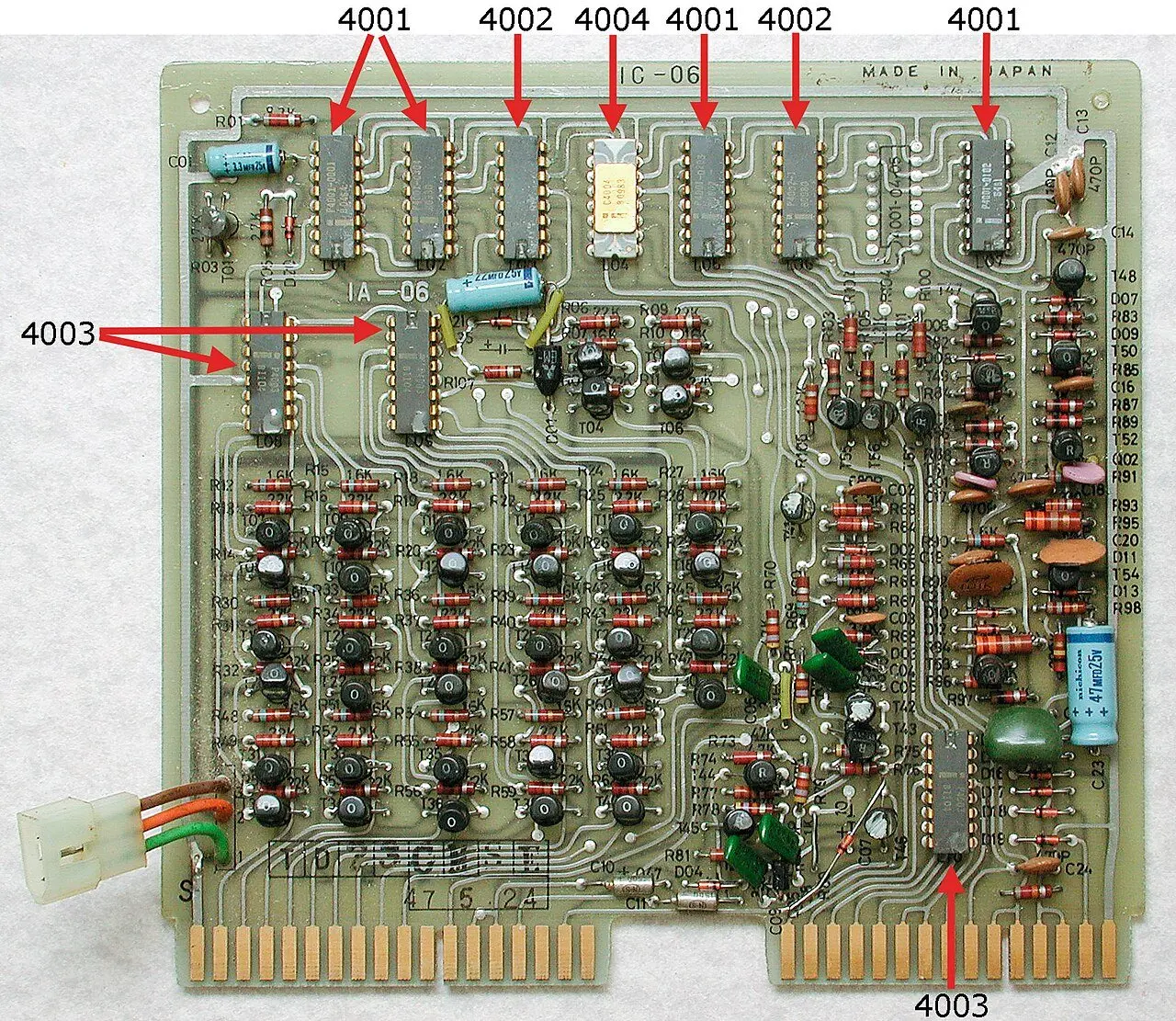
Intel then negotiated the right to sell the design to anyone — and on November 15, 1971, it announced the chip to the world with an advertisement in the trade magazine Electronic News. The Intel 4004 was billed as “a micro-programmable computer on a chip”: a 4-bit processor packing 2,300 transistors, built on a 10-micron process, running at 740 kilohertz, and priced at $60. It was the heart of a four-chip family — the 4001 ROM, the 4002 RAM (with just 40 bytes of memory), the 4003 shift register, and the 4004 CPU — that together formed a complete, if tiny, computer.
Before the 4004, a computer's “brain” filled circuit boards, or entire rooms. After it, computing could shrink into everything — calculators, then cash registers, then personal computers, then the phone in your pocket. Co-inventor Stan Mazor later said it took Intel about five years just to teach engineers how to build products around a microprocessor. Within three years came the 8-bit 8008; the 8080 followed, powering the first personal computers. Every processor in the world today is a descendant of that fingernail-sized chip, announced on a November day in 1971.
Photo: MaltaGC, CC BY-SA 4.0 (via Wikimedia Commons).
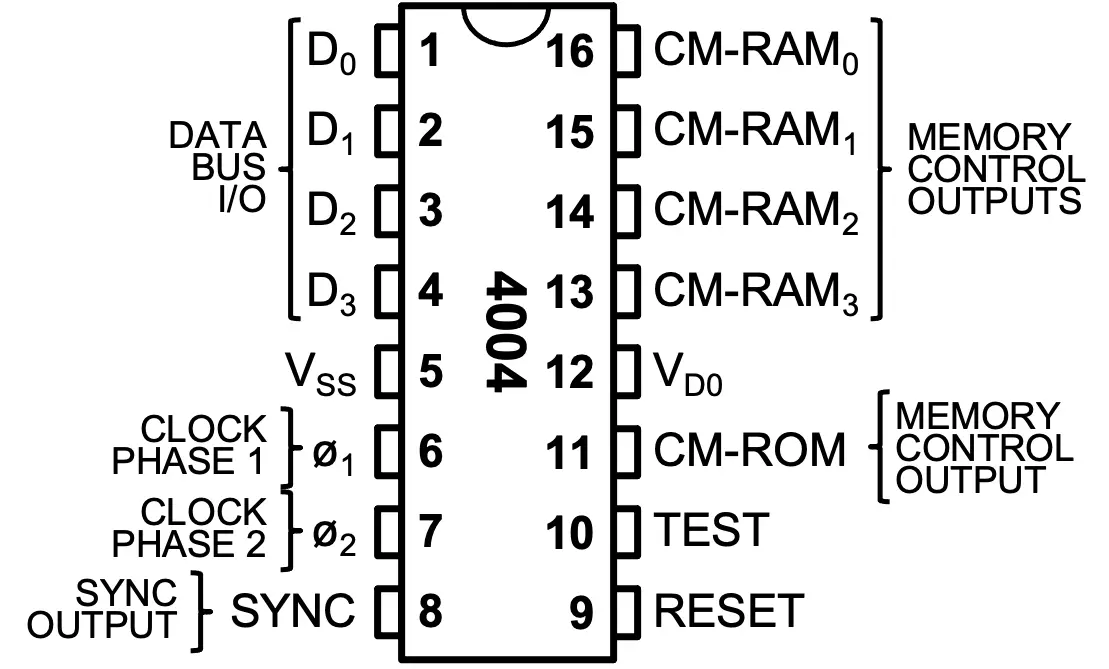
More images (via Wikimedia Commons): the Intel 4004 chip layout (Wolfgang Stief, CC0); Federico Faggin (Intel Free Press, CC BY-SA 2.0); the Intel 4004 pinout diagram (Rudiniemeijer, CC BY-SA 4.0).