America's First Constitution: The Articles of Confederation
On November 15, 1777, the Continental Congress adopted the Articles of Confederation — the young nation's first frame of government, a 'firm league of friendship' among 13 wary states.
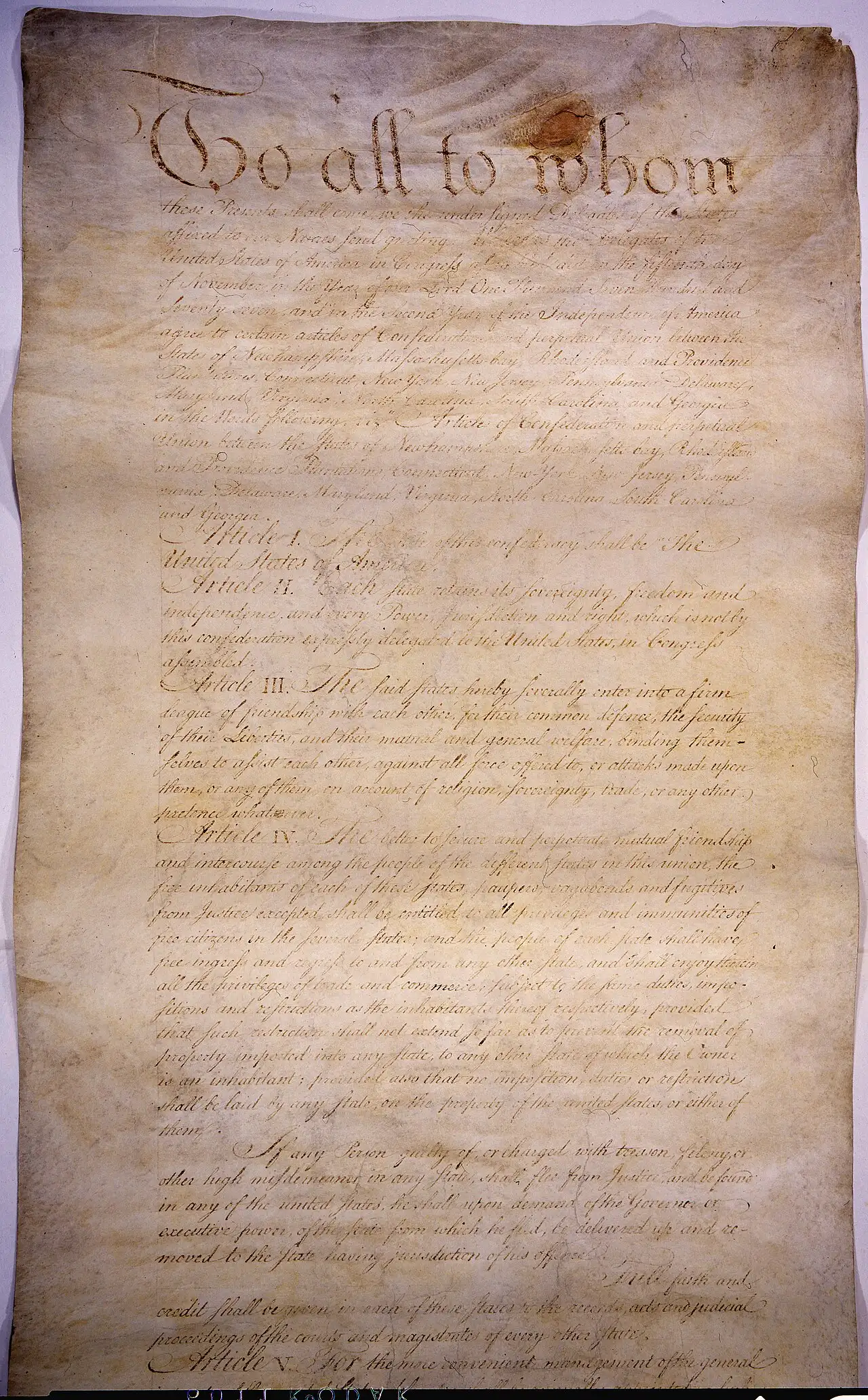
The United States got its name on November 15, 1777 — along with its first constitution. After sixteen months of debate, the Continental Congress, meeting in its temporary capital of York, Pennsylvania, adopted the Articles of Confederation and Perpetual Union, the new nation's first frame of government.
The timing was audacious. The Revolutionary War was still raging — Congress had fled Philadelphia ahead of the British army — and yet the delegates paused to write down how their rebellion would govern itself. The principal author was John Dickinson of Delaware, who had submitted a first draft in July 1776. His version imagined a strong central government; what emerged after more than a year of argument was something far looser.
The Articles made the thirteen states a "firm league of friendship." Each state kept its sovereignty and its independence, and each got exactly one vote in Congress, large or small.
The document's full title — the Articles of Confederation and Perpetual Union — gave the new nation its lasting name: the United States of America. Congress sent the Articles to the states for ratification and, while waiting, simply carried on under them, directing the war effort, conducting diplomacy with foreign powers, and managing relations with Native American nations. Eight states had ratified by the time Congress formally reissued the document for signing in July 1778. The central government could conduct foreign affairs, declare war and peace, and maintain an army and navy — but it could not levy taxes, and it could not force a state to do much of anything. Changing the Articles required the agreement of all thirteen states.
It was, deliberately, the opposite of the British system the patriots had just rejected: a government designed to be too weak to become a tyrant. That design came at a price. Congress struggled to pay for the war, to enforce treaties, and to settle disputes between states. Ratification itself dragged on for years while the states bickered over western land claims; Maryland, the last holdout, did not sign on until March 1, 1781, when the Articles finally took effect as the law of the land.
Within a few years, the weaknesses were impossible to ignore. In 1787, Congress called a convention in Philadelphia to revise the Articles — and the delegates instead wrote an entirely new Constitution, which took effect in 1789. The Articles are often treated as a failed first draft of America. But they carried the young country through the Revolution, gave it its name, and taught the founders exactly what a workable union would require: a government strong enough to act, and restrained enough to trust.
Photo: U.S. Government, public domain (via Wikimedia Commons).