
Telstar: The 171-Pound Sphere That Shrunk the World
Launched July 10, 1962, a tiny satellite beamed the first live television pictures across the Atlantic — and TV went global.
In the small hours of July 10, 1962, a Delta rocket lifted off from Cape Canaveral carrying a cargo that weighed less than a grown man. Telstar 1 was a 34.5-inch sphere, studded with solar cells and packed with transistors, built by Bell Telephone Laboratories for AT&T and launched by NASA — the first privately sponsored space mission in history.
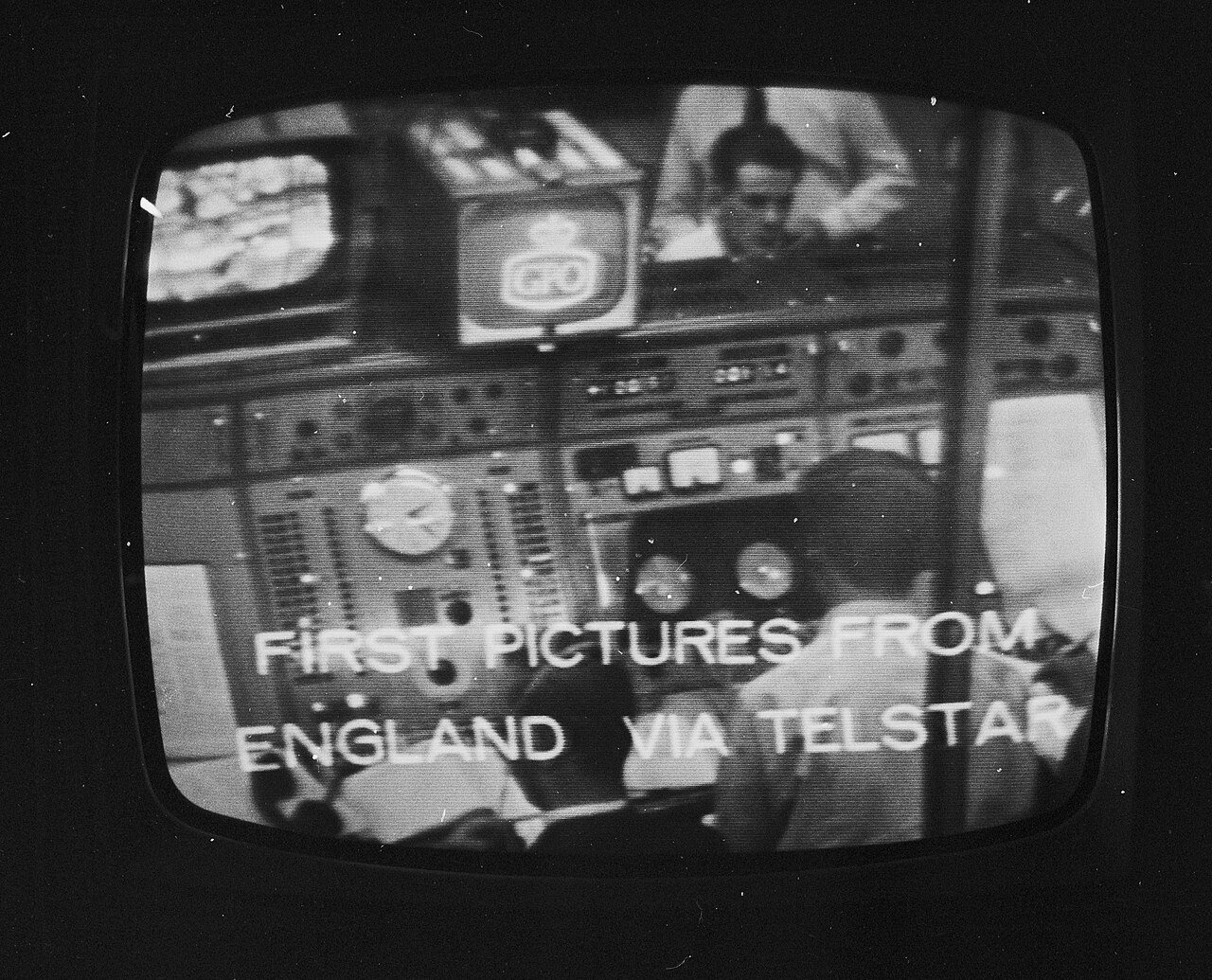
Just hours later, the little satellite made history. As Telstar swept through its elliptical orbit — looping between 593 and 3,503 miles above the Earth — it relayed the first live television pictures to France: an American flag waving outside the receiving station in Andover, Maine. In the days that followed came the first live transatlantic television seen by American viewers: the Statue of Liberty, the Eiffel Tower, remarks from President John F. Kennedy, clips from a baseball game between the Philadelphia Phillies and the Chicago Cubs, and the French singer Yves Montand. Between broadcasts, Telstar also relayed telephone calls, data transmissions, and picture facsimiles.
Before Telstar, live television across an ocean was impossible. Networks that wanted to show a foreign event had to ship film by airplane — the tapes arriving long after the fact. Telstar’s passes offered only brief transmission windows as it raced around its orbit, but the proof of concept was electrifying. A delighted President Kennedy praised America’s new communications satellite as an “outstanding symbol” of the nation’s space achievements.
Telstar’s own life was short. In February 1963, just seven months after launch, the satellite fell silent, knocked out by radiation from Starfish Prime, a U.S. high-altitude nuclear test. It remains in Earth orbit to this day, a silent monument to the moment it opened.
But the idea outlived the hardware. Telstar proved that a satellite could bounce live pictures around the planet, opening the door to the global television age — the live Olympics, the moon landing watched worldwide, the 24-hour news cycle. Every live broadcast that crosses the globe tonight traces its ancestry to that 171-pound sphere and the July morning it rode into orbit.
The launch itself was a study in early space-age optimism. “Liftoff came at 2:35 a.m.,” NASA’s deputy launch director John Neilon later recalled. “It was also the first launch attempt” — a notable achievement in an era when rockets often needed several tries. Neilon, who stayed with NASA for 28 years, said he was “really proud to be a part of it.”
The ground network was as ambitious as the satellite. In Andover, Maine, engineers had built a giant horn antenna to talk to Telstar; its counterpart at Pleumeur-Bodou in Brittany, France, listened for the signal coming back. Because Telstar orbited low and fast rather than hovering over one spot, each pass offered only a brief window for transmission — operators on both sides of the ocean had to be ready the instant the satellite crested the horizon.
The era that followed needed no briefing on what Telstar meant. Within years, engineers were launching satellites that could hover in geostationary orbit and broadcast around the clock. The 1964 Tokyo Olympics were beamed live to the world, and live global news became the background hum of modern life — all of it flowing through the path Telstar 1 first proved possible.
Photo: Thomas J. O’Halloran, public domain (via Wikimedia Commons).