The Scopes 'Monkey Trial' Begins in Dayton, Tennessee
On July 10, 1925, a young teacher's trial over teaching evolution turned a small Tennessee town into the stage for the trial of the century.
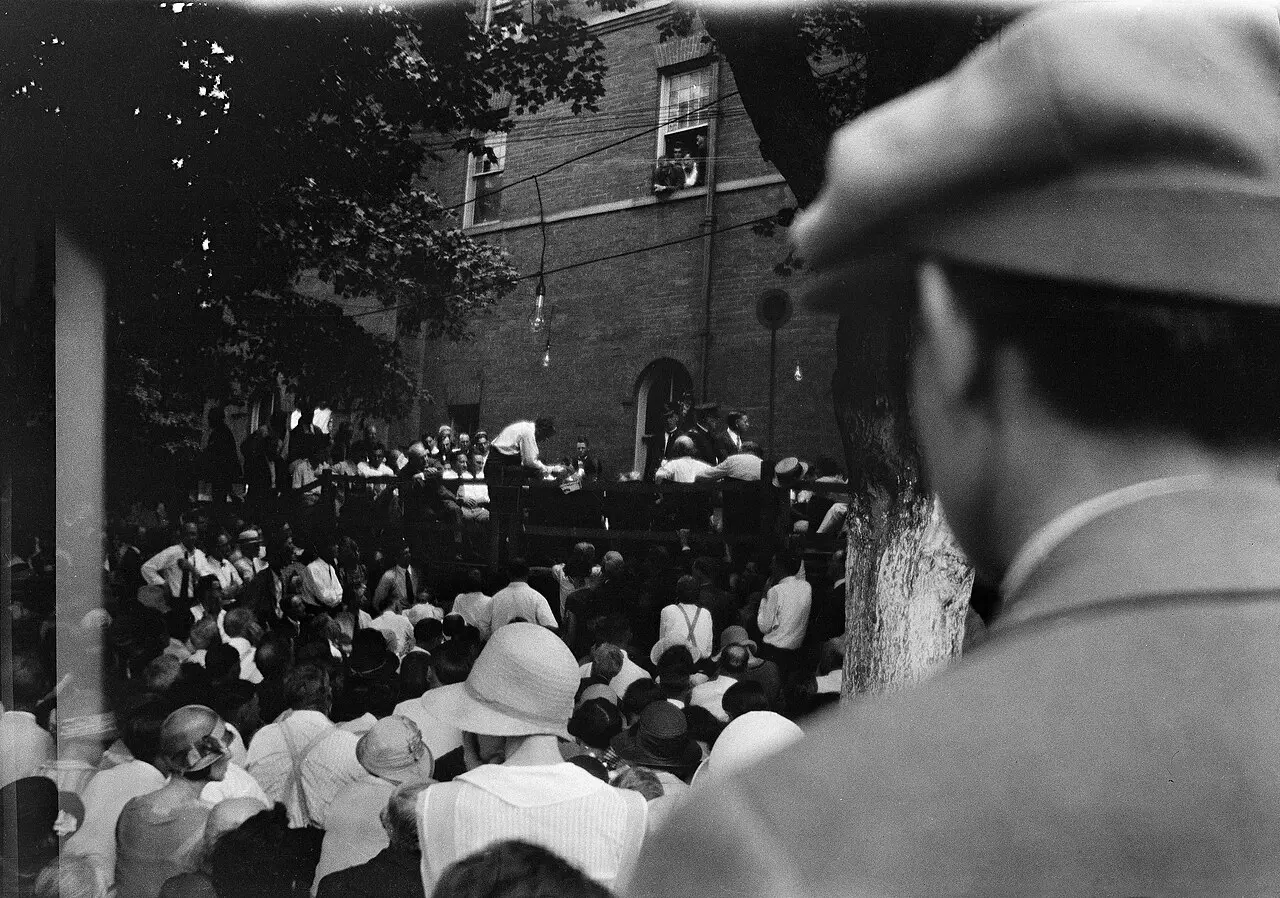
The courtroom was so hot and so packed that the judge moved the trial outside. On July 10, 1925, in Dayton, Tennessee — a town of fewer than two thousand people — the case of The State of Tennessee v. John Thomas Scopes opened under a canopy of trees on the courthouse lawn. America tuned in.
The defendant was a 24-year-old substitute teacher and football coach. The charge: violating Tennessee's Butler Act, passed that January, which made it illegal to teach any theory that denies the story of the Divine Creation of man as taught in the Bible, and to teach instead that man has descended from a lower order of animals. Scopes wasn't even sure he had ever taught evolution — he agreed to be charged so the new law could be challenged in court.
The case was a deliberate test, backed by the American Civil Liberties Union in its first major case. But it became something much bigger: a national spectacle. Defending Scopes was Clarence Darrow, the most famous criminal lawyer in America, an agnostic from Chicago. Prosecuting him was William Jennings Bryan, three-time Democratic presidential nominee and former Secretary of State, a hero of rural America and a devout believer in the Bible's authority.
It was the first trial in American history to be broadcast nationally on radio. Reporters swarmed Dayton — including the sharp-tongued H.L. Mencken of the Baltimore Sun, who coined the name that stuck: the Monkey Trial. Crowds gathered on the lawn each day as Darrow and Bryan argued not just about a teacher, but about science and scripture, modernism and fundamentalism, and who gets to decide what children learn.
In the end, Scopes was convicted and fined $100 — a verdict later thrown out on a technicality. But the verdict was never really the point. The trial had put the fundamentalist-modernist divide on the national stage, shown the power of mass media to turn a courtroom into theater, and made Dayton, Tennessee, briefly the center of the world.
Why it matters: the Scopes trial was America's first great culture-war courtroom drama, and its questions never went away. A century later, we are still arguing — in classrooms, courtrooms, and legislatures — about the line between belief and science, and about who writes the lesson plan. On a sweltering July day in 1925, that argument got its first national audience.
Photo: Smithsonian Institution, via Wikimedia Commons, no known copyright restrictions.