Boris Yeltsin Sworn In as Russia's First Elected President
On July 10, 1991, Boris Yeltsin took the oath in the Kremlin Palace — the first presidential inauguration in Russia's history.
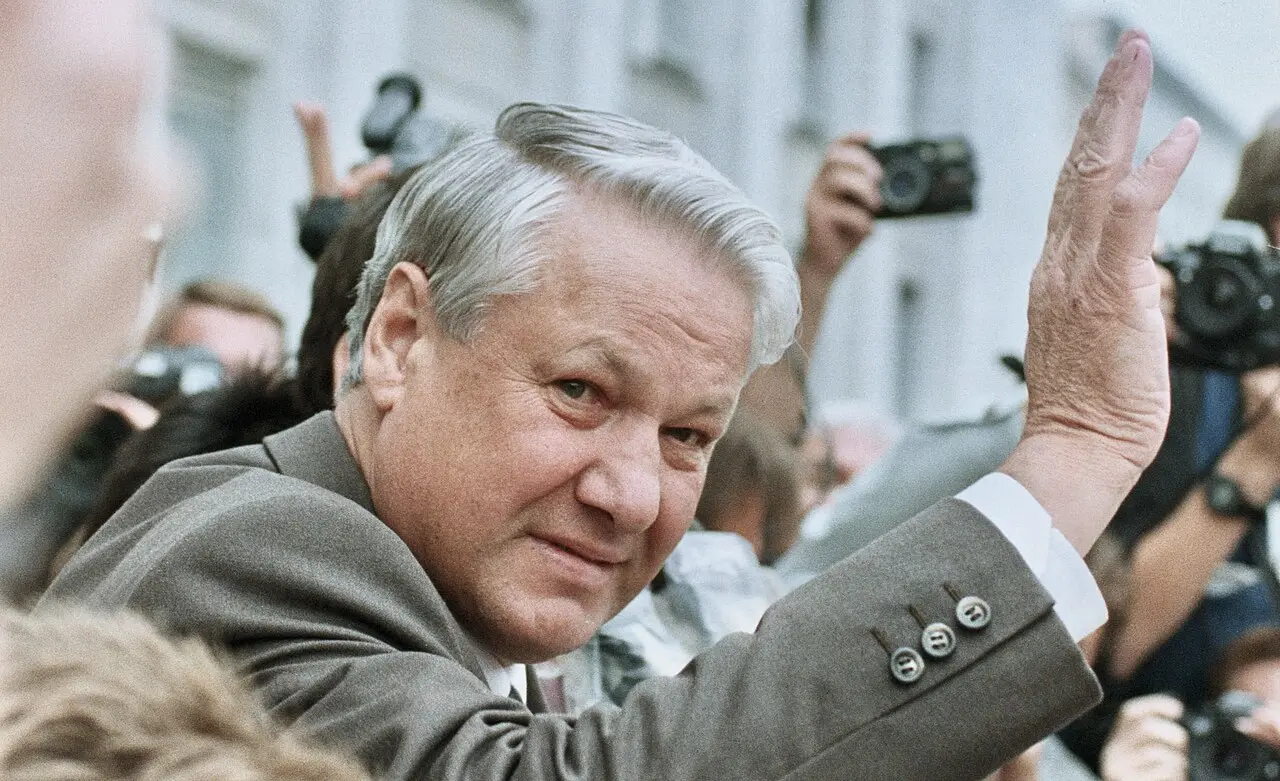
The ceremony lasted about thirty minutes. On July 10, 1991, in the State Kremlin Palace in Moscow, Boris Yeltsin took the oath of office as president of Russia — the first presidential inauguration in the thousand-year history of the Russian state.
The office itself was barely four months old. A nationwide referendum that March had approved creating a presidency for the Russian republic, and on June 12, 1991, Russia held its first direct presidential election. Yeltsin, running as an anti-establishment reformer against the Soviet old guard, won more than 57 percent of the vote, defeating five other candidates and avoiding a runoff. The man taking the oath was a former Communist Party boss who had quit the party in a dramatic speech a year earlier and now stood for Russian sovereignty against the Soviet center.
In front of a podium displaying the constitutions of Russia and the Soviet Union and Russia's Declaration of State Sovereignty, Yeltsin swore the oath, and the Russian anthem played. Speeches followed from Patriarch Alexy II of Moscow — the first time in decades a church leader had such a role at a state ceremony — and from Soviet President Mikhail Gorbachev, whose authority Yeltsin had spent the campaign challenging.
What happened next made the inauguration look like the quiet before the storm. Barely five weeks later, hardline Communists launched a coup against Gorbachev. Yeltsin rushed to the Russian White House in Moscow, climbed atop a tank, and denounced the plotters — rallying crowds and defecting troops until the coup collapsed in three days. By December 1991, the Soviet Union itself was gone, dissolved into fifteen independent states.
Yeltsin would go on to preside over one of the most turbulent decades in Russian history: shock-therapy economics, a constitutional crisis in 1993, and a war in Chechnya. His presidency ended as dramatically as it began, with his surprise resignation on New Year's Eve, 1999.
Why it matters: on July 10, 1991, Russia did something it had never done — chose its leader by popular vote. Whatever came after, that half-hour ceremony in the Kremlin marked the moment a thousand years of tsars and commissars gave way, however briefly, to the ballot box.
Photo: Presidential Press and Information Office of Russia, via Wikimedia Commons, CC BY 4.0.