Six Years Old and Fearless: Ruby Bridges' First Day
On November 14, 1960, six-year-old Ruby Bridges walked into William Frantz Elementary in New Orleans escorted by federal marshals — and desegregated a school alone.
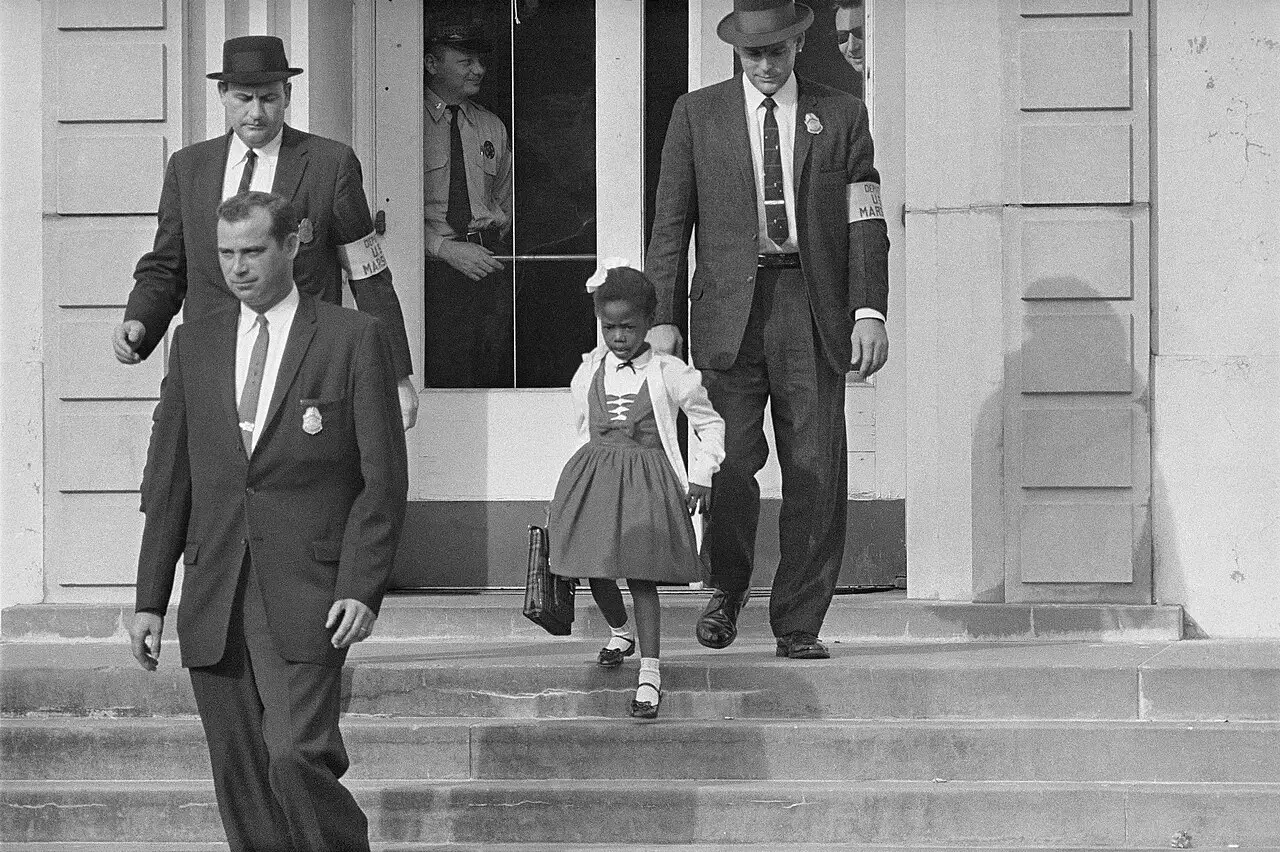
She was six years old, in a crisp dress, carrying her school things — and she needed four federal marshals to get to first grade. On the morning of November 14, 1960, Ruby Bridges became the first Black child to desegregate an all-white elementary school in the South, walking into William Frantz Elementary in New Orleans past a furious mob.
Ruby had been born on September 8, 1954, in Tylertown, Mississippi, and grown up in segregated New Orleans. Six years after the Supreme Court's Brown v. Board of Education decision declared school segregation unconstitutional, Louisiana was still resisting. Under a federal court order from Judge J. Skelly Wright, the Orleans Parish school board gave Black children an entrance exam designed to keep them out. Six passed. Two families chose to keep their children at their old school; three girls — Gail Etienne, Leona Tate, and Tessie Prevost — were sent to McDonogh No. 19. Ruby went to William Frantz alone.
Her father was reluctant to send her. Her mother insisted the step had to be taken — not only for Ruby, but for all the Black children who would come after. Driving up to the school that morning, Ruby later recalled, she saw the shouting crowd and assumed it must be Mardi Gras. The marshals walked her through it and into the building, where she spent most of her first day in the principal's office while white parents streamed in to pull their children out.
For the rest of the school year, Ruby was the only student in her classroom, taught by Barbara Henry, the one teacher willing to stay. The marshals escorted her to and from school every day. One of them, Charles Burks, remembered years later: "She showed a lot of courage. She never cried. She didn't whimper. She just marched along like a little soldier, and we're all very very proud of her."
The image of the small girl in white, flanked by tall marshals, became one of the defining pictures of the civil rights era — immortalized by Norman Rockwell in his painting The Problem We All Live With, published in Look magazine in January 1964. Ruby Bridges went on to found the Ruby Bridges Foundation in 1999 to promote tolerance and respect, and every November 14, students across the country mark Ruby Bridges Walk to School Day in her honor.
She was six. She just wanted to go to school. And she changed one.
Photo: uncredited U.S. Department of Justice photographer, public domain (via Wikimedia Commons).