Galloping Gertie: The Bridge That Danced Itself to Death
On November 7, 1940, the Tacoma Narrows Bridge twisted itself apart in a 40-mph wind, four months after opening, and changed bridge engineering forever.
She was barely four months old when she died, and everyone saw it coming. The Tacoma Narrows Bridge, opened with fanfare on July 1, 1940, was the world's third-longest suspension bridge by main span, a slender ribbon of steel linking Tacoma to the Kitsap Peninsula across Puget Sound. But from the moment its deck was finished, it had a problem no one could fix: the wind made it dance.
Construction workers had noticed it first. Even in mild breezes, the deck developed rippling vertical waves that could make motorists and pedestrians seasick, and they gave the bridge a nickname: Galloping Gertie. Engineers tried damping measures, hired a University of Washington professor to study it, and watched months of experiments fail. The bridge was the most flexible suspension bridge ever built — just 39 feet wide and 8 feet deep, hanging on cables across a 2,800-foot main span — and it would not stand still.
On the morning of November 7, 1940, the wind reached about 40 miles per hour, and Gertie began her familiar gallop. The waves grew so violent that the bridge was closed to traffic. Then, around 11 a.m., one of the cable bands slipped, and the deck shifted from its up-and-down bounce into a new, terrifying motion: an alternating twist, side to side, each swing bigger than the last. Leonard Coatsworth, editor of the Tacoma News Tribune, was the last man on the bridge. "Just as I drove past the towers, the bridge began to sway violently from side to side," he wrote. "Before I realized it, the tilt became so violent that I lost control of the car." He abandoned his car and crawled to safety — but his cocker spaniel, Tubby, left inside, became the disaster's only fatality.
The twisting was aeroelastic flutter, a self-feeding interaction between wind and structure that physics textbooks would cite for generations (many wrongly calling it simple resonance). The deck tore apart and plunged into the Sound. The wreckage was dismantled and sold as scrap; America's entry into World War II delayed any replacement. A new bridge finally opened on the same spot in 1950, reusing the original tower pedestals and cable anchorages, and the drowned span became an artificial reef. But Gertie's real legacy is invisible: bridge aerodynamics became a science, and every long-span bridge built since carries her lesson in its bones.
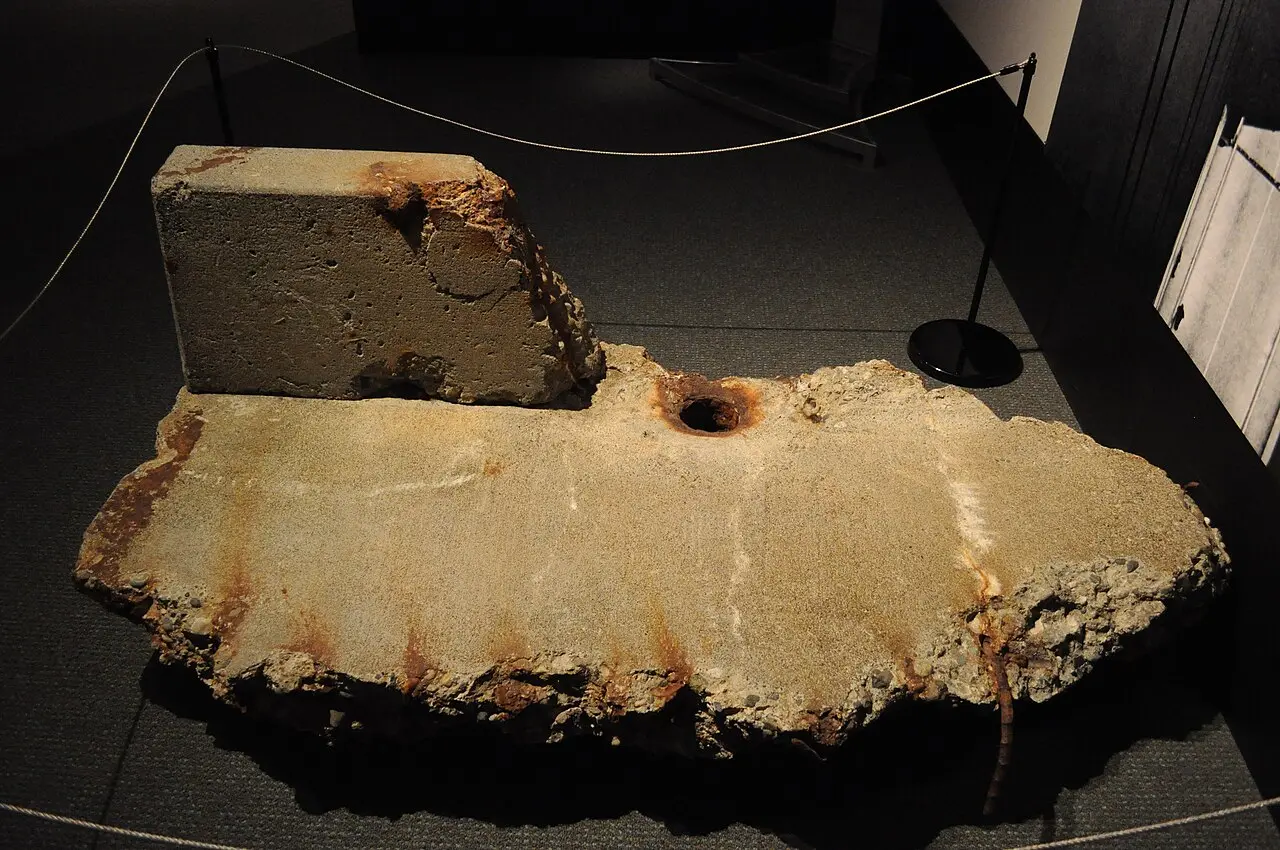
Photo: Joe Mabel, CC BY-SA 3.0 (via Wikimedia Commons).