Eleven Ships Struck Their Colors: Camperdown, 1797
On October 11, 1797, Admiral Adam Duncan smashed a Dutch fleet off Camperduin, capturing eleven ships and killing France's planned invasion of the British Isles.
In the spring of 1797, the British Royal Navy — the most powerful fleet on earth — nearly destroyed itself. Sailors at Spithead and the Nore, furious over pay and conditions, mutinied, and for weeks the fleet that guarded Britain sat paralyzed. Watching from across the North Sea, Britain's enemies saw their chance. By autumn, a Dutch fleet was at sea, and Admiral Adam Duncan was sailing straight toward it.
The Dutch were no longer the independent traders of the old republic. In 1795, revolutionary France had overrun the Netherlands and reorganized it as the Batavian Republic, a French client state — and its navy had been ordered to join France in a planned invasion of Ireland and then Britain. Duncan, a 66-year-old Scot commanding the North Sea Fleet from his flagship Venerable, had spent two years blockading the Dutch at the Texel. But in early October he was forced to sail to Yarmouth for supplies, and the Dutch vice-admiral, Jan Willem de Winter, slipped out of port.
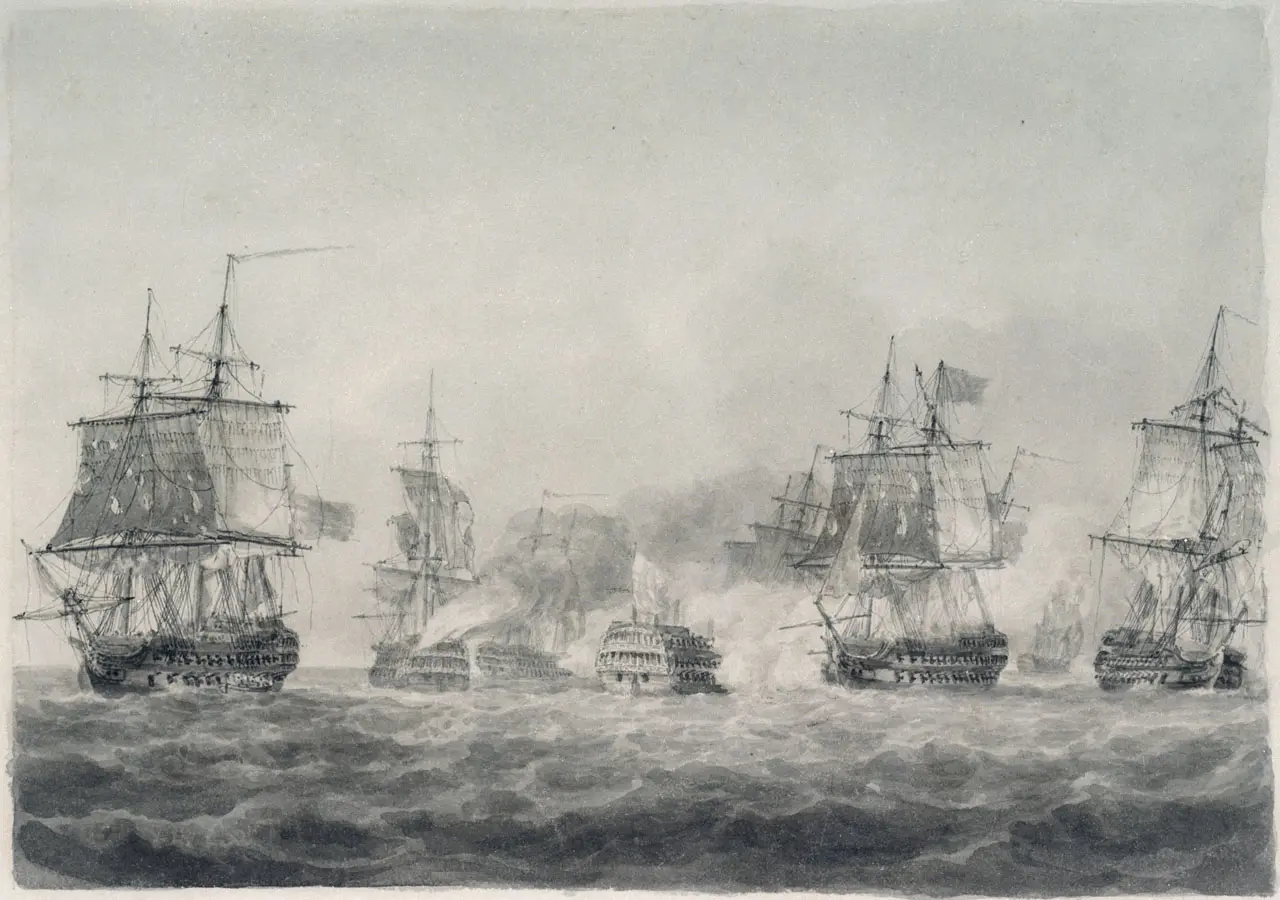
On the morning of October 11, 1797, Duncan found him: the Dutch fleet returning to its coast off the village of Camperduin. The two fleets were nearly evenly matched, about sixteen ships of the line apiece. Duncan, seeing the Dutch trying to reach shallow waters where his heavier ships couldn't follow, did the boldest thing a commander of his era could do — he broke the rules. Instead of forming the traditional single line of battle, he split his fleet into two groups and drove them straight through the Dutch line, shattering it into two separate, chaotic melees.
For two and a half brutal hours the fleets hammered each other at close range. Duncan's own flagship took fearsome punishment; at one point his flag was shot from the masthead, and a young seaman, Jack Crawford, famously climbed up and nailed it back to the shattered mast. By afternoon it was over. The Dutch flagship Vrijheid and ten other ships had struck their colors — eleven prizes for the British, without the loss of a single British ship. It was called, at the time, the greatest victory a British fleet had ever won against an equal opponent.
When the defeated de Winter was brought aboard the Venerable and offered his sword in surrender, Duncan — according to the accounts of those present — refused to take it. "I would much rather take a brave man's hand than his sword," he is said to have replied. Whether the words are exact or polished by retelling, the gesture was real, and it became part of the legend of the battle.
The consequences were immediate and enormous. The French invasion plan collapsed. The Dutch navy, which had challenged England for two centuries, never again sailed as a fighting force. And Britain — alone in Europe against revolutionary France, abandoned by its allies, its fleet fresh from mutiny — had proof that it could still fight. Parliament raised Duncan to the peerage as Viscount Duncan of Camperdown.
The Battle of Camperdown matters because it was the moment Britain's darkest year turned. In the spring of 1797, the nation faced invasion, bankruptcy, and a navy in revolt. On October 11, off a small Dutch village, Adam Duncan proved that the fleet — and the country — were still in the fight.
Painting: Nicholas Pocock, "The Battle of Camperdown 1797," public domain (via Wikimedia Commons).