Burma Wins Its Freedom at 4:20 in the Morning
At 4:20 a.m. on January 4, 1948, at an hour chosen by an astrologer, Burma became the Union of Burma — though the leader who won its freedom, Aung San, had been assassinated months earlier.
It was 4:20 in the morning when the flag went up. The hour had been chosen by an astrologer, who declared it the most auspicious moment for a new nation to be born. At Stone Pillar in Rangoon, as British governor Hubert Rance looked on, the Union Jack came down and the flag of the new Union of Burma rose over a free country for the first time in more than sixty years.
The road to that dawn had been long and bloody. Britain had seized the last of Burma in the Third Anglo-Burmese War of 1885, annexing the entire kingdom the following year and ruling it as a province of British India. For decades, students, monks, and intellectuals kept the flame of independence alive, and in the 1930s a young nationalist named Aung San emerged as their leader.
World War II scrambled everything. In 1941, Aung San and his "Thirty Comrades" trained with the Japanese and formed the Burma Independence Army, hoping Tokyo would drive out the British. The Japanese proved to be occupiers under a different flag, not liberators, and in 1945 Aung San turned his army against them, fighting alongside the returning British and Allies. The war left him the undisputed leader of Burmese nationalism — and the man London had to deal with.
The dealing went quickly. In February 1947, Aung San signed the Panglong Agreement with leaders of the Shan, Kachin, and Chin peoples, promising a federal union that respected ethnic identities. The next month he traveled to London and signed the Aung San–Attlee Agreement with Prime Minister Clement Attlee: full independence, with a date — January 4, 1948.
He never lived to see it. On the morning of July 19, 1947, gunmen burst into the Secretariat building in Rangoon and murdered Aung San along with six members of his executive council. The assassin, the rival politician U Saw, was tried, convicted, and executed the following year. Hundreds of thousands of mourners lined the streets of Rangoon for Aung San's funeral.
His friend and fellow nationalist U Nu took up the fallen leader's work and carried the country to the appointed day. In the small hours of January 4, 1948, the Union of Burma was proclaimed an independent republic. Sao Shwe Thaik, a Shan prince, became its first president; U Nu its first prime minister. In a final clean break with empire, Burma declined to join the British Commonwealth — unlike most former British colonies.
The triumph was shadowed from the start. The federal vision of Panglong was never fully honored, and by August 1948 — barely seven months after independence — civil war had broken out between the central government and communist and ethnic insurgencies. In 1962 the military seized power in a coup, and Myanmar, as the country is now called, has struggled toward the democracy Aung San envisioned ever since.
Yet every January 4, Myanmar celebrates Independence Day, and Aung San remains the father of the nation — his portrait in countless homes, his name on the great market of Yangon. He won his country's freedom and died for it within the same year. The flag that rose at 4:20 that morning still flies.
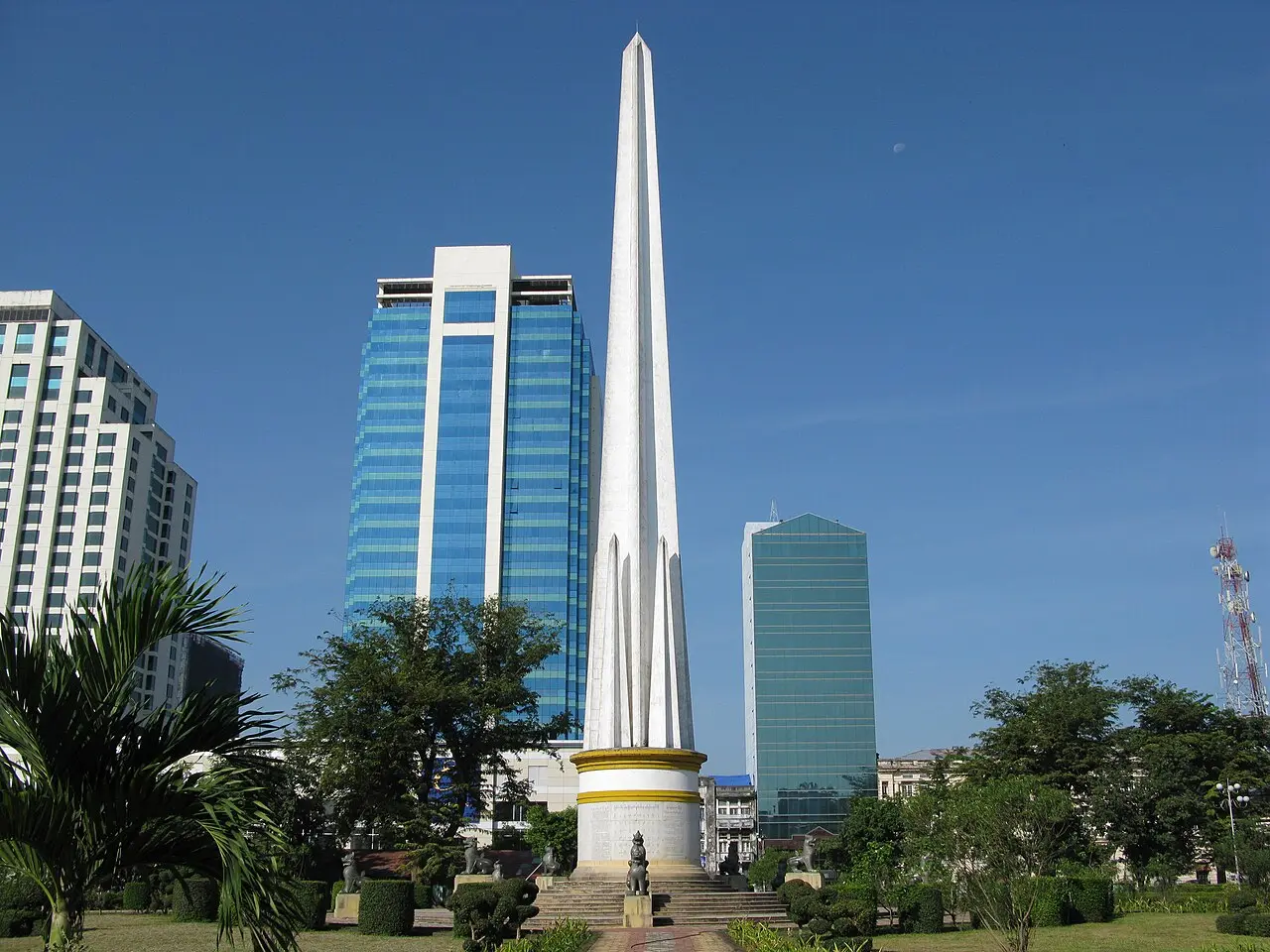
Photo: Vyacheslav Argenberg, CC BY 4.0 (via Wikimedia Commons). A modern photograph of the Independence Monument in Maha Bandula Park, Yangon — an obelisk built to commemorate Burmese independence — illustrative of the event rather than a contemporary image.