
Six Wheels Touch Down on Mars
On January 4, 2004, NASA's Spirit rover bounced to a landing inside Mars' Gusev Crater, starting a 90-day mission that would stretch into more than six years of exploration.
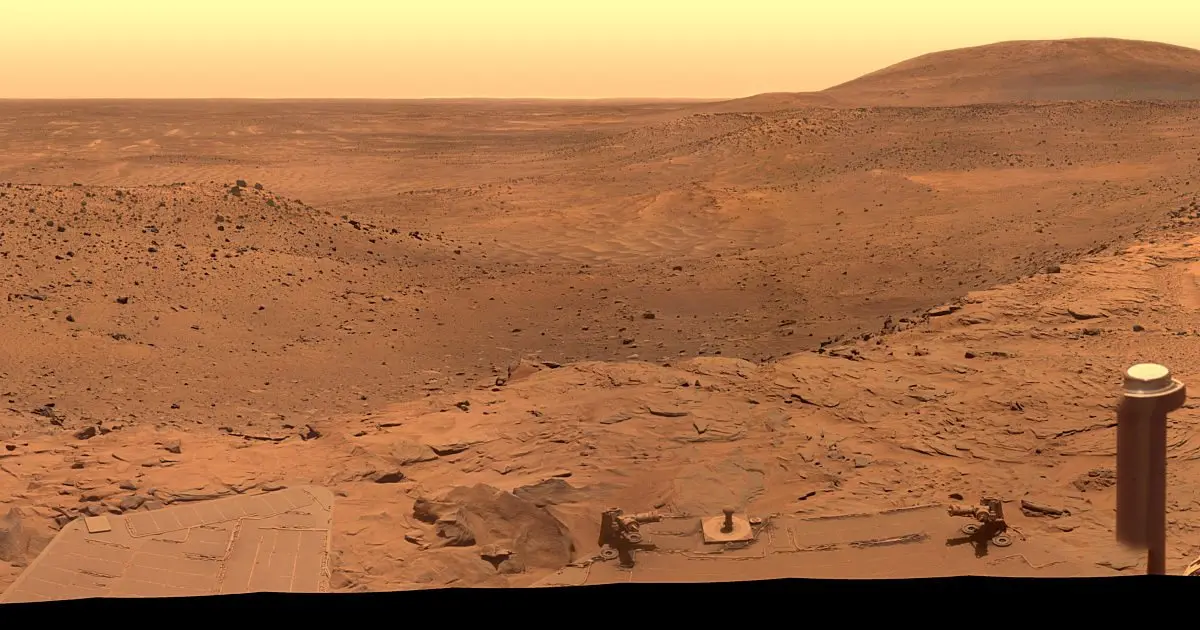
It fell out of the Martian sky cocooned in airbags, bounced across the red dust like a giant beach ball, and rolled to a stop inside a vast ancient crater. In the early hours of January 4, 2004, NASA's Spirit rover touched down on Mars — the first of twin robotic geologists sent to read the planet's history in its rocks.
Even its name had a story: "Spirit" was chosen through a NASA-sponsored student essay contest, one of a pair of names meant to capture the explorers' character. The landing itself was pure drama — a six-minute plunge through the thin Martian atmosphere, a parachute, retrorockets, and then the airbag bounce across the floor of Gusev Crater, a basin some 150 kilometers wide that scientists believed might once have held a lake.
Spirit — about the size of a golf cart and running on solar panels — had a straightforward job: spend 90 Martian days examining rocks and soil for clues about water. Its twin, Opportunity, would land on the opposite side of the planet three weeks later and go on to roam for nearly fifteen years, until a planet-wide dust storm silenced it in 2018.
The 90-day plan turned out to be wildly pessimistic. Wind gusts and dust devils periodically swept Spirit's solar panels clean, giving the rover fresh energy, and it just kept going — rolling 7.73 kilometers instead of the planned 600 meters, climbing hills, and surviving frigid Martian winters. It completed its prime mission and then kept exploring for years, returning evidence that ancient Mars had indeed been warmer and wetter, with water-shaped rocks and minerals.
The end came slowly. In late 2009 Spirit bogged down in a sand trap, tilted at an angle that starved its panels of sunlight. Its last signal reached Earth on March 22, 2010 — after 2,208 Martian days, more than twenty times its designed lifetime. Engineers refused to give up: the team beamed more than 1,400 commands to the silent rover over the following months, listening through NASA's Deep Space Network and two Mars orbiters, before concluding that Spirit had finally succumbed to its fourth brutal Martian winter.
Spirit and Opportunity rewrote what a robot could do on another world. Every later Mars mission drives on roads they paved: proof that a machine built for three months could explore for six years, and that Mars was once a place where water flowed.
Photo: NASA/JPL-Caltech, public domain (via The Planetary Society).