Underway on Nuclear Power: The USS Nautilus Launches
On January 21, 1954, the USS Nautilus slid into the Thames River as the world's first nuclear-powered submarine, and naval warfare changed forever.
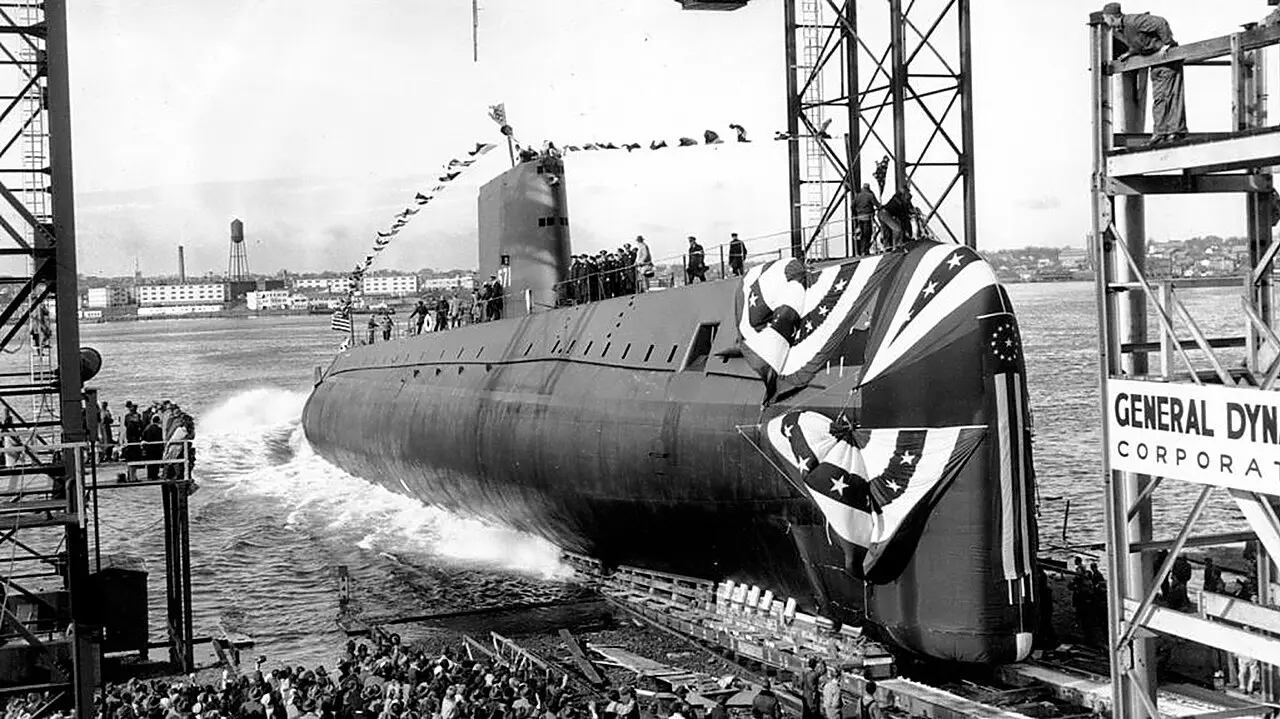
On January 21, 1954, on a freezing morning in Groton, Connecticut, First Lady Mamie Eisenhower swung a bottle of champagne against a steel hull, and the future slid sideways into the Thames River. The USS Nautilus, the world's first nuclear-powered submarine, was launched, and naval warfare would never be the same.
The idea had been driven for years by one relentless man: Admiral Hyman G. Rickover, the Russian-born engineer the Navy had put in charge of atomic propulsion, who would become known as the father of the nuclear navy. Conventional submarines were really just surface ships that could duck underwater for a while; their diesel engines needed air, and their batteries ran down fast. A nuclear reactor changed everything. It needed no air and almost no refueling, which meant a submarine could stay submerged, fast and silent, for as long as its crew could stand it.
Nautilus was the proof. She was the sixth American warship to carry the name, honoring both a World War II submarine and the fictional vessel of Jules Verne's Twenty Thousand Leagues Under the Sea. Her keel had been laid in June 1952 with President Truman looking on, and after her launch she was commissioned on September 30, 1954 under Commander Eugene P. Wilkinson. On January 17, 1955, Wilkinson sent the message that announced a new age: "Underway on nuclear power." She could top 20 knots beneath the waves, faster submerged than on the surface, and she shattered every distance record in the book. In May 1955 she sailed from New London, Connecticut, to San Juan, Puerto Rico, entirely submerged, setting new records for time underwater and sustained speed.
Her most famous voyage came in the summer of 1958. Under Commander William R. Anderson, Nautilus slipped under the Arctic ice cap and on August 3 became the first vessel in history to cross the North Pole beneath the sea, surfacing to report the feat to a stunned world. Over a 25-year career she steamed nearly half a million miles before retiring in 1980. Today she rests as a museum and National Historic Landmark back home in Groton.
Why does it matter? Nautilus was the founding ship of the nuclear navy, the ancestor of the ballistic-missile submarines that became the silent backbone of Cold War deterrence. She proved that atomic power could take humans anywhere, even beneath the roof of the world, and she opened an ocean that had been closed to everyone before her.
Photo: U.S. Navy, public domain (via Wikimedia Commons) — the USS Nautilus sliding down the ways at her launch ceremony in Groton, Connecticut, January 21, 1954.