Twice the Speed of Sound: Concorde Enters Service
On January 21, 1976, the first supersonic passenger flights took off from London and Paris, shrinking the Atlantic to three and a half hours.
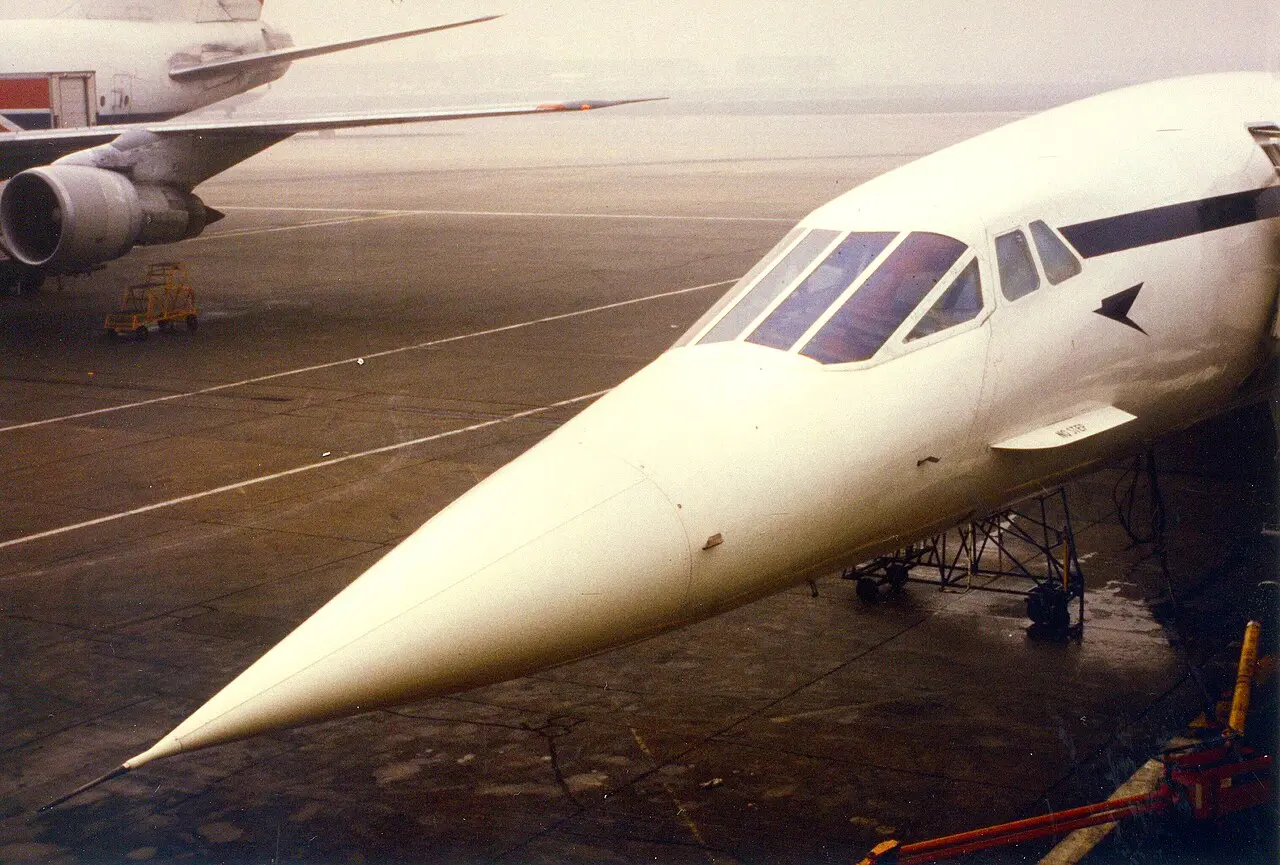
On January 21, 1976, two slender white darts climbed out of Europe within minutes of each other and did what no airliner had ever done: they carried paying passengers faster than sound. From London's Heathrow, a British Airways Concorde lifted off for Bahrain; from Orly outside Paris, an Air France Concorde departed for Rio de Janeiro by way of Dakar. The supersonic age of travel had begun.
It was the payoff of twelve years of stubborn Anglo-French engineering. In 1962, fifteen years after Chuck Yeager first broke the sound barrier, Britain and France signed a treaty on November 29 to build the world's first supersonic passenger jet, racing Soviet engineers who were chasing the same prize. The technical hurdles were enormous: engines twice as powerful as a normal jet's, a needle-thin delta wing, and a fuselage built to survive shock waves and skin temperatures hot enough to stretch the aircraft several inches in flight.
The result was the most beautiful airliner ever built, and the fastest. Concorde cruised at about 1,350 miles an hour, twice the speed of sound, high above the weather where the sky turns dark blue. It cut the Atlantic crossing to around three and a half hours, less than half the time of an ordinary jet, while passengers sipped champagne in leather seats. Air traffic controllers knew it by its special radio call sign, "Speedbird Concorde," a mark of the aircraft's unique abilities. Only fourteen of the twenty aircraft built ever carried fare-paying passengers, and a ticket cost a small fortune.
The dream had limits. The sonic boom meant most countries banned supersonic flight over land, so routes were few. The United States initially refused Concorde landing rights altogether; Washington got service in 1976 and New York only in 1977. Rising costs, the tragic crash of an Air France Concorde outside Paris in 2000, and the slump in air travel after September 11 finally grounded the fleet in 2003.
Why does it matter? Concorde remains the only successful supersonic airliner in history. Half a century after that January morning, no scheduled flight has ever gone faster, and the sight of that droop-nosed delta still stands as proof of what engineering ambition can do when two nations decide to build the future together.
Photo: M McBey, CC BY 2.0 (via Wikimedia Commons) — a British Airways Concorde at London Heathrow in 1984; an illustration of the aircraft in service, not the 1976 inaugural flights.