Truman Signs the Marshall Plan
On April 3, 1948, President Truman signed the Marshall Plan, committing about $13 billion to rebuild war-torn Western Europe.
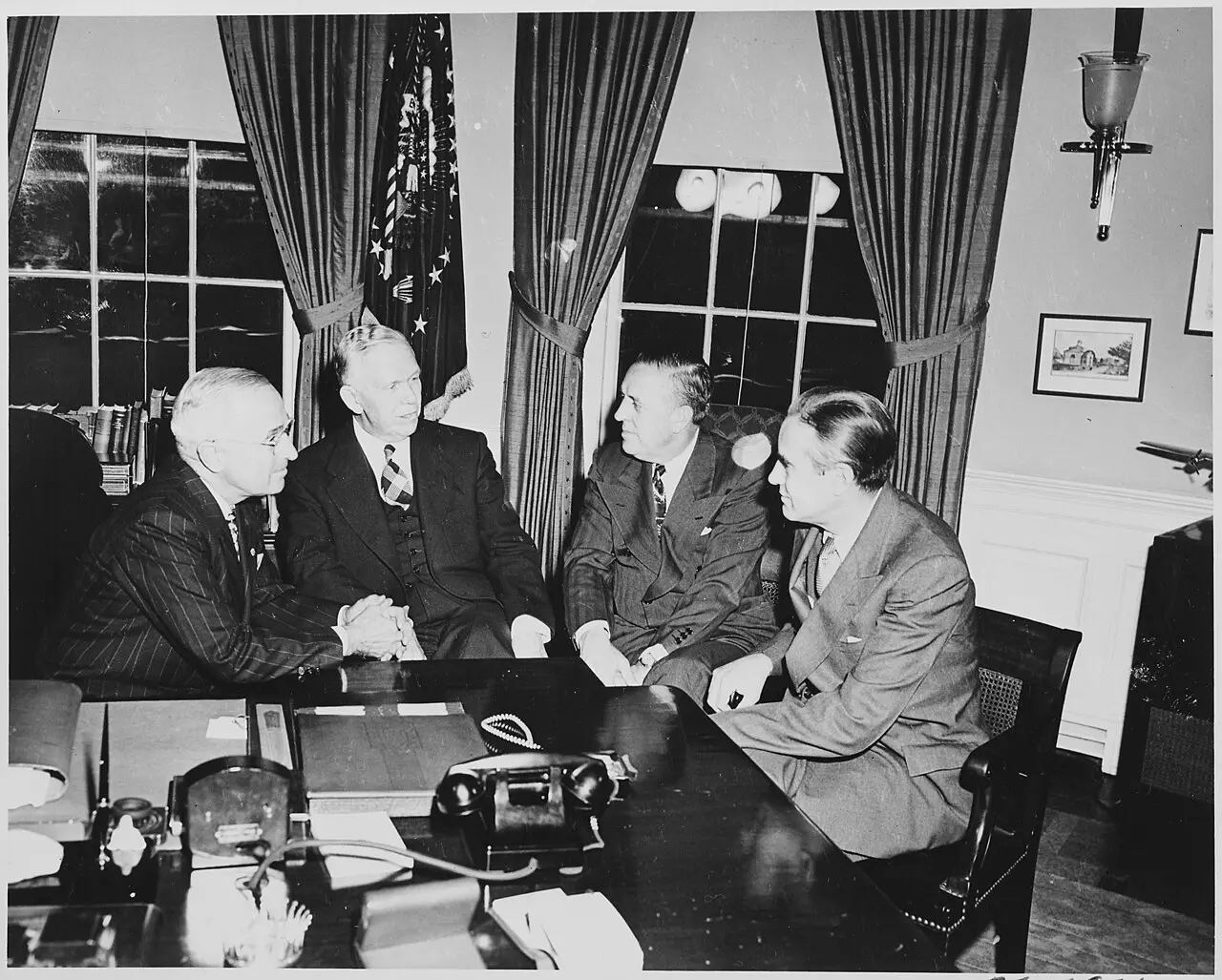
On April 3, 1948, President Harry Truman picked up his pen in the White House and signed one of the most ambitious acts of generosity in history — a plan to rebuild an entire continent.
The law was the Economic Cooperation Act, better known as the Marshall Plan. It committed the United States to sending about $13 billion in aid — food, fuel, raw materials, machinery — to sixteen war-shattered countries across Western Europe, from Britain and France to Italy and West Germany.
Europe in 1948 was in ruins. Three years after World War II, factories stood idle, farms lay fallow, and hunger stalked the cities. American leaders feared that misery would breed extremism — and that a collapsed Europe would drag the American economy down with it.
The idea had come from Secretary of State George C. Marshall, who proposed it in a commencement address at Harvard University on June 5, 1947. His offer was striking: the Europeans themselves would draw up a joint recovery program, and America would help pay for it. The program didn't even have an official name yet — the press dubbed it the "Marshall Plan" after his speech. Britain and France invited every European nation to Paris to plan it together. The Soviet Union refused to come — and pressured its neighbors to stay away too.
Congress debated for months. But the plan's backers, led by Republican Senator Arthur Vandenberg, built a bipartisan coalition, and the bill passed the Senate 69 to 17 and the House 329 to 74. Truman signed it the day after Congress acted.
Washington ran the program through a new Economic Cooperation Administration, headed by industrialist Paul Hoffman, with veteran diplomat Averell Harriman as its man in Paris. More than 90 percent of the money went out as grants, not loans, arriving as food, animal feed, fertilizer, fuel, raw materials, and factory equipment. A "counterpart fund" system required recipients to set aside matching sums in their own currencies, multiplying every American dollar. The results were dramatic: participating countries saw their economies grow 15 to 25 percent, and by 1950 most had rebuilt their industries past prewar levels.
Why it matters: the Marshall Plan didn't just feed Europe — it anchored the Western alliance that would define the Cold War, proved that large-scale foreign aid could work, and set a template for American engagement with the world. Marshall himself received the Nobel Peace Prize in 1953.
Photo: Abbie Rowe, public domain (via Wikimedia Commons).