
Ten Days by Horseback: The Pony Express Rides Out
On April 3, 1860, the first Pony Express rider galloped out of St. Joseph, Missouri, carrying the mail on a 1,900-mile relay to California.
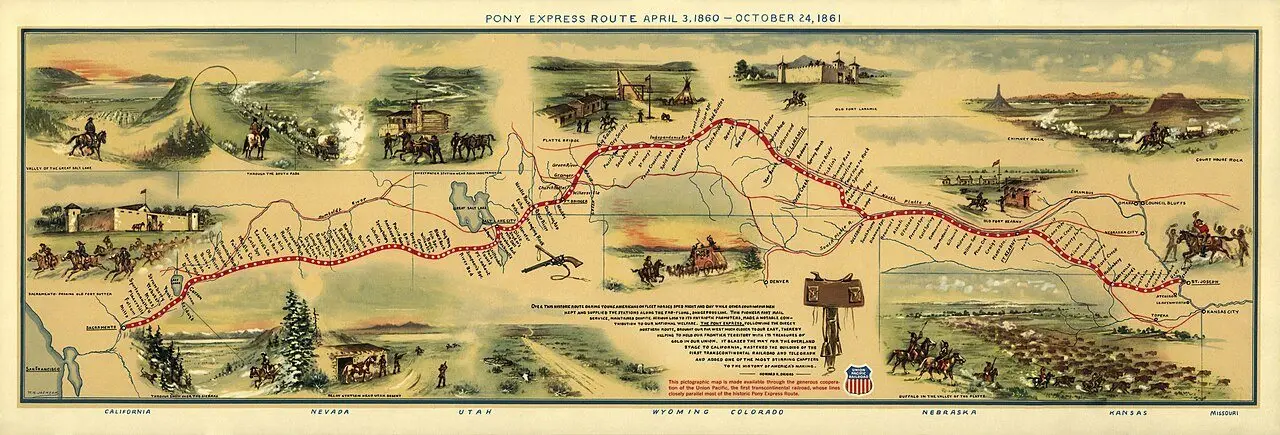
At 7:15 on the evening of April 3, 1860, a cannon boomed over St. Joseph, Missouri. A young rider grabbed a leather mail pouch, sprinted for the ferry across the Missouri River, and galloped into history. The Pony Express was running.
California was the reason. Gold had drawn hundreds of thousands of people west — by 1860 the state held some 380,000 people — and they were starved for news from home. Letters and newspapers from 'the States' took weeks or months to arrive by stagecoach or ship. With the nation sliding toward civil war, fast communication wasn't a luxury; it felt like a necessity.
The idea was gloriously simple and nearly impossible: carry the mail from Missouri to California — about 1,900 miles — in ten days, using nothing but horses and riders. The freighting firm of Russell, Majors, and Waddell had spent just two months building it: roughly 190 relay stations, some 400 to 500 horses, and about 80 riders.
The system was a relay race against distance itself. Stations stood every 10 to 15 miles; at each one, the rider leaped onto a fresh horse and kept going. Every 75 to 100 miles, a fresh rider took over. The mail rode in a mochila — a leather sheet draped over the saddle, with four padlocked pockets called cantinas. The rider sat on top of it; the company line was that horse and rider could perish before the mochila did. Each rider swore an oath: no swearing, no drinking, no fighting — just ride.
The men who rode were mostly young and light — weight was everything when a horse had to gallop all out. They earned about $125 a month, rich pay when unskilled labor fetched well under a dollar a day, and they rode through everything the West could throw at them: blizzards in the Sierra, furnace heat in the Nevada desert, and the constant threat of attack.
That first pouch held 49 letters, five telegrams, and some newspapers. The price of speed was steep: $5 per half ounce at the start, a small fortune in 1860. But it worked. Ten days later the mail reached Sacramento, and by around midnight on April 14 it was in San Francisco, greeted with fireworks and a brass band. Coast-to-coast communication had shrunk from weeks to days. The New York Times crowed that 'citizens paraded the streets with bands of music, fireworks were set off... the best feeling was manifested by everybody.'
For eighteen months the riders kept their impossible schedule through blizzards, deserts, and danger, helping hold California close to the Union as the Civil War approached. Then, in October 1861, the transcontinental telegraph was completed. What had taken ten days now took seconds. The Pony Express ran its last ride, and the company went bankrupt.
Why it matters: the Pony Express proved a year-round transcontinental system could work — and it gave America its purest image of the West: a lone rider, a fast horse, and the mail getting through no matter what.
Photo: William Henry Jackson, public domain (via Wikimedia Commons).