The Treaty That Made America Coast to Coast
On February 22, 1819, the United States signed the Adams–Onís Treaty, gaining Florida and its first boundary line stretching to the Pacific.
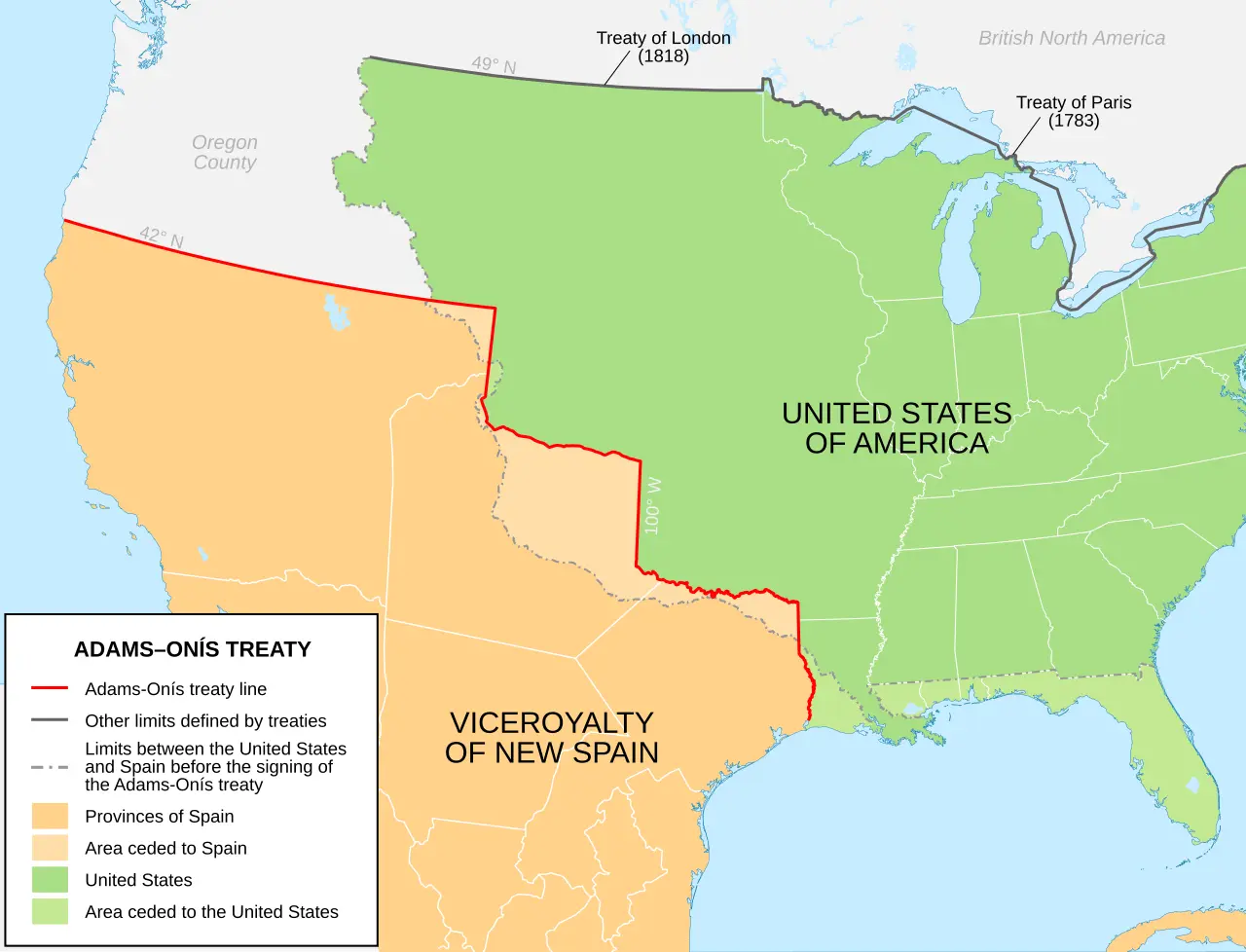
On February 22, 1819, in Washington, D.C., two men signed a document that redrew North America. U.S. Secretary of State John Quincy Adams and Spain's minister to the United States, Luis de Onís, put their names to the Treaty of Amity, Settlement and Limits — better known as the Adams–Onís Treaty. Spain gave up Florida. The United States gave up its claims to Texas. And for the first time, an American boundary line ran all the way from the Atlantic to the Pacific Ocean.
The deal had been years in the making. Spain had planted its flag at St. Augustine in 1565, lost Florida to Britain in 1763, and won it back after the American Revolution. But Madrid's grip was slipping: American settlers poured in, border raids flared, and in 1818 General Andrew Jackson invaded Florida to pursue raiding Seminoles, seizing Spanish posts. With rebellions erupting across Latin America, Spain could no longer defend a distant province — and Adams, President Monroe's hard-bargaining secretary of state, knew it.
The terms were a masterpiece of horse-trading. Spain ceded East and West Florida to the United States. In return, Washington assumed up to $5 million in claims that American citizens held against Spain — Florida itself cost the U.S. Treasury nothing. The treaty also settled the fuzzy western edge of the Louisiana Purchase: the boundary ran up the Sabine River, placing Texas firmly on Spain's side of the line, then northwest along the Red and Arkansas Rivers to the 42nd parallel, and straight west to the Pacific. Spain also surrendered its claims to the Oregon Country. Adams had negotiated America a transcontinental border.
The signing was only the beginning. The U.S. Senate ratified the treaty unanimously two days later, but Spain's King Ferdinand VII stalled — he had just granted much of East Florida to three court favorites and wanted those land deals honored. Madrid finally ratified in October 1820, and on February 22, 1821 — exactly two years after the signing — the treaty was formally proclaimed. Jackson, the hero of New Orleans, arrived in Pensacola that July as military governor to take formal possession. Florida became a U.S. territory in 1822 and a state in 1845.
The Adams–Onís Treaty, also called the Transcontinental Treaty, closed the first era of American expansion. It made the United States a nation that could finally draw itself on a map from sea to sea. It cleared the way for the Santa Fe Trail, for emigration to Oregon, and for the century of westward movement that followed. All of it, from one signature on a February day in Washington.
Map: Milenioscuro, CC BY-SA 4.0 (via Wikimedia Commons).