Dolly the Sheep: The Clone That Startled the World
On February 22, 1997, Scottish scientists announced Dolly the sheep, the first mammal cloned from an adult cell, and changed medicine forever.
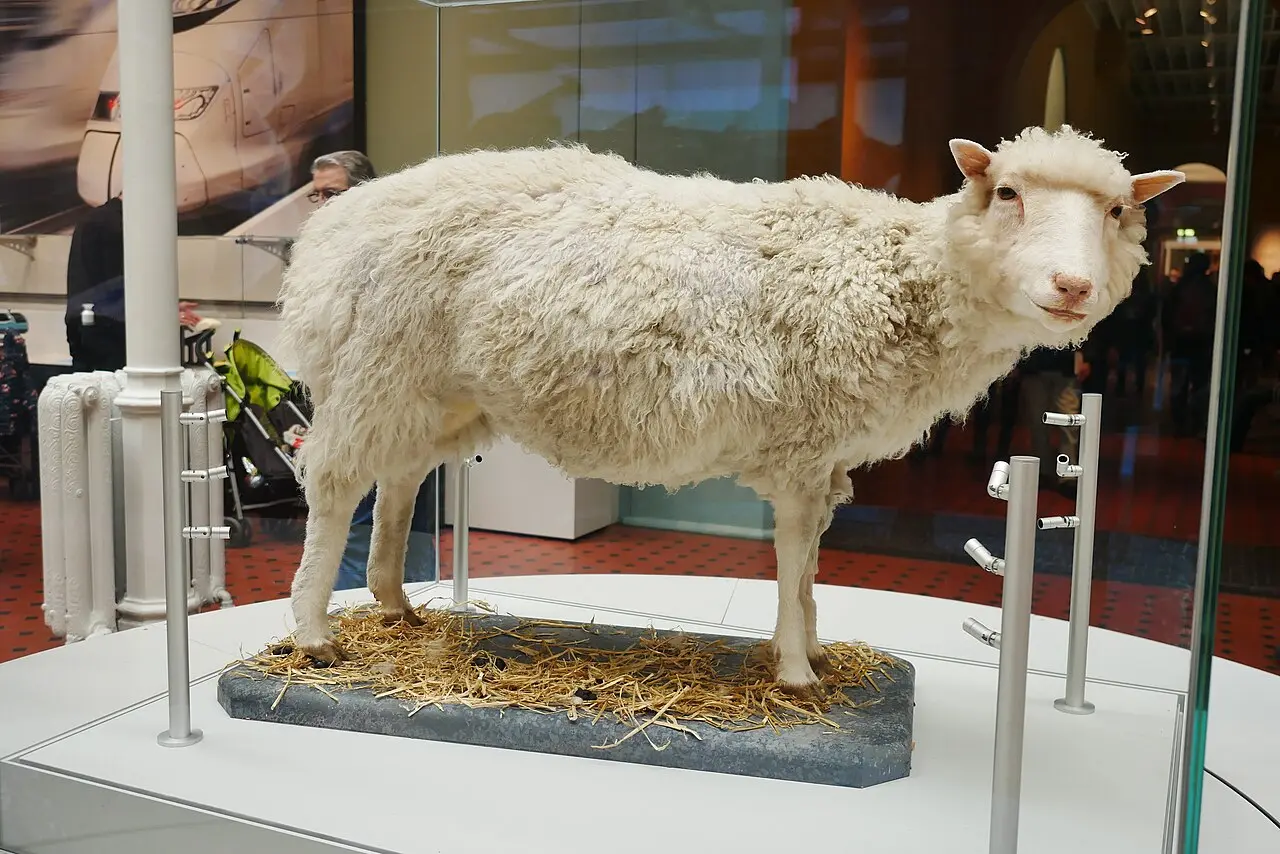
The most famous sheep in history never did anything sheepish. When the world met Dolly on February 22, 1997, she was already seven months old — a quiet lamb kept under wraps at the Roslin Institute in Scotland while scientists finished the paper that would make her immortal. She looked utterly ordinary. That was exactly the point: Dolly was the first mammal ever cloned from an adult cell, and she proved that a fully grown cell still carried the instructions to build a whole new animal.
The experiment had started with a single cell taken from the mammary gland of a six-year-old Finn-Dorset ewe. Scientists removed the nucleus from an unfertilized egg donated by a Scottish Blackface ewe, fused the two with a jolt of electricity, and implanted the resulting embryo in a surrogate mother. The technique — somatic cell nuclear transfer — had to be repeated 276 times before it worked. Three ewes contributed to Dolly's creation: one provided the egg, one the DNA, and one carried her to term. She was born on July 5, 1996.
The team, led by biologist Ian Wilmut and cell biologist Keith Campbell alongside Roslin colleagues and the biotechnology company PPL Therapeutics, first knew her only as "6LL3." The cuter name came from the cell she started from: a mammary gland cell. Wilmut later admitted the reasoning — that they "couldn't think of a more impressive pair of glands than Dolly Parton's."
The announcement detonated around the world. In the week that followed, the Roslin Institute received some 3,000 phone calls from across the globe. Scientists hailed the breakthrough: if an adult cell could be reset to an embryonic state, medicine might one day grow replacement tissues, preserve endangered species, and treat genetic diseases. Others were horrified. Governments rushed to ban human reproductive cloning, and ethicists wrestled with what cloning meant for identity and for what it means to be human. Science magazine named Dolly the Breakthrough of the Year.
Dolly herself lived a quiet life at the Roslin Institute. Bred with a Welsh Mountain ram, she gave birth to six lambs the normal way — Bonnie in 1998, twins Sally and Rosie the next year, and triplets Lucy, Darcy, and Cotton in 2000. In late 2001, at age four, she developed arthritis. In February 2003 she developed a cough; a CT scan revealed tumors in her lungs, and she was euthanized on February 14, 2003, at age six, rather than left to suffer. She was preserved, and her remains stand on display at the National Museum of Scotland in Edinburgh.
Dolly's legacy is still unfolding. Her cloning proved that a cell's development could be rewound — a principle that led other scientists to create induced pluripotent stem cells from adult cells, work that earned the 2012 Nobel Prize in Physiology or Medicine. She also forced the world to write the ethical rulebook for cloning before the technology wrote it for us. One small sheep, cloned in a Scottish lab, redrew the boundaries of what life itself could do — and of what humanity should do with that power.
Photo: Sgerbic, CC BY-SA 4.0 (via Wikimedia Commons).