The Treaty Signed on a Warship's Deck
On August 29, 1842, Britain and China signed the Treaty of Nanking aboard HMS Cornwallis, ending the First Opium War — and handing Hong Kong to Britain for the next 155 years.
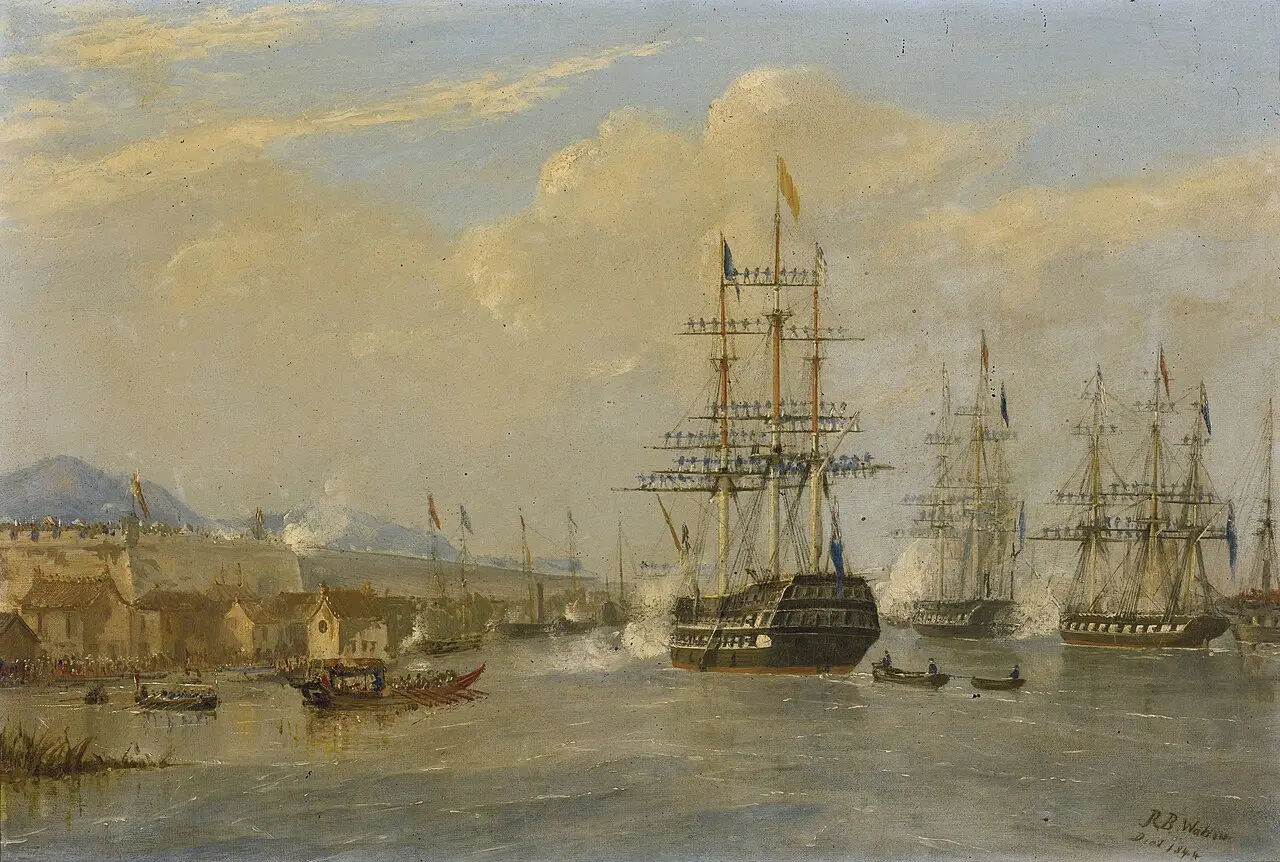
In August 1842, the walls of Nanking looked out on a sight no Chinese city had ever seen: a British fleet anchored in the Yangtze River, warships poised to attack the empire's second capital. The Qing dynasty's armies had lost battle after battle, and there was nothing left to bargain with except surrender terms.
So the emperor's commissioners climbed aboard the enemy's flagship.
The First Opium War had begun over a drug trade that was bleeding China dry. British merchants were shipping opium grown in India into China in ever-growing quantities, creating widespread addiction and draining the empire's silver. When the Qing government cracked down — seizing and destroying British opium stocks in 1839 — London answered with warships. It was a conflict fought to force China to keep buying a narcotic it did not want.
The Daoguang Emperor authorized his diplomats to sign a peace treaty on August 21. Eight days later, aboard HMS Cornwallis, the British plenipotentiary Sir Henry Pottinger sat across from the Qing commissioners Qiying, Yilibu, and Niu Jian and put names to a thirteen-article document. The Treaty of Nanking ended the war on terms dictated by the victor.
The terms were staggering. Hong Kong Island was ceded to Britain "in perpetuity." Five ports — Canton, Amoy, Foochow, Ningpo, and Shanghai — were thrown open to British trade and residence, ending the old Canton system that had confined foreign merchants to a single harbor. China agreed to pay an indemnity of $21 million silver dollars, covering both the war's cost and the opium destroyed in 1839. A follow-up pact, the 1843 Treaty of the Bogue, added extraterritoriality — British subjects in China would answer to British law, not Chinese.
The treaty was the first of what the Chinese would call the unequal treaties, agreements imposed by force that no Chinese government had freely chosen. It marked the beginning of what China remembers as the "Century of Humiliation," the long erosion of sovereignty that would shape Chinese nationalism for generations.
And Hong Kong? Britain's own foreign secretary, Lord Palmerston, dismissed it as "a barren island with hardly a house upon it." The "barren island" went on to become one of the world's great financial centers under British rule — until it returned to China in 1997, exactly 155 years after the signatures dried on the deck of the Cornwallis.
The treaty was ratified by the Daoguang Emperor on October 27 and by Queen Victoria on December 28, with the formal exchange of ratifications taking place in Hong Kong on June 26, 1843. A copy is kept by the British government; another survives in the National Palace Museum in Taipei.
Qiying, the imperial clansman who signed for China, would spend the following years negotiating the follow-on treaties that Britain demanded — the Treaty of the Bogue and others — each one carving a little more out of Qing sovereignty. Within decades, France, the United States, Russia, and other powers had extracted their own unequal treaties, and the treaty-port system the Nanking agreement created would define China's relationship with the West for a century.
For Britain, the prize was exactly what the treaty said it was: the end of the Canton system and the opening of China to British commerce. For China, it was the beginning of a reckoning that would run through the Taiping Rebellion, the Boxer Rebellion, and the fall of the Qing itself — a reckoning that began with signatures on a warship's deck on an August morning in 1842.
Photo: Rundle Burges Watson, public domain (via Wikimedia Commons).