
The Spark in the Iron Ring
On August 29, 1831, Michael Faraday's notebook recorded the experiment that revealed electromagnetic induction — the principle behind nearly all the electricity in the modern grid.
For eleven years, Michael Faraday had been chasing a hunch. In 1820, the Danish scientist Hans Christian Ørsted had shown that an electric current creates a magnetic field. Faraday — a bookbinder's apprentice turned laboratory assistant at London's Royal Institution, with almost no formal education — was convinced the reverse had to be true: that magnetism could create electricity. He just couldn't prove it.
On August 29, 1831, he tried something new. He wrapped two separate coils of wire around opposite sides of an iron ring, making a primitive transformer. He connected one coil to a battery and the other to a galvanometer, a delicate instrument for detecting current. Then he closed the switch.
The needle jumped — and fell back to zero. He opened the switch. It jumped the other way — and fell back to zero. While the current flowed steadily, nothing happened at all. That was the revelation: it wasn't magnetism that made electricity. It was change. A changing magnetic field, and only a changing one, could induce a current. Faraday called it a 'wave of electricity.'
Faraday wrote it all down the way he always did. His laboratory diary entry for that day begins, in his neat hand: 'Aug 29th 1831. 1. Expts on the production of Electricity from Magnetism, etc.' — followed by a full description of the iron ring, its six-inch diameter, the three lengths of copper wire wound on one side and two on the other, the battery of ten plate pairs, and the needle that 'oscillated and settled.' The diary, published in facsimile by the Royal Institution, is the reason we know exactly what happened on that August day, down to the wiring.
Within weeks he found the effect everywhere: a bar magnet thrust into a coil of wire sent the needle leaping; held still, it did nothing. He even built a copper disk that spun between magnets to produce a steady current — the first electric generator. (An American, Joseph Henry, had seen similar effects, but Faraday published first, so the law bears his name; the unit of inductance, the henry, honors Henry.)
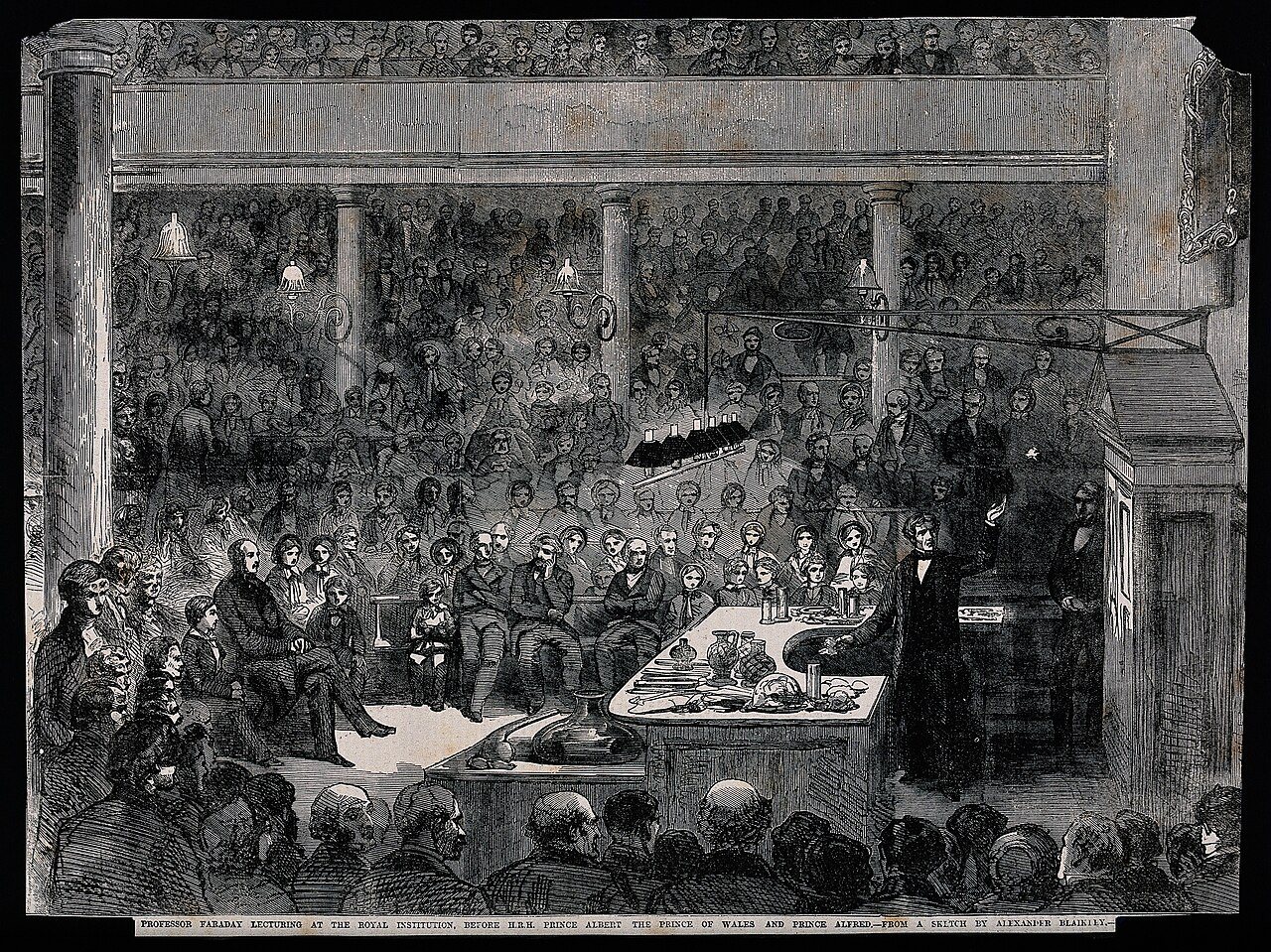
Faraday did as much for the public's understanding of science as for science itself. In the mid-1820s he founded the Royal Institution's Christmas Lectures — talks on science for young people — and gave many of them himself. His most famous series, 'The Chemical History of a Candle,' first delivered in 1860, remains a classic of popular science. The Christmas Lectures continue to this day, televised each year to millions of children.
Faraday could barely do the mathematics, and the theorists of his day were skeptical of his talk of invisible 'lines of force.' But three decades later, James Clerk Maxwell turned those lines into equations — and into the foundation of modern electromagnetism. Every power plant on Earth today, from coal to nuclear to wind, still makes electricity the way Faraday's ring did: by moving magnetism through wire.
Honors followed him everywhere, and he refused most of them. He was twice offered the presidency of the Royal Society and declined both times, saying he must remain 'plain Michael Faraday to the last.' He stated publicly that he would never accept a knighthood. What he did accept, in 1858, was a Grace and Favour house at Hampton Court from Queen Victoria, where he died in 1867. He turned down even burial in Westminster Abbey, preferring a simple grave in Highgate Cemetery — where he rests today, the bookbinder's apprentice who lit the modern world.
Photo: The Illustrated London News (after Alexander Blaikley), public domain (via Wikimedia Commons).