The Stroke of a Pen That Desegregated America's Military
On July 26, 1948, President Truman signed Executive Order 9981, ending official segregation in the U.S. armed forces — and the Korean War would prove it worked.
On the morning of July 26, 1948, President Harry S. Truman picked up his pen and, with a few strokes, ordered the United States military to do what no American institution had yet done: treat every person in uniform the same, "without regard to race, color, religion or national origin."
Executive Order 9981 abolished official segregation in the armed forces. It was issued alongside Executive Order 9980, which attacked discrimination in federal employment, and it created a new body — the President's Committee on Equality of Treatment and Opportunity in the Armed Services — to make sure the order became more than words.
The road to that signature ran through violence and persistence. In February 1946, Black Army sergeant Isaac Woodard, hours after being honorably discharged, was beaten by South Carolina police while still in uniform and left permanently blind. Truman ordered a federal investigation, created the President's Committee on Civil Rights, and in June 1947 became the first president to address the NAACP, calling civil rights a moral imperative. When Southern senators threatened to filibuster his civil-rights bill, and when labor leader A. Philip Randolph warned that Black Americans would refuse to serve in a segregated military, Truman reached for his executive power instead.
The order met fierce resistance. Secretary of the Army Kenneth Royall refused to desegregate the Army and was forced into retirement in 1949. Army Chief of Staff Omar Bradley openly opposed the idea. The Air Force moved quickly — it was largely integrated by 1949 — while the Army and Navy dragged their feet.
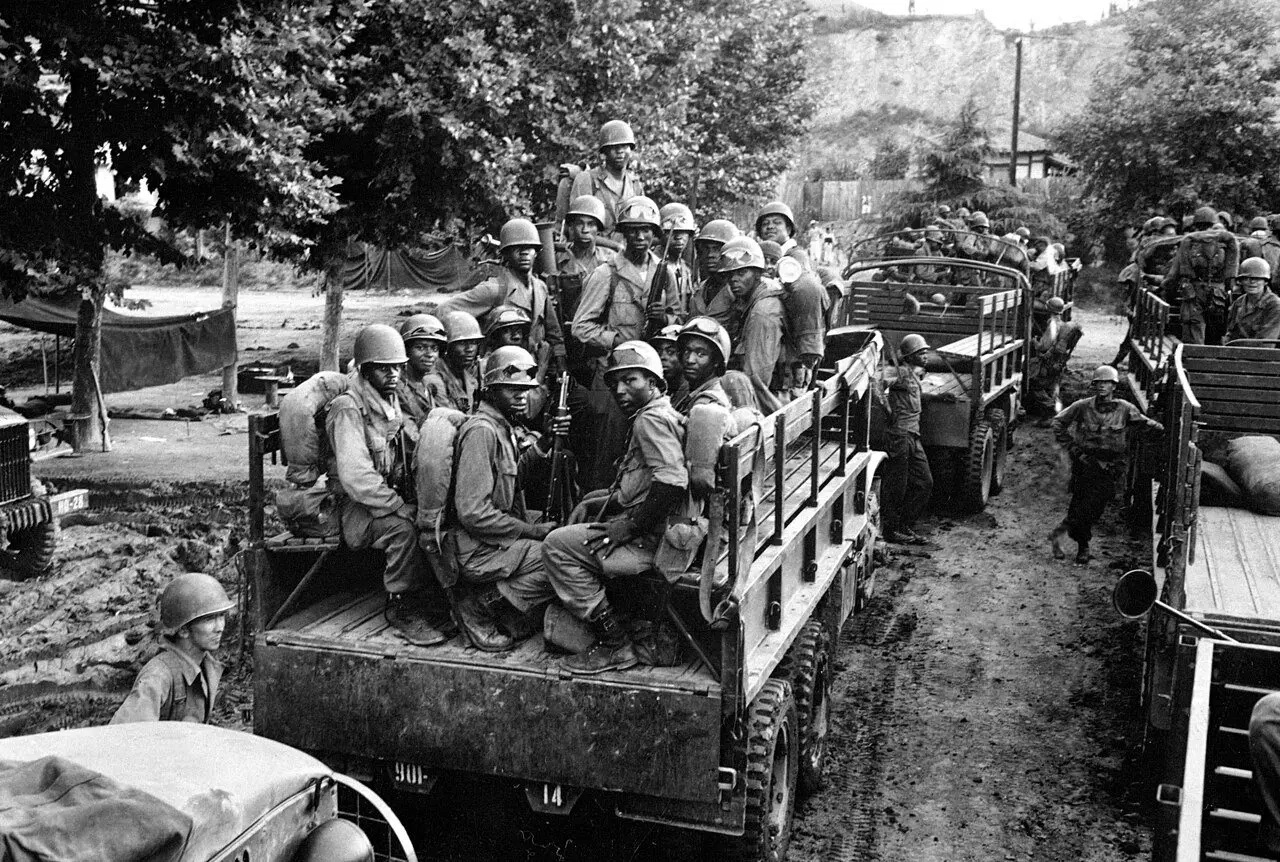
Then history intervened. When North Korea invaded the South in June 1950, under-strength white combat units desperately needed reinforcements, and Black replacements flowed into the ranks. The war became the order's proving ground. The 24th Infantry Regiment — an all-Black regiment that deployed to Korea in June 1950 and fought through the defense of the Pusan Perimeter — was inactivated on October 1, 1951, and its soldiers were dispersed into integrated units as the Army's segregation policy disintegrated.
By the end of the Korean War, the U.S. military was largely integrated, and the last all-Black units were eliminated in September 1954. It was one of the first times a president had used executive authority to advance civil rights — and it worked. The armed forces became the most integrated institution in American life, years before the Montgomery bus boycott and the March on Washington, showing the rest of the country what equality in practice could look like.
Photo: U.S. Army Signal Corps, public domain (via Wikimedia Commons). The image shows soldiers of the 24th Infantry Regiment, an all-Black unit, in Korea in 1950 — the war that put Truman's order to the test.