
The Reformer They Burned: Jan Hus and the Fire That Started a Movement
On July 6, 1415, a Czech preacher was burned at the stake for refusing to take back his words — and his ideas outlived the fire.
The fire was lit in the morning. On July 6, 1415, in a field outside the German city of Constance, a crowd watched as Jan Hus — a priest, a professor, and the most famous preacher in Bohemia — was chained to a stake and burned alive. His crime was heresy. His real offense was refusing to recant words he insisted he had never taught, and refusing to pretend the church’s abuses were God’s will.
Hus was born around 1369 in the village of Husinec, in what is now the Czech Republic. He studied at the University of Prague, became a priest around 1400, and in 1402 took the pulpit at Bethlehem Chapel, where he preached in Czech — the language of ordinary people — to enormous crowds. His sermons carried the influence of the English reformer John Wycliffe, but Hus made the message his own: the church had grown corrupt, the sale of indulgences was a fraud, and the clergy should be judged by Scripture and their own conduct, not their rank.
That plain-spoken challenge was dangerous. In 1410 the Archbishop of Prague ordered Hus’s books burned. Hus was excommunicated in 1412, and for two years he lived under the protection of Bohemian nobles, writing his most important work, De ecclesia (The Church), in exile.
In 1414 Hus traveled to the Council of Constance to defend his teaching. Emperor Sigismund had promised him safe conduct — protection even if the council ruled against him. The promise proved worthless. Hus was arrested on arrival, imprisoned, and tried for heresy. The council ordered him to recant doctrines he said he had never taught. Hus answered that he would gladly declare any doctrine false, but he would not swear under oath that he had once held it. The council, having just reunited Western Christendom under a single pope, was in no mood for dissent, and it found him guilty.
Condemned, Hus was led to the stake on July 6, 1415. Tradition holds that his ashes were thrown into the Rhine, so that nothing of him could be venerated.
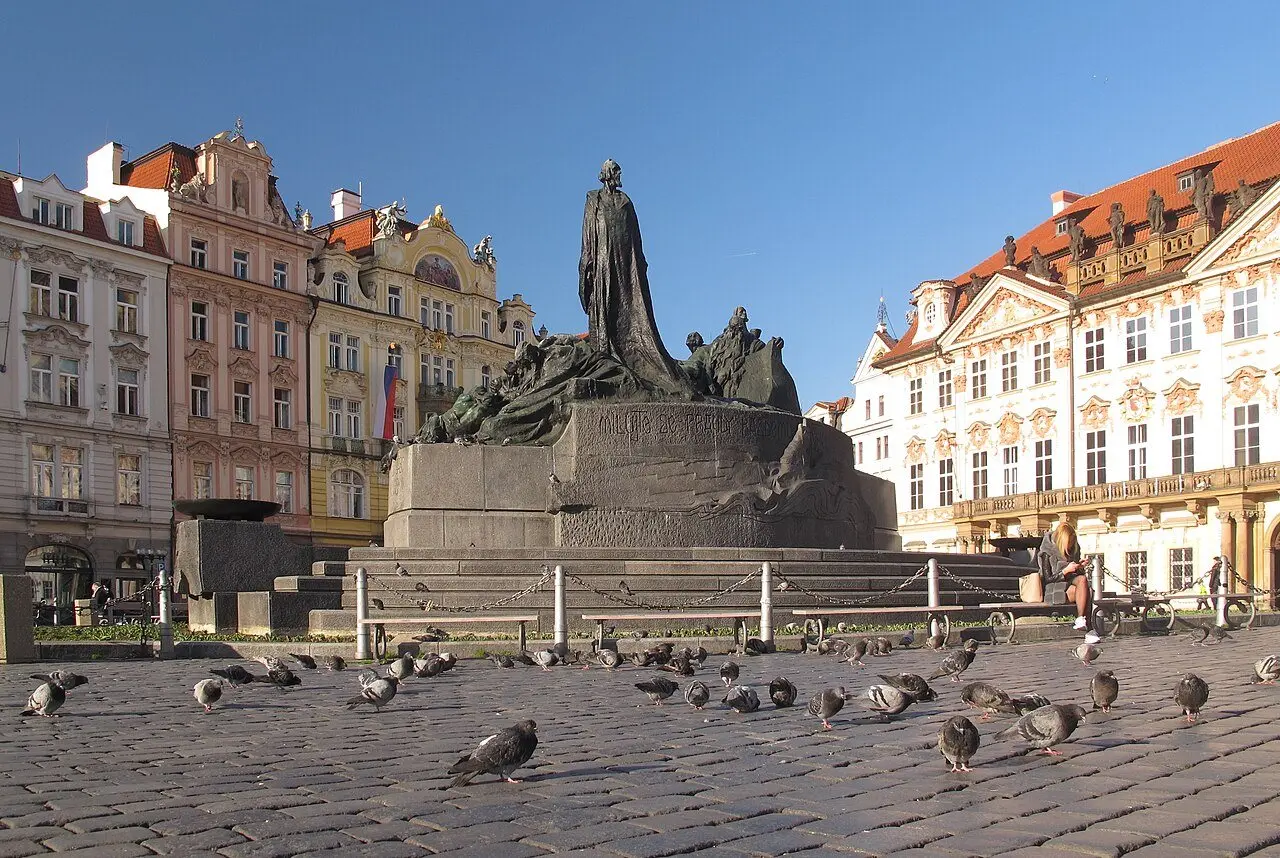
The council meant the fire to end an argument. It started a movement. News of Hus’s death enraged Bohemia, and his followers, the Hussites, rose against church authority, setting off the Hussite Wars that shook Central Europe. A century later, Martin Luther took up many of Hus’s criticisms, and Luther named him as a forerunner. The Czech nation never forgot: July 6 is a national holiday in the Czech Republic, and in 1915, five hundred years after the execution, a great monument to Hus was unveiled in Prague’s Old Town Square.
Hus’s story endures because it is not only about theology. It is about a man who believed that conscience, honestly held, outranks the orders of the powerful — and who paid for that belief with his life.
Photo: Tadeáš Gregor, CC BY-SA 4.0 (via Wikimedia Commons).