The Pale Blue Dot: Earth's Portrait From 6 Billion Kilometers
On Valentine's Day 1990, Voyager 1 turned its camera home one last time and photographed Earth as a single pale-blue pixel -- the most distant portrait of our planet ever taken.
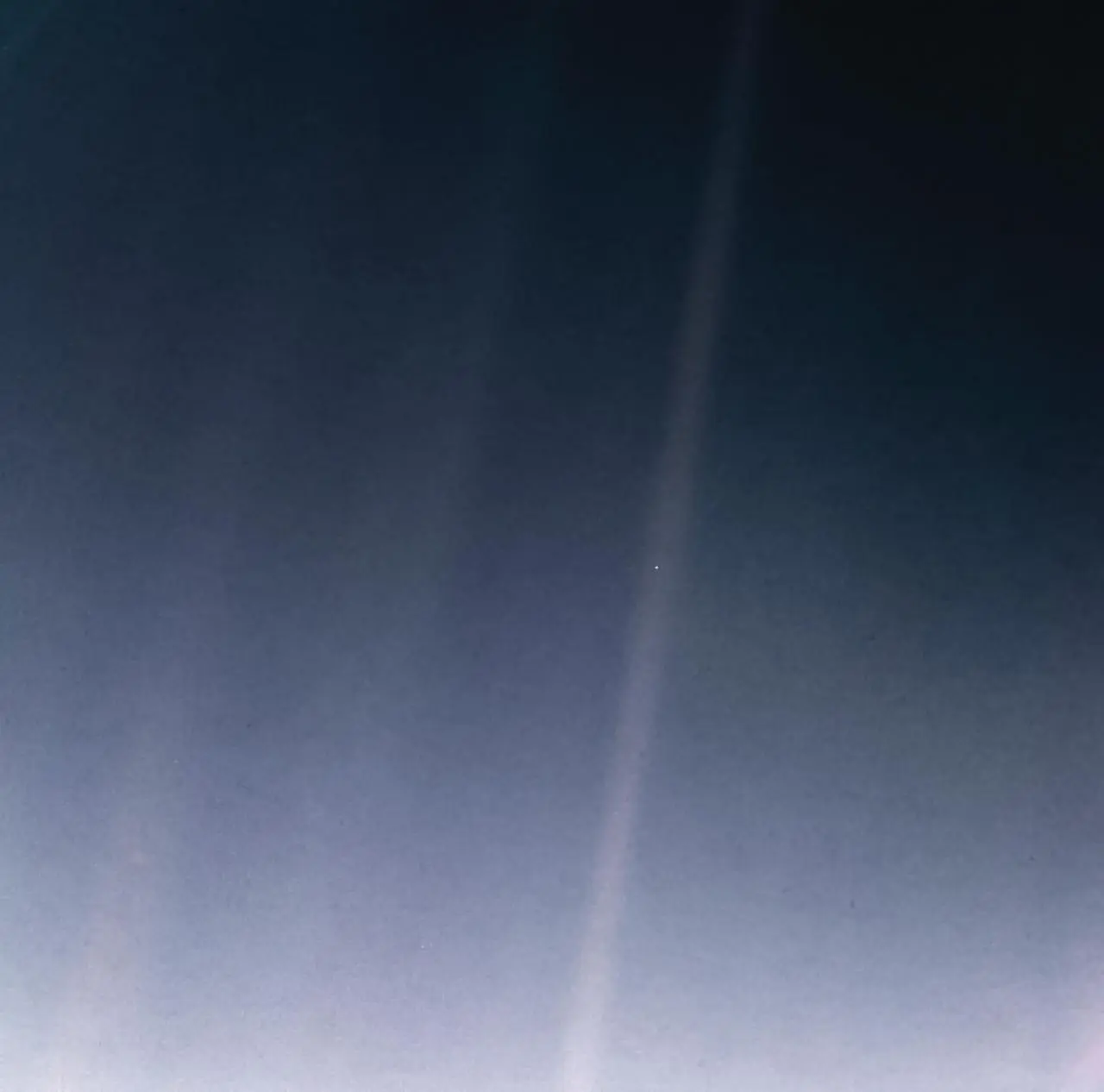
On February 14, 1990 -- Valentine's Day -- a spacecraft 6 billion kilometers from home turned around and took one last look back.
Voyager 1 had launched on September 5, 1977, and spent a dozen years touring the outer solar system: Jupiter in March 1979, Saturn in November 1980. By 1990 it was speeding toward interstellar space, and its cameras were about to be shut off forever to save power. Before they went dark, mission planners commanded the probe to take a parting series of 60 images -- a "Family Portrait" of the solar system, with the camera pointed back toward the inner planets. The sequence returned images for making color views of six of the solar system's planets, and imaged the Sun in monochrome.
The idea had been Carl Sagan's. The astronomer had proposed it as early as 1980: from out there, he argued, Earth itself would be visible -- a mote of dust in the sunbeams. Engineers Carolyn Porco and Candy Hansen designed the command sequence. At 04:48 GMT on February 14, Voyager 1's narrow-angle camera captured the frame -- just 34 minutes before the cameras were shut off forever. In it, Earth appears as just 0.12 of a pixel -- a pale blue speck caught in a shaft of scattered sunlight.
The images took months to come home; the radio signal needed about five and a half hours to cross the distance, and the full set arrived between March and May 1990. Then the cameras were powered down, as planned, never to take another picture.
Sagan made the image famous in his 1994 book Pale Blue Dot. "Look again at that dot," he wrote. "That's here. That's home. That's us." In the passage that followed, he set everything that tiny pixel contains -- everyone loved, everyone known, every human being who ever lived -- against our imagined self-importance, and found us humbled.
Voyager 1 kept going. In August 2012 it crossed into interstellar space, the first human-made object to do so. For the image's 30th anniversary in 2020, NASA released the reprocessed version shown here, rebuilt with modern software by engineer Kevin M. Gill with guidance from two of the original planners, Candy Hansen and William Kosmann.
The Pale Blue Dot is the most distant photograph ever taken of Earth, and it remains the purest perspective science has ever offered: every war, every love story, every human life, on a mote of dust suspended in a sunbeam.
Photo: NASA/JPL-Caltech, public domain