ENIAC: The 30-Ton Brain That Launched the Computer Age
On February 14, 1946, the Army and the University of Pennsylvania unveiled ENIAC, the first general-purpose electronic computer -- and it could out-calculate an artillery shell in flight.
On the evening of February 14, 1946, in a room at the University of Pennsylvania's Moore School of Electrical Engineering, the lights dimmed and a machine the size of a small house woke up.
ENIAC -- the Electronic Numerical Integrator and Computer -- stretched more than 150 feet across, weighed some 30 tons, and hummed with more than 17,000 vacuum tubes. It had been built in secret during World War II, a U.S. Army project led by John Mauchly and J. Presper Eckert, to solve one urgent problem: computing artillery firing tables. Construction had begun in 1943, and the finished machine drew 150 kilowatts of power -- so much, according to legend, that the lights of Philadelphia dimmed whenever it was switched on. Each table told gunners exactly where to aim under different conditions, and human "computers" working with desk calculators needed days to produce a single trajectory.
For the unveiling, ENIAC's operators gave it a demonstration with a point. They fed it a ballistics problem that took a skilled human three days to solve. ENIAC solved it in 20 seconds -- faster, the Army noted with satisfaction, than the 30 seconds the actual artillery shell spent in the air. In another demonstration, it added 5,000 numbers in a single second. An Army press release promised "a new machine that is expected to revolutionize the mathematics of engineering and change many of our industrial design methods."
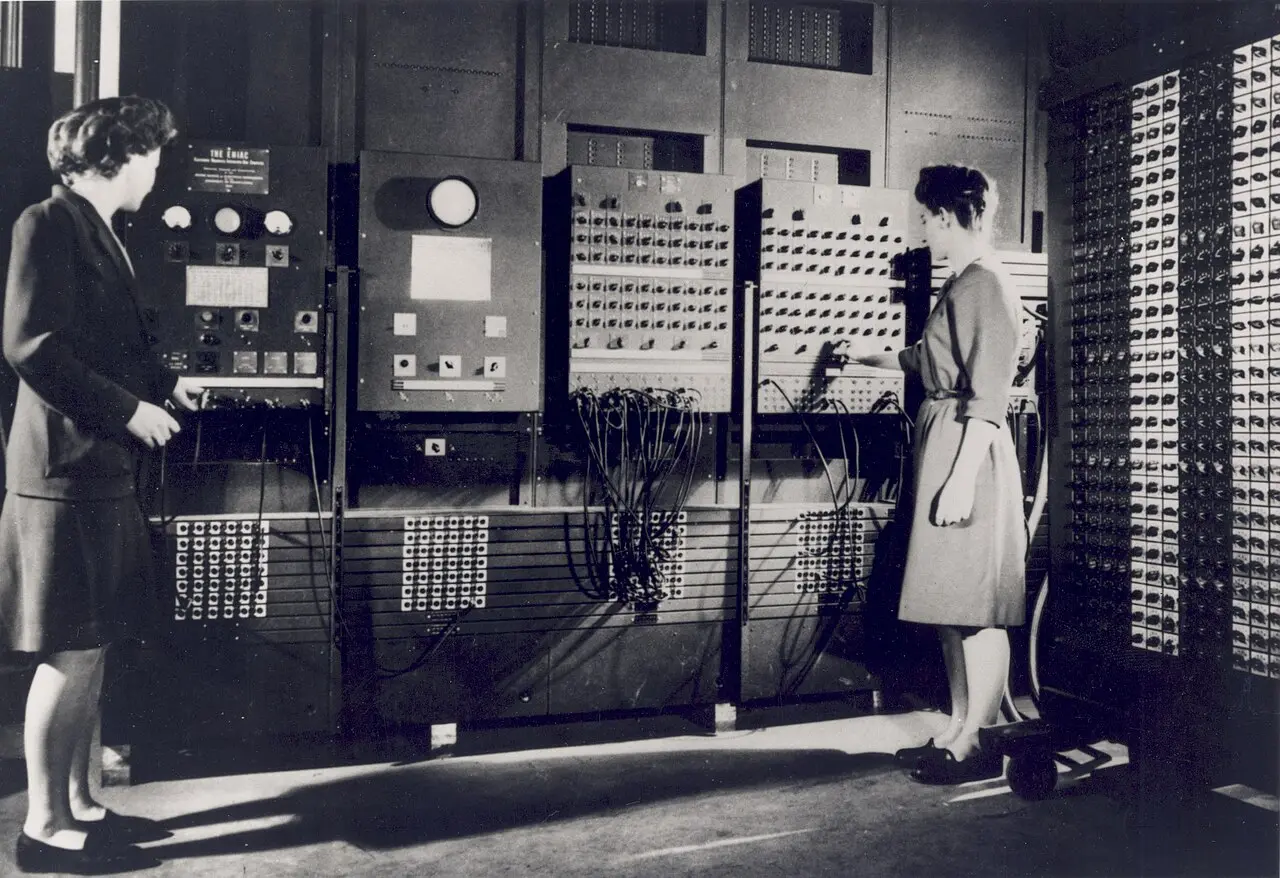
The machine was programmed by hand -- literally. Six young women, hired as "computers," taught themselves to wire ENIAC's panels, setting thousands of switches and cables to make it calculate. Two of them, Betty Jennings and Frances Bilas, were photographed preparing the machine for its big day. Their work was essential and, for decades, nearly invisible: the engineers got the fame while the programmers' names faded from the story.
ENIAC was formally dedicated the next day -- February 15 was declared "ENIAC Day" in Philadelphia -- but February 14 was the night the world first saw what an electronic computer could do. The machine went on to run calculations for the hydrogen bomb design and kept working, in improved forms, until 1957.
Every computer on every desk and in every pocket descends from that room in Philadelphia. ENIAC proved that electronics could calculate at a speed no human could match -- and the women who taught it to do so remind us that the computer age was built by more hands than history first remembered.
Photo: U.S. Army, public domain (via Wikimedia Commons)