The Night the Soldiers Turned: The Wuchang Uprising, 1911
On October 10, 1911, a botched bomb plot forced revolutionaries in Wuchang to mutiny ahead of schedule — and the uprising they started ended more than 2,000 years of imperial rule in China.
On the evening of October 10, 1911, nobody in Wuchang was ready for a revolution — least of all the revolutionaries themselves. Their uprising was scheduled for later that month. But a bomb had already exploded, the police had their names, and the soldiers of China's modern New Army had a choice: mutiny tonight, or be arrested tomorrow morning.
The explosion had come the day before, in a house in the Russian concession across the river in Hankou. A revolutionary named Sun Wu was assembling a bomb when it went off by accident, badly wounding him. Police searched the house and found membership lists of the secret revolutionary societies — the Literary Society and the Progressive Association — that had spent months infiltrating the New Army garrisons of Wuchang, Hanyang, and Hankou. Roundups began. The plotters knew their window was closing.
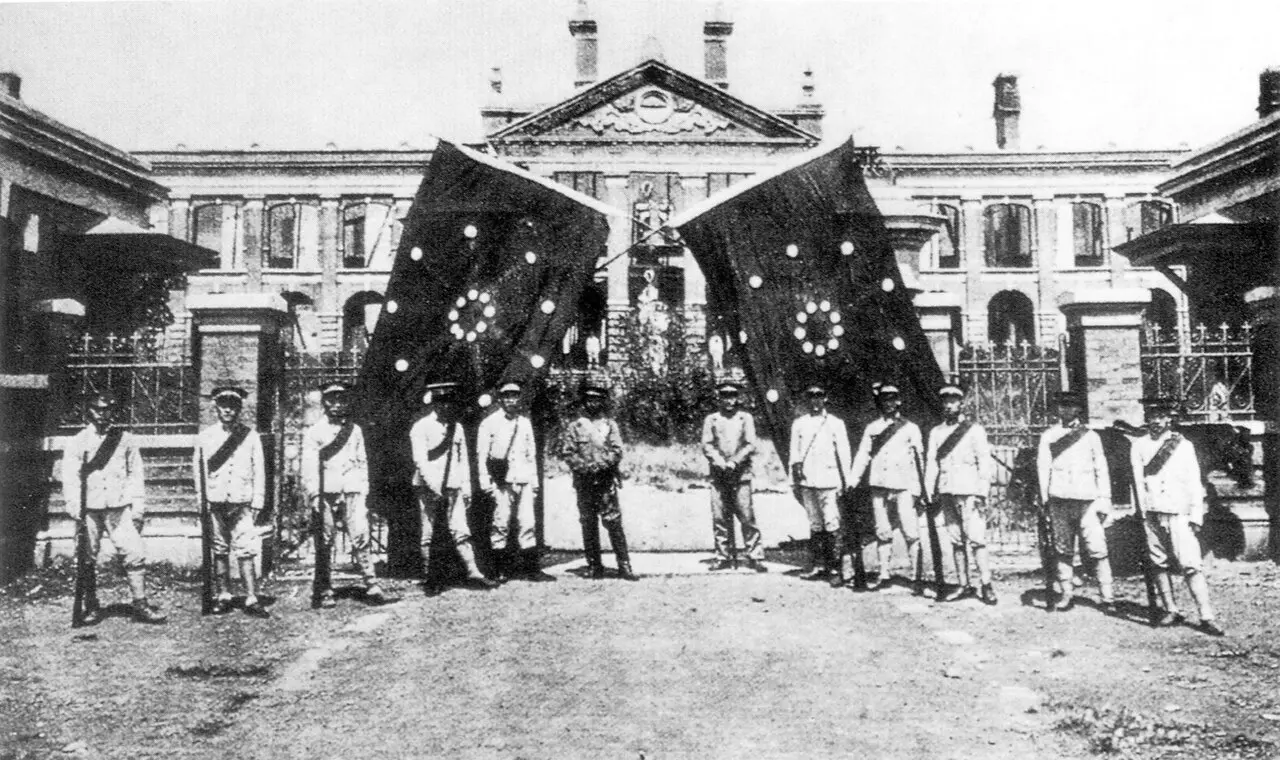
So on the night of October 10, they struck. Mutinous soldiers seized weapons, shot officers who resisted, and stormed the office of the Qing viceroy in Wuchang. The viceroy fled. By the morning of October 11, the revolutionaries held the city — and the neighboring cities of Hanyang and Hankou soon followed. In Wuchang they proclaimed a revolutionary military government of Hubei province and raised a new flag: eighteen golden stars on a dark field, one for each province of China proper, defying the Manchu Qing dynasty that had ruled for 267 years.
The timing astonished everyone, including the revolution's most famous leader. Sun Yat-sen, the exiled republican organizer, was in the United States raising funds when he read about the uprising in a newspaper — in Denver, Colorado, far from the battle he had spent a decade trying to start. He had dreamed of this moment for years; he had simply never imagined it would begin without him.
What followed was less a single revolution than a chain reaction. Province after province declared independence from Beijing. The Qing court, with the five-year-old emperor Puyi on the throne, recalled its most powerful general, Yuan Shikai, to crush the rebellion — but Yuan saw which way history was moving and began negotiating with the revolutionaries instead. On January 1, 1912, the Republic of China was proclaimed in Nanjing. On February 12, the child emperor abdicated. The dynasty that had begun in 1644 was finished, and with it, more than two thousand years of imperial rule in China.
October 10 is still celebrated as National Day in Taiwan — "Double Ten Day," for the tenth day of the tenth month — a holiday that exists because of one botched bomb and one night of desperate improvisation. The Wuchang Uprising matters because it shows how history actually turns: not on the timetable of its planners, but in the panicked hours after a plan falls apart. The soldiers of Wuchang didn't start the revolution they intended. They started it early, badly, and without their leader — and it worked anyway.
Photo: 1911 photograph of revolutionary soldiers at the Hubei Military Government in Wuchang, public domain (via Wikimedia Commons).