The Liberator Tsar: Alexander II's Assassination, March 13, 1881
On March 13, 1881, Tsar Alexander II — the emperor who freed Russia's serfs — was killed by a terrorist's bomb in St. Petersburg, and his reforms died with him.
He had signed a reform that morning. By the afternoon, he was dead.
On Sunday, March 13, 1881, Emperor Alexander II of Russia rode through St. Petersburg in his carriage, returning from a military review. He was 62, and that morning he had approved a plan drawn up by his minister Mikhail Loris-Melikov that would have given elected representatives a voice in Russia's government — a cautious first step toward a constitution.
He never lived to see what came of it.
Alexander was called the Liberator. In 1861 he had freed Russia's serfs, and he went on to reform the courts, the army, and local government. But reform made him enemies everywhere: conservatives thought he had gone too far, and revolutionaries thought he had not gone far enough. A secret terrorist group, the People's Will — Narodnaya Volya — decided the tsar himself had to die. They had tried before: a gunman in 1866, another in 1879, a bomb under his train, even an explosion in the Winter Palace dining room in 1880 that killed eleven soldiers and left the tsar untouched.
This time they were ready. A young woman named Sophia Perovskaya, one of the group's leaders, stationed four men with hand-thrown bombs along the route the tsar's carriage would take.
The first bomb came from Nikolai Rysakov. It exploded beneath the carriage, killing and wounding the tsar's Cossack guards — but Alexander stepped out unhurt. Instead of fleeing to safety, he walked over to check on the wounded men. It was a brave, humane impulse, and it killed him.
The second bomb-thrower, a young revolutionary named Ignacy Hryniewiecki, had been waiting for exactly this. He stepped forward and threw his bomb at the tsar's feet. The blast tore Alexander's legs apart and mortally wounded Hryniewiecki as well.
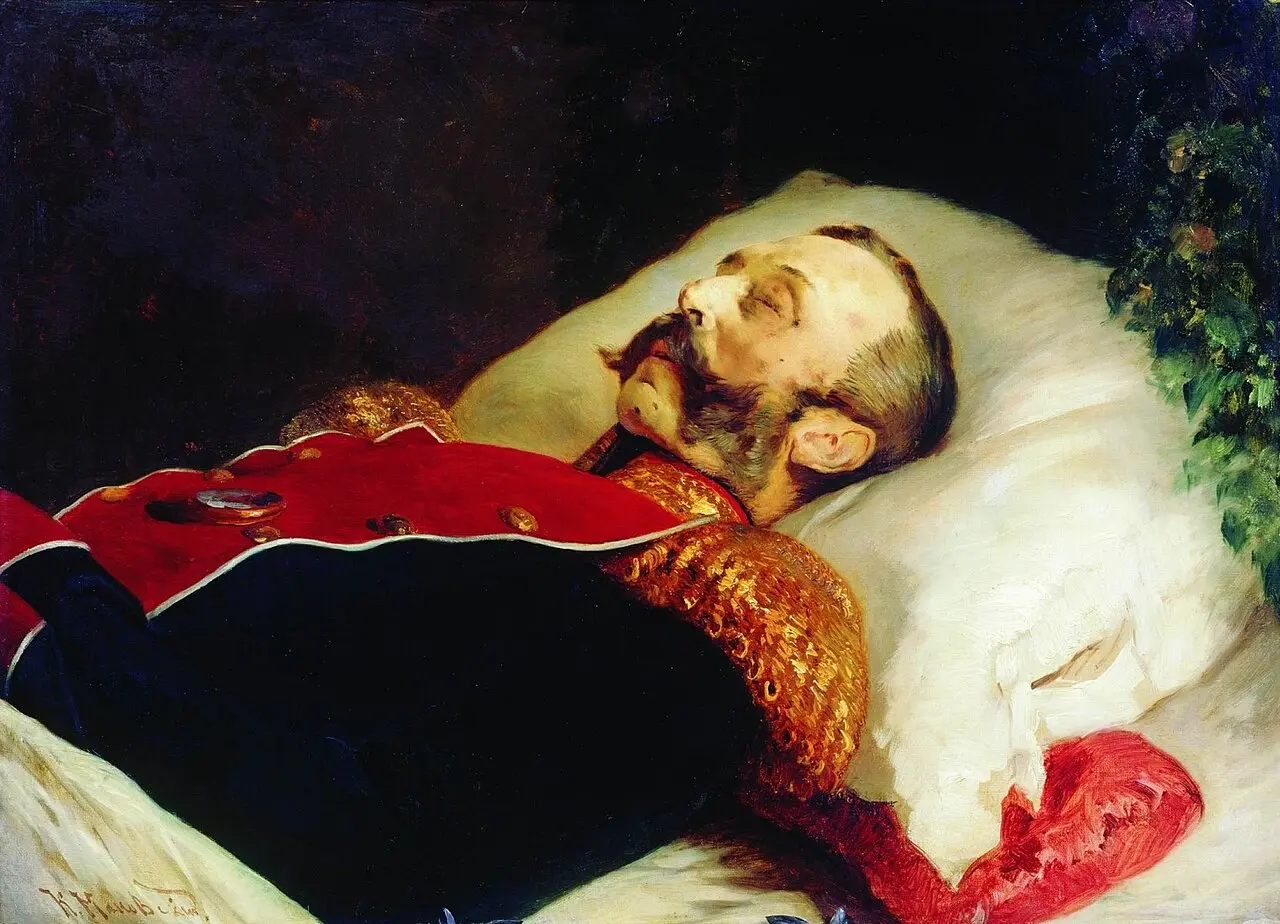
Bleeding and shattered, the emperor was carried to the Winter Palace. He died there at about half past three that afternoon.
The consequences were swift. His son and successor, Alexander III, tore up the Loris-Melikov reform his father had signed that very morning and launched an era of harsh repression. The conspirators were hunted down and hanged — Perovskaya among them, one of the first women in Russian history to be executed for a political crime.
On the exact spot where the bombs exploded, Alexander III ordered a church raised in his father's memory: the Church of the Savior on Spilled Blood, whose colorful domes still rise over the canal in St. Petersburg today, a monument built on the pavement where a tsar bled to death.
Why does it matter? The assassination of Alexander II is one of history's great turning points. A reformer was murdered on the very day he approved reform; his son answered terror with repression, and Russia's long road toward revolution grew darker and straighter. It is a grim reminder that political violence almost never produces what its perpetrators want — the bombs of March 13 killed not only a tsar, but the reforms he represented.
Photo: Konstantin Makovsky's 1881 painting of Alexander II on his deathbed, public domain via Wikimedia Commons.