
A Musician Looks Up and Doubles the Solar System, March 13, 1781
On March 13, 1781, amateur astronomer William Herschel spotted an odd greenish disk through his backyard telescope — and doubled the known size of the solar system.
William Herschel was not supposed to be an astronomer. Born in Hanover, Germany, in 1738, he had moved to England in 1757 and made his living in the spa town of Bath as a church organist and director of public concerts. But music shared his heart with another passion: the night sky. He taught himself to grind mirrors and build reflecting telescopes that outperformed anything most professionals owned.
On the night of March 13, 1781, Herschel was doing what he loved — sweeping the sky from the garden of his house at 19 New King Street in Bath, cataloging every star down to the eighth magnitude. Near the star Zeta Tauri, something caught his eye: a small, greenish disk, clearly not a pinpoint star. In his journal he wrote, 'In the quartile near Zeta Tauri ... either [a] nebulous star or perhaps a comet.'
Four days later, on March 17, he looked again — and the object had moved. Comets move; stars do not. Herschel announced his discovery to the Royal Society on April 26 in a paper titled 'An account of a comet.' But when astronomers computed its path, the surprise deepened: the orbit was nearly circular, far beyond Saturn, at about 19 times Earth's distance from the sun. Herschel was elected to the Royal Society that same year, appointed the king's personal astronomer, granted a royal pension, and was knighted. Uranus — the third-largest planet, and the seventh from the sun — was the first new world added to the solar system in recorded history. This was no comet. It was a planet — the first planet ever discovered with a telescope.
Herschel, loyal to his adopted king, proposed naming it 'Georgium Sidus' — George's Star, for George III. Other astronomers preferred tradition, and the name proposed by the German astronomer Johann Elert Bode won out: Uranus, after the Greek god of the heavens. The discovery made Herschel famous overnight.
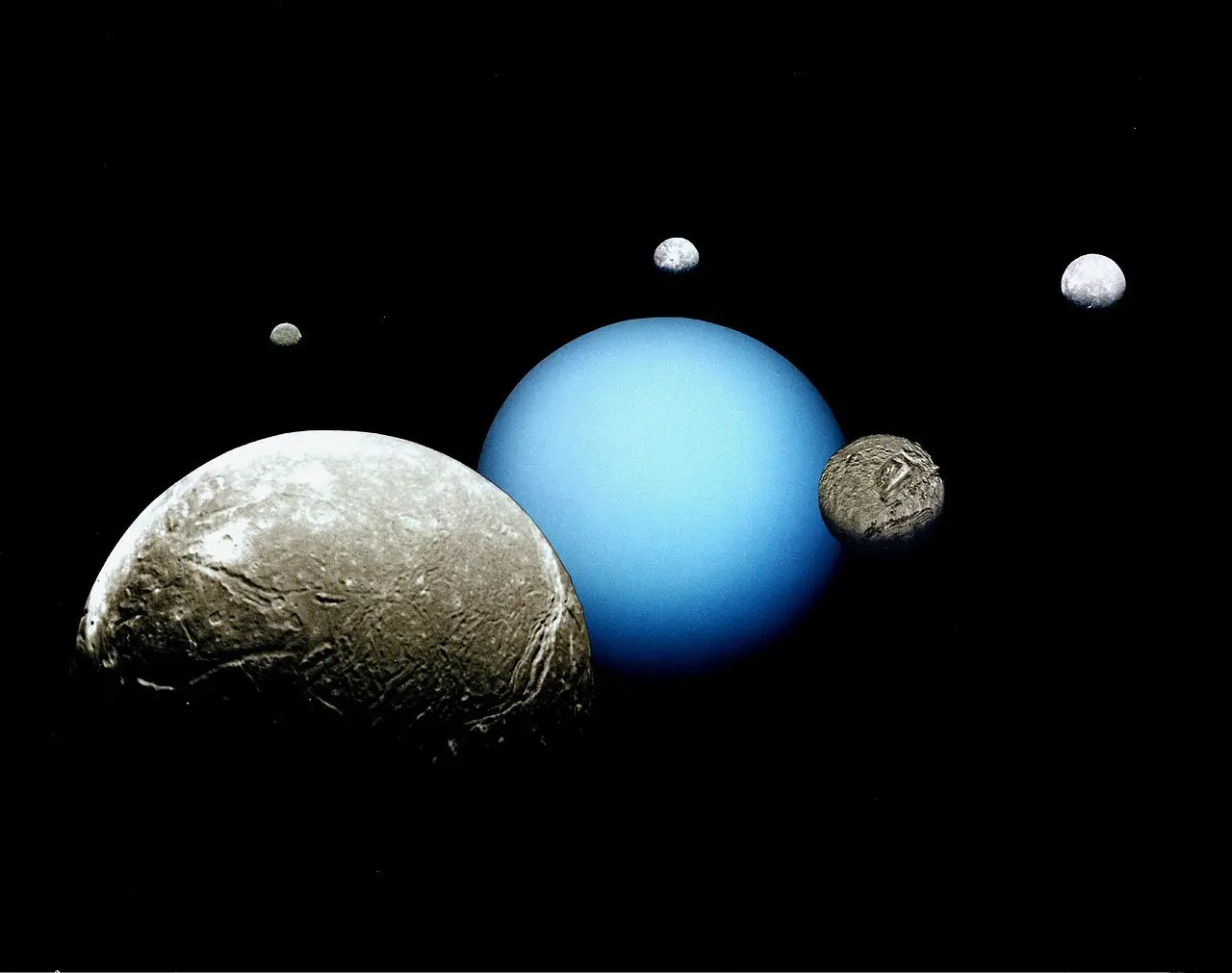
Uranus takes 84 years to orbit the sun and glows blue-green with methane in its atmosphere. Its moons carry names from Shakespeare and Alexander Pope. But the true wonder of March 13, 1781, is what it meant: the solar system was not the fixed, finished creation of the ancients. It was bigger, stranger, and waiting to be found. Telescopes had doubled the universe in a single night — and astronomers have been finding new worlds ever since.
Photo: NASA/JPL, public domain (via Wikimedia Commons).