The Day the Viet Minh Guns Opened Fire: Dien Bien Phu, 1954
On March 13, 1954, Viet Minh artillery shattered the quiet of a remote valley in Vietnam, beginning the 55-day siege that would end French colonial rule in Indochina.
The new moon rose over the valley, and then the sky caught fire.
On Saturday, March 13, 1954, in a remote valley in northwestern Vietnam, the guns of the Viet Minh opened fire on the French fortress at Dien Bien Phu. It was the new moon — the darkest night of the month — and the bombardment was the opening act of one of the most famous sieges of the twentieth century.
The French had built the fortress to trap the Viet Minh. Ringed by fortified strongpoints with women's names — Beatrice, Gabrielle, Anne-Marie — and centered on an airstrip that was the garrison's only lifeline, the valley base was supposed to be impregnable. French commanders were confident the Viet Minh could never drag heavy artillery through the jungle-covered mountains that surrounded it.
They were wrong. For months, tens of thousands of Vietnamese porters had hauled artillery pieces, shells, and rice along hidden jungle trails — sometimes by hand, sometimes by bicycle — and dug the guns into the hillsides above the valley, where French guns could not reach them.
When the shelling began that evening, the first targets were the French artillery positions and the airstrip. Within hours, the guns the French had counted on were silenced, and the runway was torn apart — the fortress's lifeline, cut. Then Viet Minh infantry attacked Beatrice, the northernmost strongpoint, advancing through trench networks under cover of the bombardment. By the next day, Beatrice had fallen, and the siege had found its terrible rhythm: bombard, dig closer, attack, repeat.
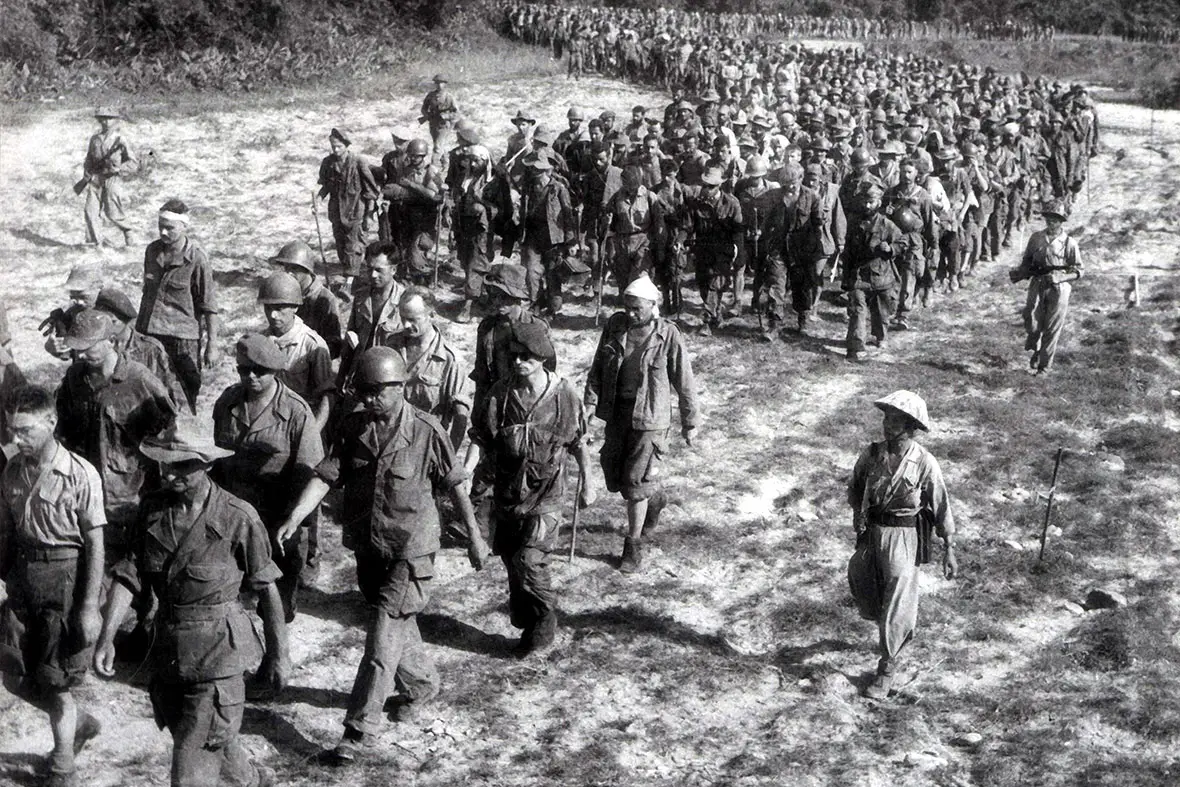
For fifty-five days the battle ground on. The French garrison, stranded and outgunned, fought from trenches that filled with monsoon rain while Viet Minh sappers tunneled steadily inward. On May 7, the fortress finally fell. Thousands of French soldiers were taken prisoner and marched off to prison camps in long, ragged columns — photographs of those columns became some of the defining images of the war.
The defeat ended France's war in Indochina. At the Geneva Conference that summer, the great powers divided Vietnam, and the French colonial empire in Asia effectively collapsed. Within a decade, the United States would step into the vacuum France left behind — the road to the Vietnam War ran straight through that valley.
Why does it matter? Dien Bien Phu proved that a determined independence movement could defeat a modern European army in open battle. It redrew the map of Southeast Asia, ended an empire, and set the stage for decades of conflict that would draw in the world's superpowers. And it began on a moonless night in March, with artillery the French were certain could never be there.
Photo: French prisoners being marched to a camp after the fall of Dien Bien Phu, May 1954; public domain photograph via Wikimedia Commons.