The Impossible Planet
On October 6, 1995, two Swiss astronomers announced the first planet ever found around a Sun-like star — a scorching gas giant so close to its sun that it defied every theory of how planets form.
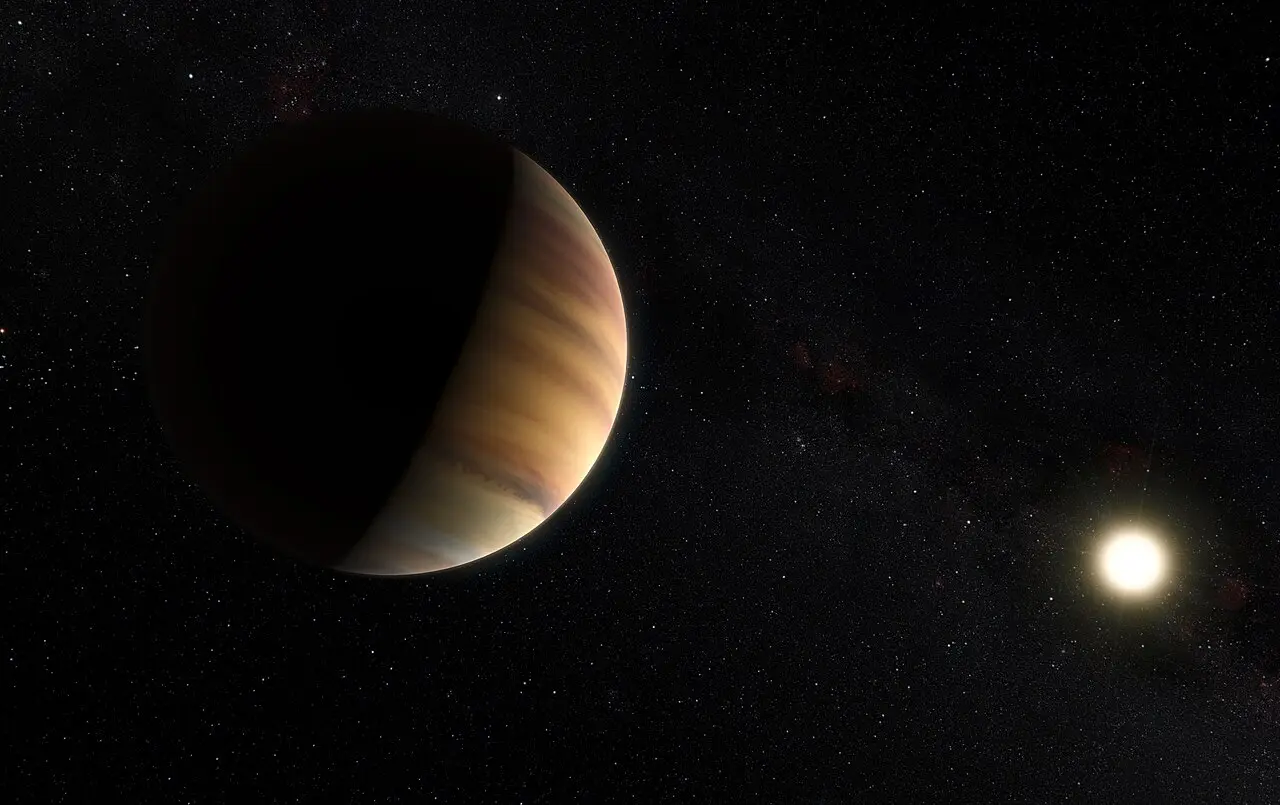
On October 6, 1995, at a scientific conference in Florence, Italy, two Swiss astronomers stood up and told the world something that, by every textbook of the time, should not exist. Michel Mayor and his doctoral student Didier Queloz, of the Geneva Observatory, had found a planet orbiting an ordinary, Sun-like star — the first ever detected around a "normal" star. And it was all wrong: a gas giant at least half the mass of Jupiter, circling its star in just four days, closer than Mercury is to our Sun, with an atmosphere hot enough to melt lead.
They hadn't seen it, of course. Nobody has ever seen 51 Pegasi b directly — it is lost in the glare of its star, fifty light-years away in the constellation Pegasus. They had felt it. Using an exquisitely precise spectrograph called ELODIE at an observatory in southern France, they spent years measuring the star's light, split into a rainbow "barcode" of dark spectral lines. Every 4.23 days, the barcode slid rhythmically back and forth — the star wobbling under the gravitational tug of an unseen companion. It was like detecting a dancer's partner by the sway of the dancer alone.
The signal was so strange that Mayor himself hesitated. Giant planets were supposed to form far from their stars, in the cold outer reaches, the way Jupiter and Saturn did. A gas giant hugging its star at one-twentieth of Earth's distance — completing a "year" in about four Earth days, roasting at more than 1,000°C — fit no model anyone had. The team spent months ruling out every alternative: starspots, pulsations, anything but a planet. Only then did they go public, in the journal Nature and on that October day in Florence.
Skepticism was immediate — and short-lived. Within days, American astronomers Geoffrey Marcy and Paul Butler, rivals in the planet hunt, confirmed the signal with their own telescope. The impossible planet was real: the prototype of a whole new class, the "hot Jupiters." Astronomers had to rewrite their theories of how planets form and migrate, and the floodgates opened. From zero known planets around Sun-like stars in 1995, the count now runs into the thousands, found by space telescopes like Kepler and TESS.
For Mayor and Queloz, the reward came in 2019, when they shared the Nobel Prize in Physics for a discovery that transformed our view of the universe. (Planets had been found before, around the dead husks of exploded stars called pulsars — but those exotic systems told us little about whether ordinary stars like ours have planets. 51 Pegasi b answered that question: yes.)
Before October 6, 1995, humanity knew of exactly one planetary system — its own. Every night sky was a question mark. That announcement turned exoplanets from speculation into science, and launched the search that may one day find a world like Earth. We now know the galaxy is crowded with planets. We learned it from a star's barely perceptible wobble, fifty light-years away.
Photo: Artist's impression of 51 Pegasi b by ESO/M. Kornmesser and Nick Risinger, CC BY 4.0, via Wikimedia Commons.