The Emperor's Escape: Napoleon Flees Elba, Feb. 26, 1815
On February 26, 1815, Napoleon slipped away from his Elba exile with about a thousand men, launching the Hundred Days that ended at Waterloo.
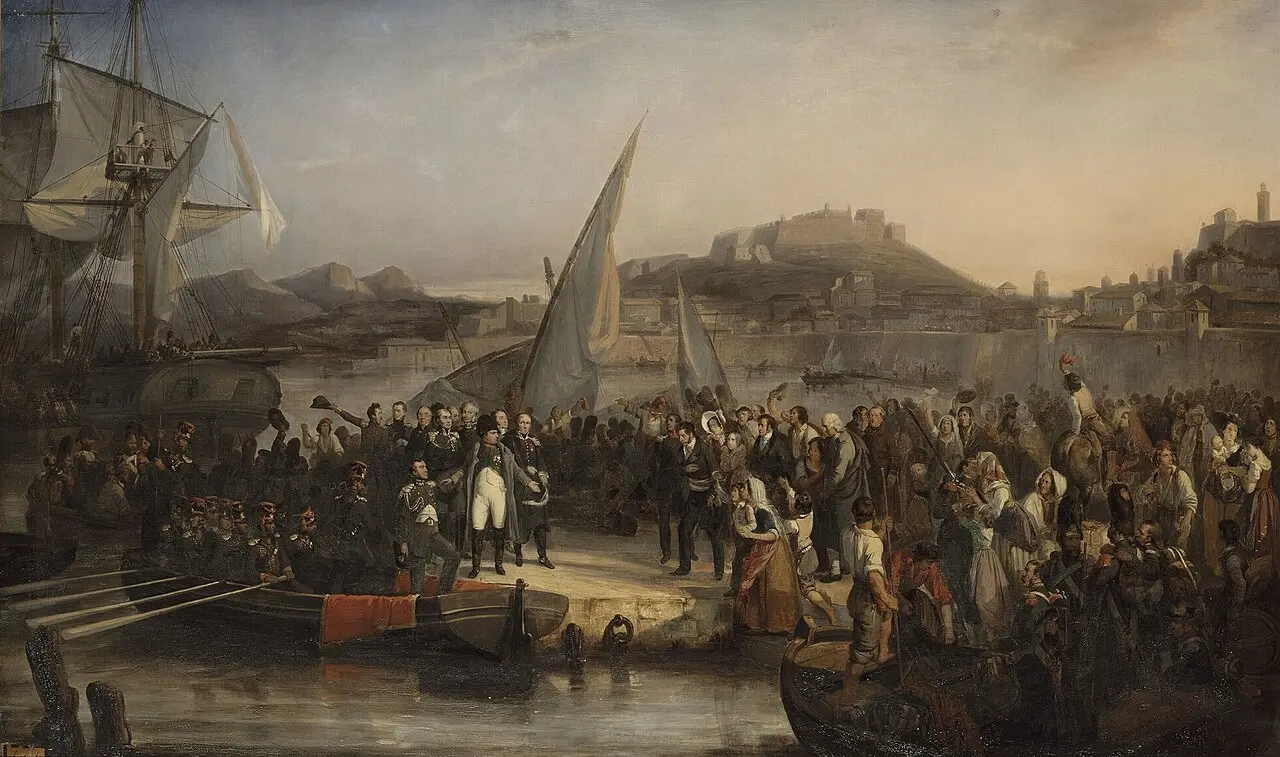
On the evening of February 26, 1815, the most closely watched prisoner in Europe simply sailed away.
Napoleon Bonaparte had ruled the Mediterranean island of Elba for nearly ten months. After his abdication in 1814, the Treaty of Fontainebleau — signed by the Allied powers on April 11 — had granted the fallen emperor complete sovereignty over the tiny island, along with his imperial title, a promised income of two million francs a year, and a personal guard of up to 400 men. He had thrown himself into the role: building roads, reforming the iron mines, and holding court at his villa in Portoferraio as if it were a miniature Paris.
But Napoleon had not stopped watching the mainland. He knew that some of the victorious powers were quietly discussing moving him somewhere far more remote, where he could trouble Europe no more. The Times of London had already declared his Elba exile "an insufficient remedy" — the emperor was, in the paper's view, "only removed from the scene of action, and the mischief remains behind." France, meanwhile, was restless under the restored Bourbon king, Louis XVIII.
So on the night of February 26, Napoleon boarded a small flotilla with roughly a thousand of his loyal guardsmen and slipped away from Portoferraio. Days later he landed on the southern coast of France and began marching north toward Paris — an army of a thousand against a kingdom.
What happened next stunned Europe. Regiment after regiment sent to arrest the returning emperor instead defected to him. At Grenoble, soldiers ordered to fire on their former commander lowered their muskets and cheered him. Louis XVIII fled the capital, and on March 20, 1815 — less than a month after the escape — Napoleon walked into Paris and reclaimed the throne in what was, remarkably, a bloodless revolution. The episode became known as the Hundred Days.
It could not last. The great powers, gathered at the Congress of Vienna to redraw the map of Europe, declared Napoleon an outlaw and mobilized. On June 18, 1815, at Waterloo in Belgium, his army was crushed. Napoleon abdicated a second time and was exiled again — this time to the remote Atlantic island of Saint Helena, where he died in 1821.
The escape from Elba remains one of history's great gambles: a deposed ruler betting everything on the loyalty of his soldiers, and winning — for a hundred days. It sealed Napoleon's legend as the man who would not stay beaten, and it gave the Congress of Vienna its final urgency, shaping the borders and balances of power that governed Europe for the next century.
Photo: Joseph Beaume, public domain (via Wikimedia Commons)