The Day Bulgaria Declared Itself Free
On October 5, 1908, Prince Ferdinand proclaimed Bulgaria's full independence from the Ottoman Empire in the old capital of Tarnovo — and crowned himself Tsar on the spot.
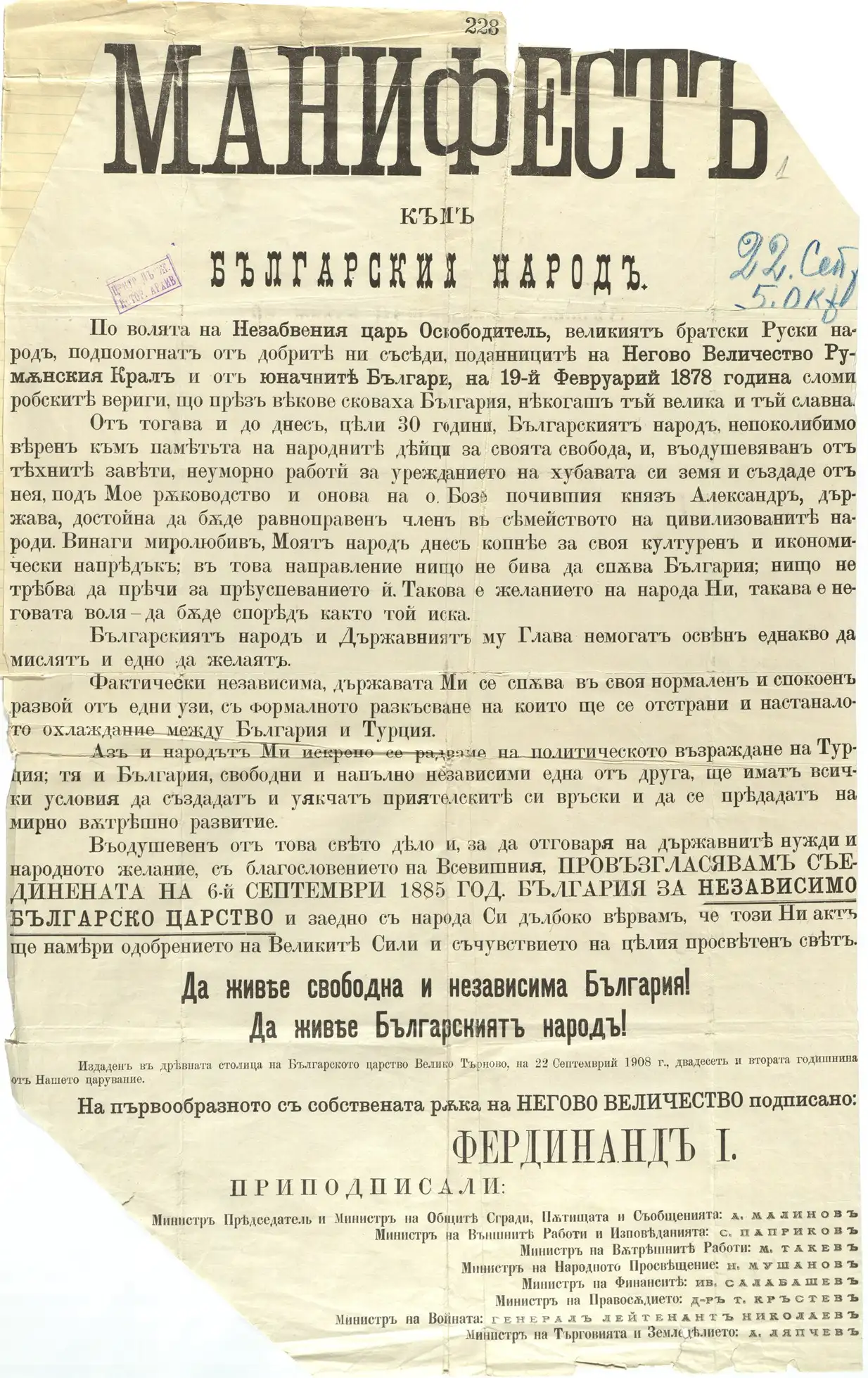
On October 5, 1908, in the ancient hilltop capital of Veliko Tarnovo, a prince decided to become a tsar. Ferdinand of Bulgaria climbed the steps of the Church of the Holy Forty Martyrs, read aloud a manifesto of independence — and in a single ceremony declared his country free of the Ottoman Empire and himself its crowned sovereign. Europe's map had just been redrawn, and the great powers learned about it after the fact.
The truth was that Bulgaria had been running its own affairs for thirty years. The 1878 Treaty of Berlin had created a Bulgarian principality — with its own constitution, flag, army, and foreign policy — but left it formally a vassal of the Ottoman sultan. In 1885 Bulgaria had absorbed the neighboring province of Eastern Rumelia without asking anyone's permission. Independence was a fact; Ferdinand wanted it to be the law.
His moment came with the Young Turk Revolution of 1908, which threw the Ottoman Empire into turmoil. Ferdinand — a canny operator who had spent two decades balancing Bulgaria between Russia, Austria, and the Ottomans — seized the chaos. He chose Tarnovo deliberately: it had been the capital of the medieval Bulgarian tsars, and proclaiming independence in the old coronation church wrapped a modern power grab in a thousand years of history. Taking the title "Tsar" was a deliberate echo of those medieval emperors — though outside Bulgaria, diplomats politely translated it as "king."
There is a calendar footnote to the story. Bulgaria still used the old Julian calendar in 1908, so the manifesto was dated September 22 — the date Bulgarians still celebrate as Independence Day. By the Gregorian calendar the rest of the world mostly uses, it was October 5. (Bulgaria didn't adopt the Gregorian calendar until 1916.)
The timing rattled Europe. The very next day, Austria-Hungary announced the annexation of Bosnia — a coordinated one-two punch against a weakened Ottoman Empire that historians call the Bosnian Crisis, and a rehearsal for the greater crisis of 1914. Within months, the Ottomans and the European powers recognized Bulgarian independence, and the new Tsardom of Bulgaria took its seat among the nations — just four years before it would help tear the Balkans apart in the Balkan Wars.
Ferdinand's ceremony was political theater, but it marked something real: the moment a small Balkan nation stopped asking permission and started writing its own history. The twentieth century would be cruel to Bulgaria — two lost world wars, a lost monarchy — but October 5, 1908, remains its Independence Day in all but date: the day the vassal became a kingdom.
Photo: The 1908 Bulgarian Declaration of Independence manifesto, public domain (Bulgarian State Archives), via Wikimedia Commons.