The Battle That Broke Tecumseh's Dream
On October 5, 1813, Shawnee leader Tecumseh was killed at the Battle of the Thames in Ontario, and with him died the dream of a united Native confederacy resisting American expansion.
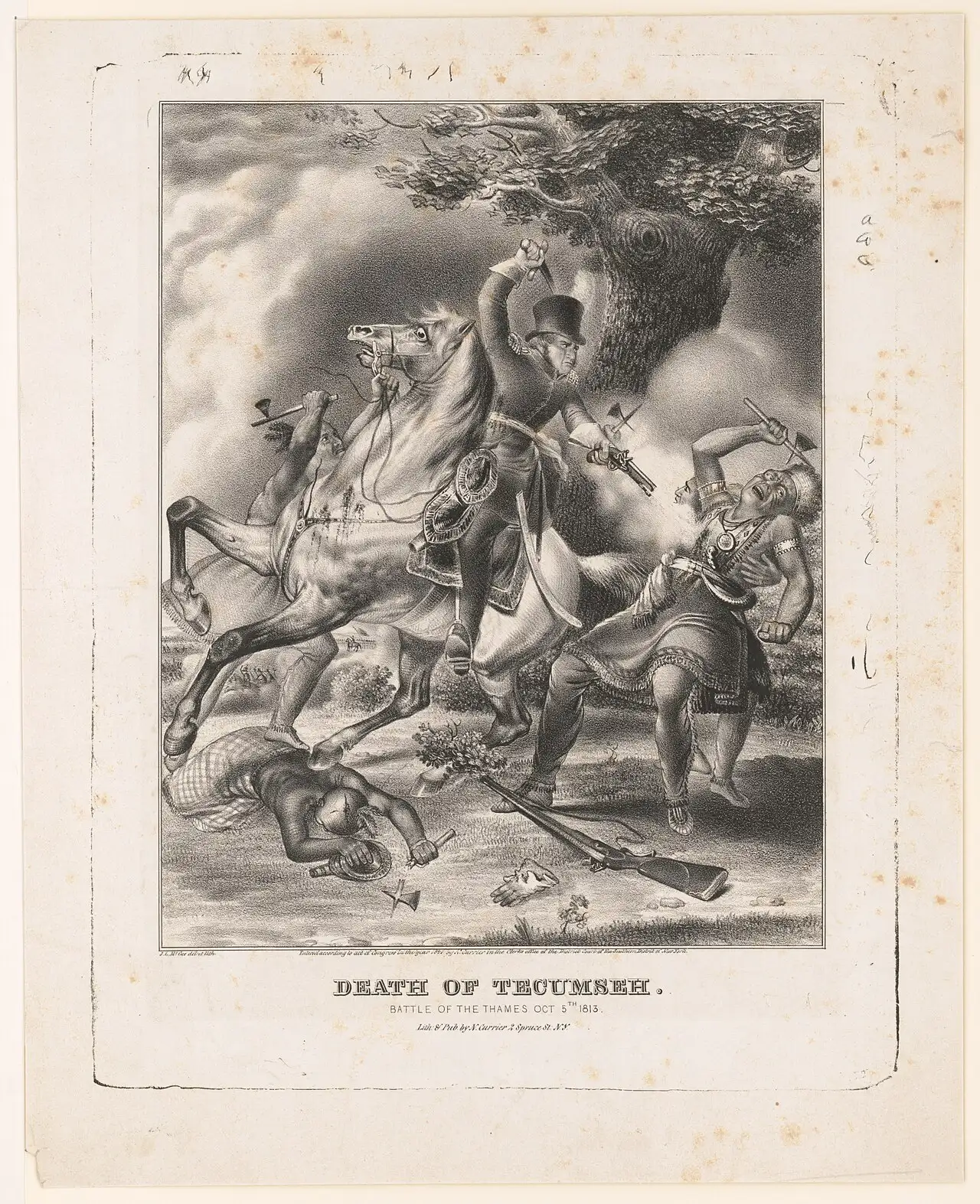
On the afternoon of October 5, 1813, along the Thames River in what is now Ontario, Canada, one of the most remarkable leaders in North American history fought his last battle. Tecumseh, the Shawnee chief who had spent a decade trying to unite the continent's Native nations into a single confederacy, was killed in the fighting. He was in his forties. With his death, the organized Indigenous resistance to American expansion east of the Mississippi effectively died too.
Tecumseh's vision had been extraordinary: that no single tribe should sell land, because the land belonged to all Native peoples in common, and that only a united front could stop the United States from swallowing it piece by piece. He traveled thousands of miles — from the Great Lakes to the Gulf Coast — preaching unity, and at his peak commanded what historians call the most formidable Native force ever assembled on the continent. When the War of 1812 broke out, he allied his warriors with Britain, and his leadership was decisive in the capture of Detroit in August 1812.
But 1813 turned against him. In September, American commodore Oliver Hazard Perry destroyed the British fleet on Lake Erie, cutting the British supply line. The British commander in the region, Colonel Henry Procter, ordered a retreat into Upper Canada. Tecumseh — who had openly scorned Procter's nerve — went along reluctantly, his warriors' families and future hanging on the alliance.
Near Moraviantown, Procter finally turned to make a stand. The American force under Major General William Henry Harrison — the same Harrison whose troops had defeated Tecumseh's brother Tenskwatawa at Tippecanoe two years earlier — attacked with mounted riflemen. The British line broke quickly; Procter fled the field. Tecumseh's warriors fought on, and in the swirling combat Tecumseh was killed. His body was carried away and buried in a secret grave that has never been found. To this day, no one knows with certainty who struck the fatal blow — though a Kentucky officer, Richard Mentor Johnson, rode a dubious claim of the kill all the way to the U.S. vice presidency.
The consequences were immediate and lasting. The multi-tribal confederacy Tecumseh had built collapsed without him. Within a generation, the depleted tribes of the region were forced west of the Mississippi. Harrison's victory burnished the military reputation that carried him to the White House in 1840. And the lands Tecumseh had fought to hold in common were carved up and sold, exactly as he had warned they would be.
Tecumseh is remembered today as one of the most gifted leaders — and most tragic what-ifs — in American history: a diplomat and strategist who saw, more clearly than his contemporaries, that division meant defeat. October 5, 1813, didn't just end a battle. It ended the last, best chance for a united Native nation to hold its ground — and set the terms of the continent for the next century.
Photo: "Death of Tecumseh. Battle of the Thames, Oct. 5th, 1813," lithograph by J. L. McGee, public domain (Library of Congress), via Wikimedia Commons.