The Book That Made Sherlock Holmes Immortal
On October 14, 1892, twelve Strand Magazine stories were bound into the book that made Sherlock Holmes immortal.
By the autumn of 1892, Arthur Conan Doyle was already tired of Sherlock Holmes. The consulting detective had made Doyle famous — the stories appearing each month in The Strand Magazine were the talk of London — but Doyle considered them potboilers, distractions from the serious historical novels he longed to write. He had no idea that the book about to appear would make Holmes immortal, and Doyle with him.
On October 14, 1892, George Newnes Ltd. of London published The Adventures of Sherlock Holmes, collecting the twelve stories that had run in The Strand from July 1891 to June 1892. Readers who had followed Holmes month by month — through "A Scandal in Bohemia," "The Red-Headed League," "The Adventure of the Blue Carbuncle," and "The Adventure of the Speckled Band" — could now hold all twelve between two covers.
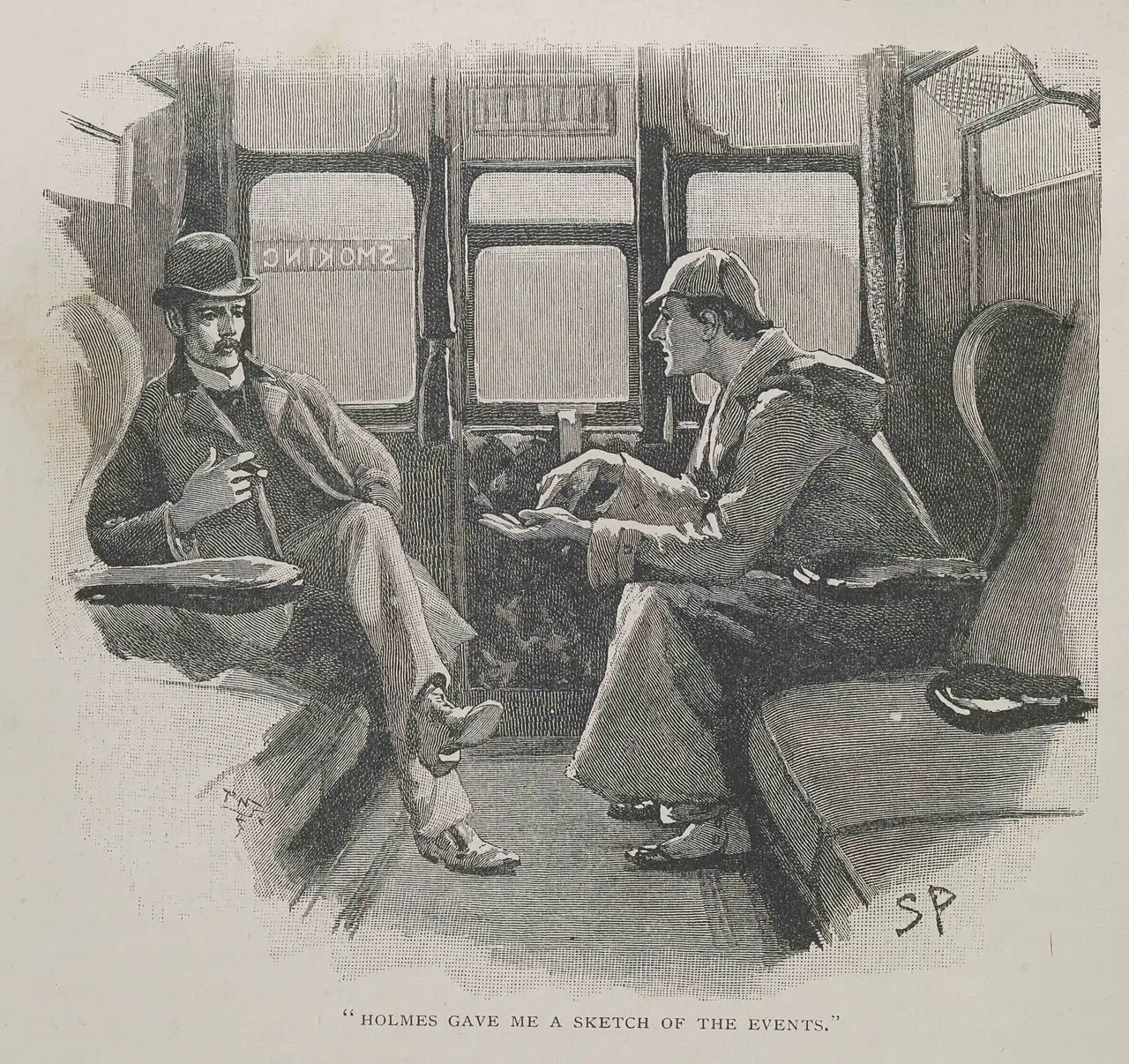
The book's success owed as much to its pictures as its prose. Every story had first appeared with illustrations by Sidney Paget, whose sharp, hawklike Holmes — deerstalker cap, Inverness cape, piercing gaze — became the face of the detective for all time. The railway-carriage scene above, from "The Adventure of the Silver Blaze," is Paget's work. Generations of actors have performed in the shadow of his drawings. It is Paget's Holmes that readers still picture when they open the book: the lean figure in the deerstalker, magnifying glass in hand, forever mid-deduction.
The first printing was modest by later standards: 10,000 copies in Britain, with 4,500 more in America, where Harper & Brothers issued the U.S. edition. It was not nearly enough. Victorian readers devoured the collection, and Holmes — the violin-playing, impossibly observant lodger of 221B Baker Street — passed from popular character into permanent myth.
Doyle's ambivalence is part of the story's irony. Within a year of the book's publication, weary of his creation, he killed Holmes off, sending him over Switzerland's Reichenbach Falls locked in combat with Professor Moriarty. Readers mourned as if for a real man — and a decade later, public demand forced Doyle to resurrect him. Holmes has never really died since: in print, on stage, and on screen, he remains one of the most portrayed characters in all of fiction. More than a century later, new Holmes films, series, and pastiches still appear every year — all of them descendants of the twelve stories bound together that October.
Image: Sidney Paget's 1892 illustration of Sherlock Holmes and Dr. Watson in a railway carriage, from "The Adventure of the Silver Blaze" in The Strand Magazine — one of the twelve stories in the collection. Paget died in 1908; public domain, via Wikimedia Commons.