Shot in Milwaukee: The Night a Bullet Couldn't Stop Roosevelt
On October 14, 1912, Theodore Roosevelt was shot in Milwaukee — then delivered his ninety-minute campaign speech anyway.
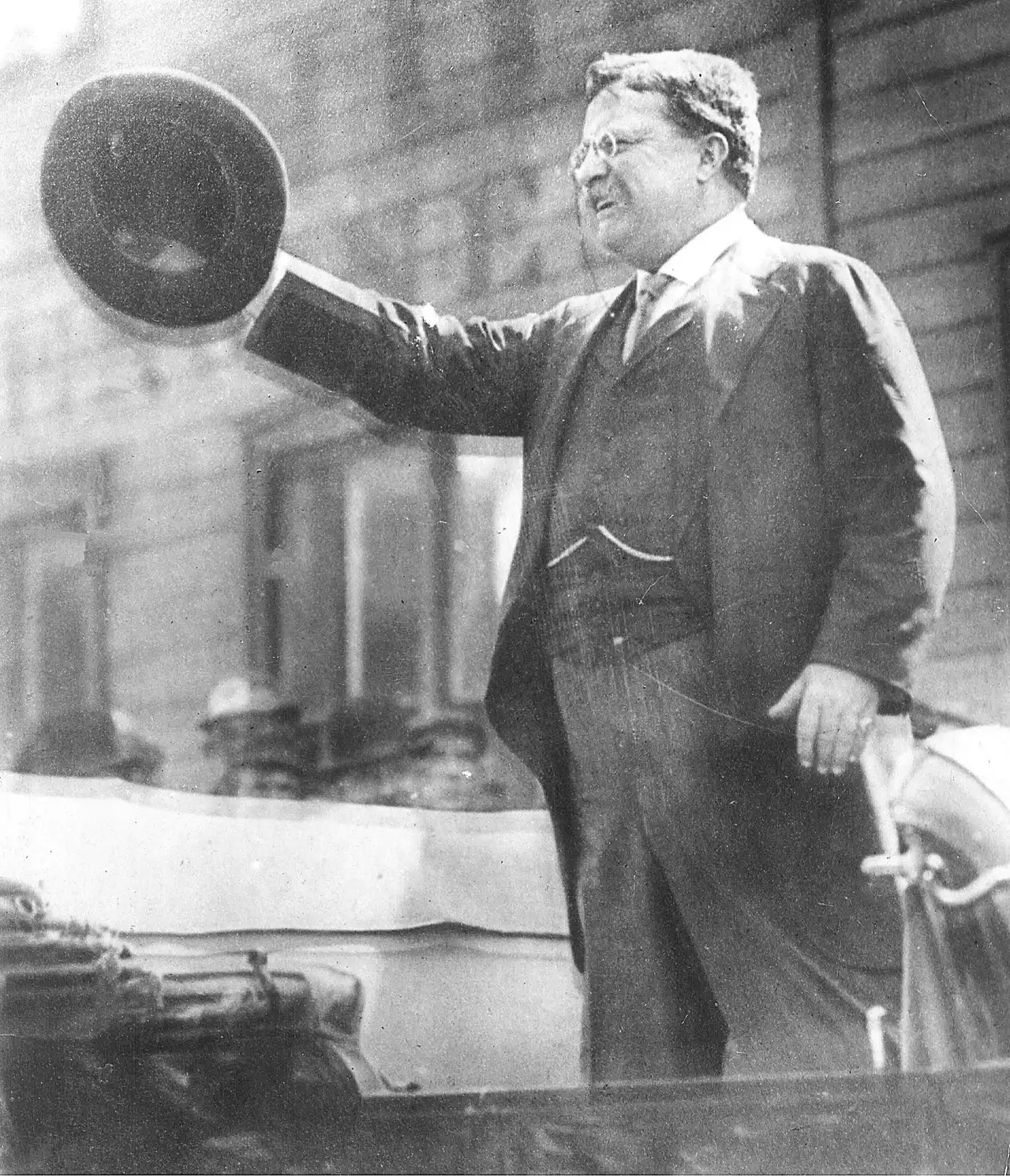
Theodore Roosevelt was running late, and he was running for president. It was the evening of October 14, 1912, and the former president — campaigning for the White House again as the candidate of his new Progressive Party — had just finished dinner at Milwaukee's Gilpatrick Hotel. He climbed into an open car, stood to wave his hat at the crowd, and a man stepped forward with a revolver. The photograph above shows Roosevelt speaking from that car, shortly before the shooting.
John Schrank, a New York saloonkeeper, fired a single shot from a few feet away. The .38-caliber bullet struck Roosevelt square in the chest — and then, astonishingly, did not kill him. In the breast pocket of Roosevelt's coat sat two unlikely pieces of armor: the folded, fifty-page text of the speech he was about to deliver, and a steel eyeglass case. The bullet tore through both before entering his body, its force spent just enough to spare his lung and heart.
What happened next became legend. Bleeding, with a bullet in his chest, Roosevelt insisted on going to the Milwaukee Auditorium anyway. His aides begged him to go to a hospital. He refused. He had a speech to give, and a packed house was waiting.
He walked onto the stage, unbuttoned his vest, and showed the crowd his bloodstained shirt. Then he began: "Friends, I shall ask you to be as quiet as possible. I don't know whether you fully understand that I have just been shot; but it takes more than that to kill a Bull Moose." "Bull Moose" was the nickname of Roosevelt's Progressive Party — born when Roosevelt declared himself as fit as a bull moose — and the line brought the house down. For the next hour and a half, Roosevelt delivered his entire speech, "Progressive Cause Greater Than Any Individual." Only when he finished did he allow himself to be taken to a hospital.
There, doctors made a remarkable decision: the bullet, lodged in his chest wall, was safer left where it was than dug out. Roosevelt would carry Schrank's bullet in his body for the rest of his life.
Schrank himself was declared insane — he told police the ghost of the assassinated President McKinley had commanded him to avenge his death — and spent the rest of his life in mental hospitals.
Roosevelt lost the election three weeks later to Woodrow Wilson. But the night in Milwaukee had already secured his place in history: the night an act of violence met a man who simply refused to be stopped by it. Shot in the chest, he spoke for ninety minutes. The bullet stayed. So did the legend.
Photo: Theodore Roosevelt speaking from an open car in Milwaukee on October 14, 1912, shortly before he was shot outside the Gilpatrick Hotel. Credit: Milwaukee Journal Sentinel, via Wikimedia Commons; public domain.