The Blast That Shook Wall Street — and Was Never Solved
On September 16, 1920, a wagon bomb exploded outside J.P. Morgan at 23 Wall Street, killing 38 people in the deadliest terrorist attack on American soil to that date — and no one was ever charged.
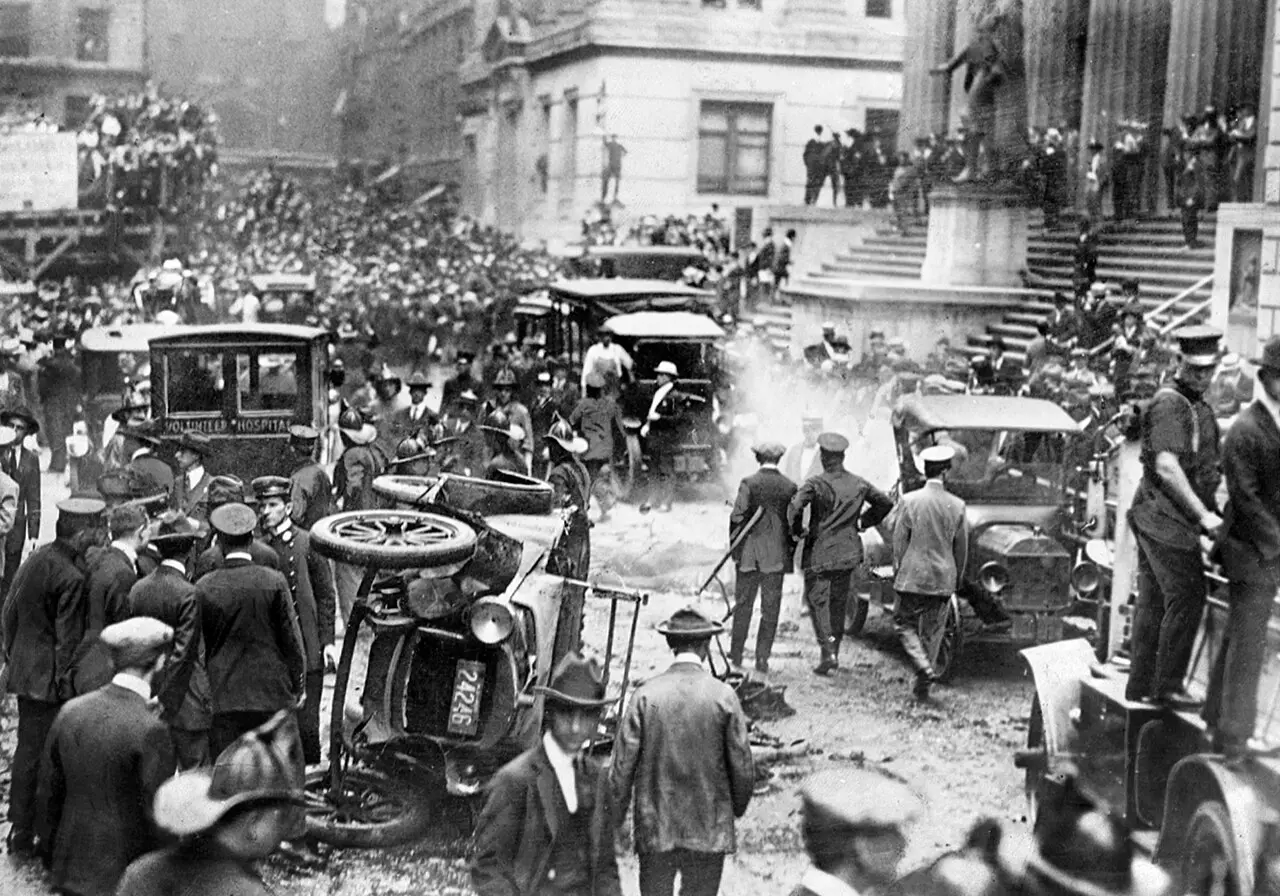
Noon was the busiest hour on Wall Street. On September 16, 1920, the lunch crowds were out — bankers, clerks, messengers, and newsboys filling the narrow street outside the headquarters of J.P. Morgan & Co. at 23 Wall Street, the most famous bank in America.
At 12:01 p.m., a horse-drawn wagon parked across the street exploded.
The wagon had been packed with about 100 pounds of dynamite laced with roughly 500 pounds of iron sash weights — the kind used to balance window sashes. The iron turned the blast into a storm of shrapnel. The explosion killed 30 people outright and wounded hundreds; eight more died later of their injuries, bringing the death toll to 38, with more than 140 seriously hurt. Windows shattered for blocks. The blast was so powerful that the president of the New York Stock Exchange, William H. Remick, suspended trading within a minute.
Among the chaos were some famous names. A young Joseph P. Kennedy — later the ambassador to Britain and father of a president — was knocked off his feet by the blast. J.P. Morgan Jr. himself was in Scotland at the time, but his son Junius was cut by flying glass, and the bank's chief clerk, Thomas Joyce, was killed.
Who did it? More than a century later, nobody knows for certain. Suspicion fell on followers of the Italian anarchist Luigi Galleani — the so-called Galleanists — who had been bombing targets across America, and investigators found anarchist flyers in a mailbox near the scene. But the trail went cold. No one was ever arrested, let alone convicted.
The bombing left a permanent scar you can still see today: the pockmarks in the limestone facade of 23 Wall Street were never repaired, and J.P. Morgan's successor bank left them as a quiet memorial.
At the time, it was the deadliest act of terrorism on American soil — a grim record it held until the Oklahoma City bombing in 1995. It shocked a nation already on edge after the First World War and the Red Scare, and it forced American law enforcement to confront a new kind of threat: anonymous, mass-casualty violence in the heart of a city.
The Wall Street bombing matters because it was a rehearsal for the century to come. A century later, the questions it raised — who plants a bomb in a crowd, why, and how a free society responds — are still the questions we ask after every attack. The wagon is gone. The crater is gone. But the pockmarks in the stone, and the mystery of who put them there, remain.
Photo: aftermath of the Wall Street bombing, September 16, 1920, photographer unknown, public domain, via Wikimedia Commons.