The Little Ship That Sailed Away From Everything They Knew
On September 16, 1620, the Mayflower finally sailed from Plymouth, England, carrying 102 passengers toward a wilderness none of them would have chosen — and toward the founding of New England.
They had already sailed twice.
The first time, in early August of 1620, the Mayflower and her companion ship, the Speedwell, set out together from Southampton. The Speedwell was supposed to carry some of the same travelers, a group of religious separatists who had fled England for Holland years earlier and now dreamed of starting over in America. But the Speedwell leaked — twice — and by the time both ships limped back into Plymouth, the company had run out of patience, money, and summer. The Speedwell was abandoned. Its passengers crammed aboard the Mayflower.
So on September 16, 1620, a single ship set sail from Plymouth, England, packed with 102 passengers and about 30 crew, under a captain named Christopher Jones. (England still used the Julian calendar then, so the sailors themselves would have called it September 6 — but by the calendar we use today, it was September 16.) They were bound for Virginia. They would never get there.
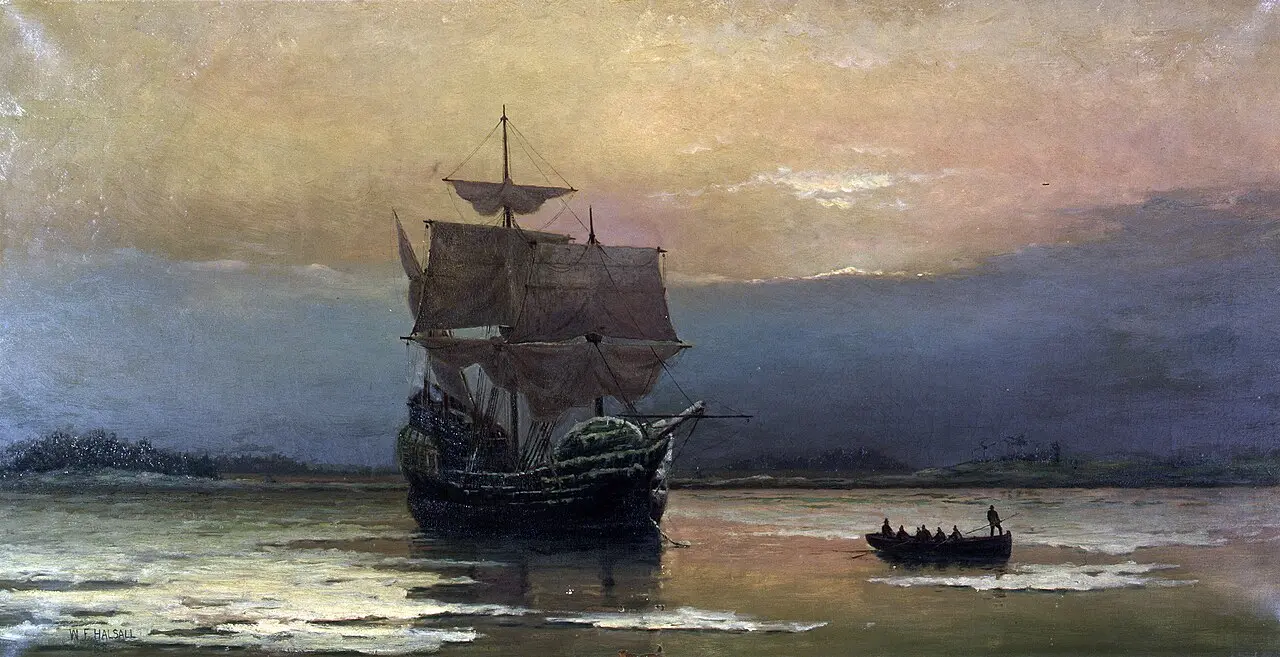
Picture the scene below decks: a gun deck about 100 feet long and barely five and a half feet of headroom, jammed with families, furniture, provisions, and animals. There was no privacy and little fresh air. Storms battered the ship for weeks. At one point, a main beam cracked and had to be shored up with a great iron screw the settlers had brought for building houses. In the middle of the voyage, a young servant named John Howland was swept overboard in a storm — and, by sheer luck and a rope, hauled back aboard. He lived to marry, raise ten children, and fill New England with descendants.
After more than two months at sea, the exhausted voyagers sighted Cape Cod on November 19. They tried to sail south toward Virginia, but shoals and breakers turned them back. So they anchored off what is now Provincetown, far north of where they were supposed to be. Before anyone set foot on shore, 41 of the men signed a remarkable agreement — the Mayflower Compact — promising to form a government and obey its laws. It was one of the first documents of self-rule in the New World.
The first winter was brutal. Half the company died of cold, hunger, and disease. The survivors only made it because of help from the Wampanoag people, especially a Patuxet man named Tisquantum — known to history as Squanto — who taught them to plant corn and showed them where to fish.
Four centuries later, the Mayflower's voyage still matters, not because the crossing was smooth — it wasn't — but because it worked. A leaky second ship, a cracked beam, a blown-off course, and a compact signed in desperation: out of that mess came Plymouth Colony, and out of Plymouth Colony came a whole region of America. The ship that finally sailed on September 16 was not the voyage anyone planned. It was the one that counted.
Photo: "Mayflower in Plymouth Harbor" by William Halsall (1882), Pilgrim Hall Museum collection, public domain, via Wikimedia Commons.