The Airship Race Around the Eiffel Tower
On October 19, 1901, Alberto Santos-Dumont flew his airship from Saint-Cloud around the Eiffel Tower and back in 29 minutes 30 seconds, winning a 100,000-franc prize after his engine quit mid-flight.
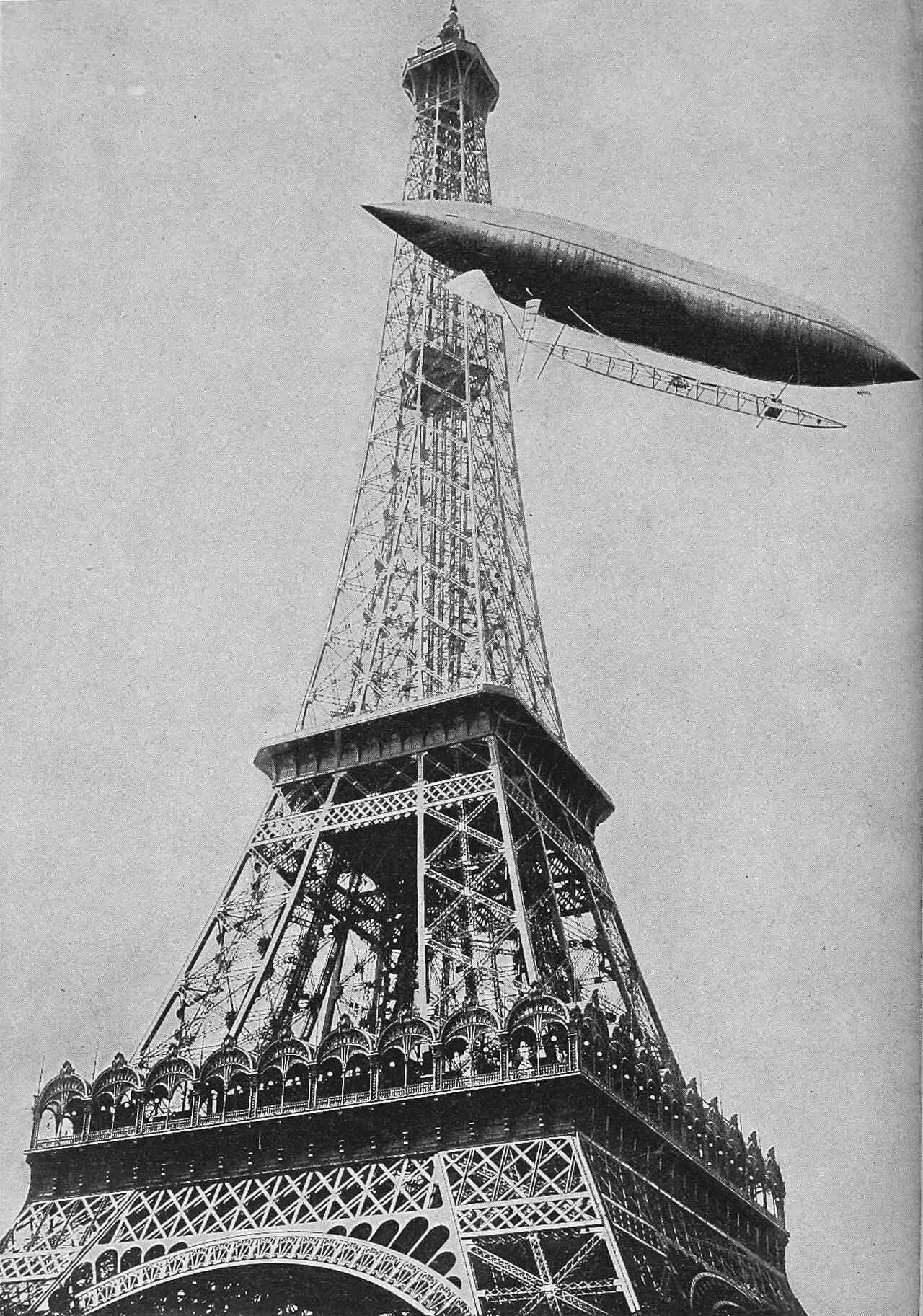
At twenty minutes to three on the afternoon of October 19, 1901, a slim young Brazilian stepped into the basket of his airship on the grounds of the Aéro-Club at Saint-Cloud, west of Paris, and gave the order to let go. Below him, thousands of spectators held their breath. His target was the Eiffel Tower, miles away across the city — and a prize of 100,000 francs that had already made him famous and nearly killed him.
The prize had been offered by Henri Deutsch de la Meurthe, an oil magnate and patron of aviation, to the first person to fly a powered airship from Saint-Cloud to the Eiffel Tower, circle it, and return — all within thirty minutes. Alberto Santos-Dumont, heir to a Brazilian coffee fortune, had spent three years building a series of small, gasoline-powered dirigibles in Paris, crashing and rebuilding them with a showman's flair. His No. 6 was a hydrogen-filled envelope with a little engine and propeller slung beneath it: fragile, loud, and barely steerable.
He lifted off at 2:42 p.m. and pointed the nose of the No. 6 toward the tower. The outward leg went smoothly — the little craft rounded the Eiffel Tower as crowds cheered. But on the way home, the engine began to fail. In his own account of his flights, Santos-Dumont described the moment: he had to abandon the steering wheel, at the risk of drifting off course, to work the lever controlling the engine's electric spark. The motor caught. A second's hesitation, he wrote, might have cost him his life.
He crossed back over the starting field in 29 minutes and 30 seconds — with less than a minute to spare. The crowd erupted. His biographer Paul Hoffman records that Santos-Dumont called down to the judges: had he won the prize? The answer was not immediate. The timing committee at first refused to award the 100,000 francs, disputing whether he had beaten the thirty-minute limit. Paris was outraged — the newspapers took up his cause — and the committee relented. The prize was his.
What he did with it sealed his legend. Santos-Dumont gave half the fortune to his mechanics and technicians, the men who had kept the fragile machines flying, and the other half to the poor of Paris. In a single gesture, the wealthy young Brazilian became the city's darling — proof, to Parisians, that the future belonged to the bold.
The flight was the first great public proof that powered, steerable flight was practical — not a laboratory curiosity but a machine that could go somewhere and come back. It electrified Europe, drew thousands into aviation, and made Santos-Dumont one of the most famous people in the world. Within five years he would turn to heavier-than-air machines and fly his 14-bis before crowds in Paris. The age of the airship — and soon the airplane — had announced itself over the Eiffel Tower.
Photo note: the airship circling the Eiffel Tower in this 1901 photograph is Santos-Dumont's earlier No. 5, photographed that July attempting the same maneuver; the prize-winning No. 6 flight of October 19 is not the one pictured. Photograph: Internet Archive Book Images, no known restrictions, via Wikimedia Commons.