Paris Goes Underground
On July 19, 1900, at 1 p.m., the first Paris Métro line opened to the public, running between Porte Maillot and Porte de Vincennes.
At one o'clock in the afternoon on July 19, 1900, Paris did something it had never done before: it went underground. The first trains of the Paris Métro rolled out of their stations and carried passengers beneath the boulevards, from Porte Maillot in the west to Porte de Vincennes in the east. The city had spent years arguing about whether to build it at all. Now, in the middle of the great Universal Exhibition, the Métro was suddenly, quietly real.
The opening was deliberately low-key. The operating company, the Compagnie du chemin de fer métropolitain de Paris, wanted ridership to grow gradually, so there was no grand ceremony. Only eight of the line's eighteen stations were even finished; the rest opened over the following weeks. But the timing was no accident: the line was built to connect the scattered sites of the 1900 World's Fair and to serve the Olympic Games events being held in the Bois de Vincennes.
Getting there had been a fight. For years, the French state and the city of Paris battled over who would control an underground railway, with the state wary of a local system it couldn't commandeer. The dispute was finally settled in 1895, and in 1896 the city adopted the plan of engineer Fulgence Bienvenüe: a unified network, built for Paris alone. Construction began in November 1898, using the cut-and-cover method — dig up the street, build the tunnel, pave it back over. Bienvenüe's crews worked so fast that most of the planned lines were finished within two decades.
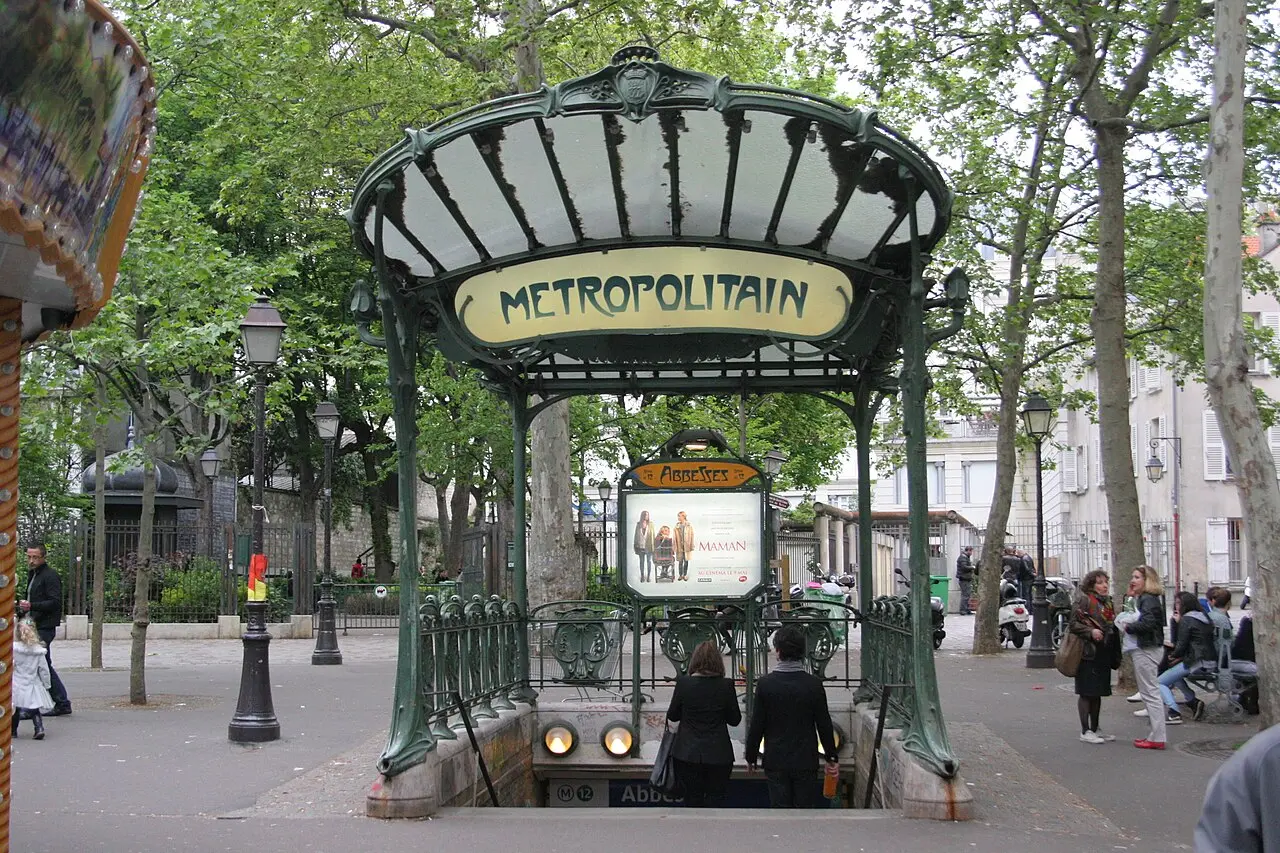
What riders noticed first wasn't the engineering — it was the entrances. The architect Hector Guimard designed the station canopies in flowing Art Nouveau ironwork, all curling vines and glass, with the word "Métropolitain" glowing above the stairs. Eighty-six of his entrances still stand, and they became as much a symbol of Paris as the Eiffel Tower.
Line 1 was just the beginning. The network grew into one of the densest subway systems on Earth, and today Line 1 alone carries around 750,000 passengers a day, making it the busiest line in the system.
The Métro changed what a city could be. Before it, Paris was a city you walked or rode through at street level, choked with horse-drawn traffic. After it, the city belonged to everyone who could afford a ticket — workers could live farther from their jobs, neighborhoods mixed, and the whole metropolis started moving at a new speed. And Guimard's entrances proved that infrastructure could be art.
Image: A Guimard-designed Art Nouveau Métro entrance at Abbesses, Paris — one of the surviving early designs. Photo by Alexander Baranov, licensed CC BY 2.0 via Wikimedia Commons.