"Mr. Gorbachev, Tear Down This Wall!"
On June 12, 1987, Ronald Reagan stood before the Berlin Wall and delivered the Cold War's most famous dare: "Mr. Gorbachev, tear down this wall!"
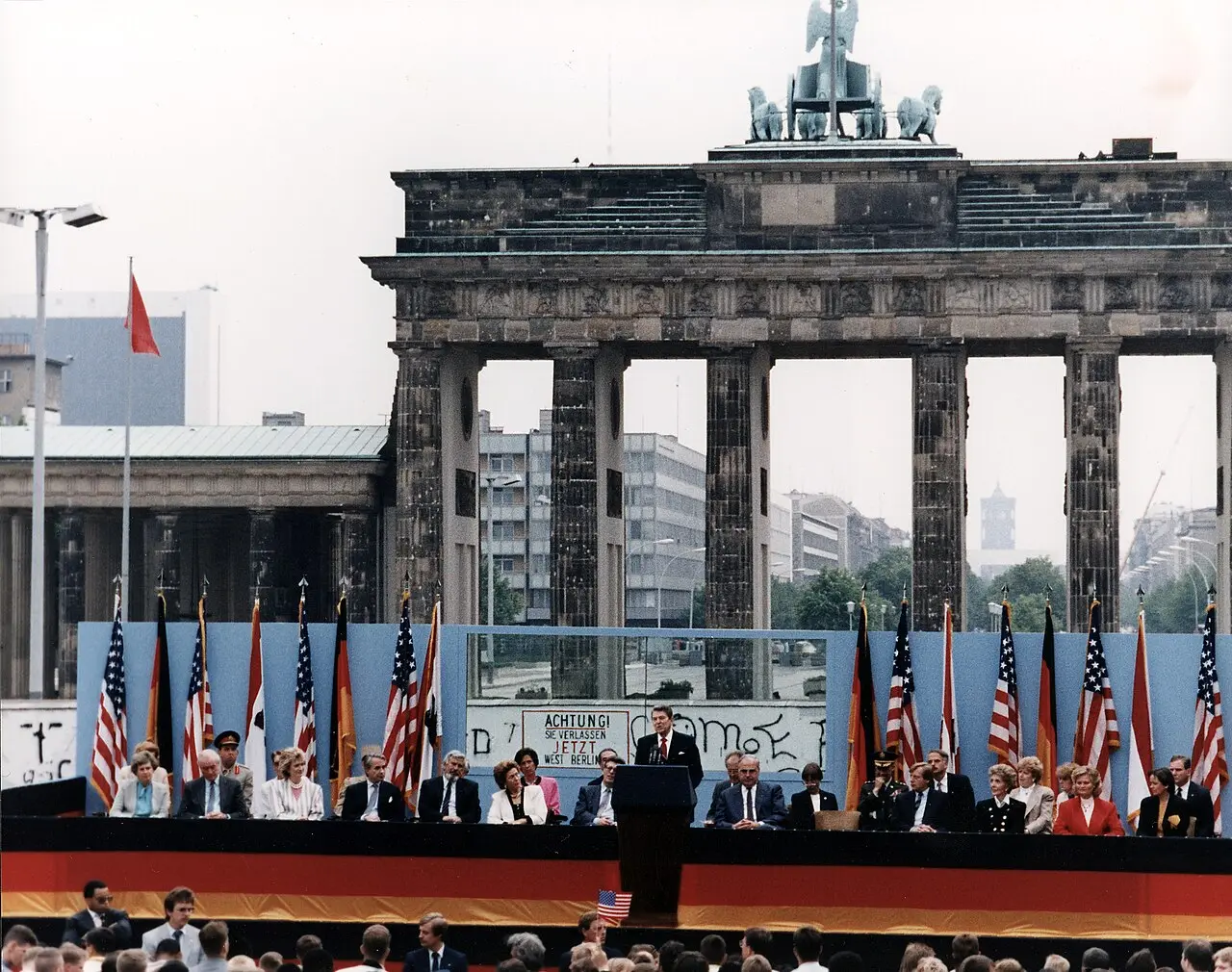
His own advisors told him to cut the line — it might embarrass the Soviet leader, they warned. On June 12, 1987, standing before the Berlin Wall, Ronald Reagan said it anyway.
Reagan hadn't planned to visit Berlin at all. He was in Europe for an economic summit in Venice, and at the West German government's request his schedule was adjusted for a brief stop in the divided city, which was celebrating the 750th anniversary of its founding. The advance team expected a crowd of about 10,000; the president would speak about foreign policy at the Wall.
The speech was written by Peter Robinson, a young White House speechwriter who spent a day and a half in Berlin with the advance team, scouting the site and gathering material. The phrase that made history emerged from that research trip — and then had to survive a full round of objections: several senior staffers and aides argued that anything that might cause further East-West tensions, or embarrass Soviet leader Mikhail Gorbachev — with whom Reagan had built a good relationship — should be cut. Reagan kept the line.
On a June afternoon, an estimated 20,000 people gathered near the Brandenburg Gate, including West German Chancellor Helmut Kohl. Reagan stood about a hundred yards from the concrete barrier that had encircled West Berlin since 1961 and addressed Gorbachev directly: "General Secretary Gorbachev, if you seek peace, if you seek prosperity for the Soviet Union and Eastern Europe, if you seek liberalization: Come here to this gate! Mr. Gorbachev, open this gate! Mr. Gorbachev, tear down this wall!"
The next day, The New York Times put Reagan's picture on its front page under the headline "Reagan Calls on Gorbachev to Tear Down the Berlin Wall." Two and a half years later, in November 1989, crowds of East and West Berliners did exactly what he had demanded — climbing the Wall, then tearing it down.
Why it matters: few presidential sentences have outlived their moment so completely. The speech became the signature statement of the Cold War's endgame — proof that carefully chosen words, delivered in the right place, can concentrate a whole era's hopes into a single demand. It is often ranked alongside John F. Kennedy's 1963 "Ich bin ein Berliner" address as one of the most memorable American presidential performances in Berlin. The U.S. Congress later proposed placing an artistic tribute to the speech inside the Capitol, calling the lines immortal.
Photo: Reagan White House Photographs, public domain (via Wikimedia Commons).