Hailing Frequencies Open: Mae Jemison Goes to Space
On September 12, 1992, the space shuttle Endeavour carried Mae Jemison into orbit, making her the first African-American woman in space.
As the space shuttle cleared the launch tower, a voice crackled over the radio: "Hailing frequencies open." It was a line from Star Trek — and the astronaut who said it, Mae Jemison, meant every word.
On September 12, 1992, the shuttle Endeavour lifted off from Florida's Kennedy Space Center carrying the seven-member crew of mission STS-47. Among them was Jemison, a physician serving as a mission specialist — and the first African-American woman ever to fly in space.
The flight was Spacelab-J, a joint American-Japanese science mission. For eight days — 190 hours, 30 minutes, and 23 seconds, to be exact — the crew worked around the clock in the pressurized Spacelab module riding in Endeavour's cargo bay, running experiments on everything from materials science to how the human body adapts to weightlessness. NASA called the launch picture-perfect: a smooth countdown and a clean climb into the Florida sky. Eight days later, Endeavour glided home to a landing at the Kennedy Space Center.
Jemison brought two small symbols of her journey with her: a photograph of Bessie Coleman, the pioneering Black pilot of the 1920s who had learned to fly in France after American flight schools turned her away, and a Bundu statue from West Africa — reminders of the heritage she carried into orbit. She had grown up glued to the Apollo missions and to Star Trek; years later, she would appear on "Star Trek: The Next Generation" herself, the first real astronaut ever to do so.
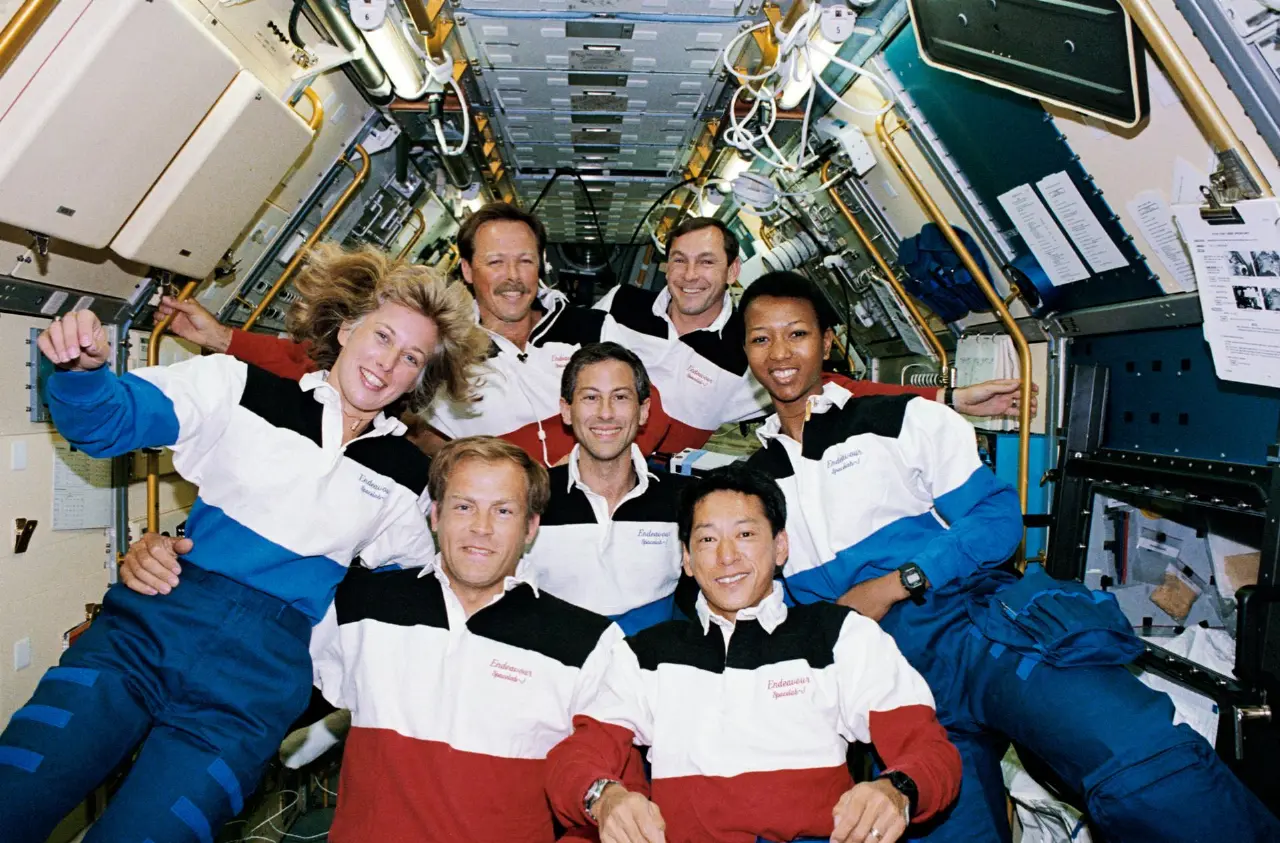
The crew's in-flight portrait shows all seven of them floating together in the Spacelab module — scientists at work in the most remote laboratory ever built, with Jemison among them, calm and intent. It remains one of the defining images of the shuttle era: not a lone hero, but a team, and a team that looked like the future.
Her flight mattered far beyond its experiments. For every girl who watched that September launch and saw someone who looked like her riding a pillar of fire into orbit, the universe got a little bigger. Barriers in spaceflight had fallen before, but each one that falls makes the next one easier to imagine — and Jemison, hailing frequencies open, was inviting everyone along. Back on Earth, her flight made her an inspiration far beyond NASA: proof, beamed into living rooms, that the astronaut corps belonged to everyone. She would go on championing science education for the rest of her career.
Photo: NASA, public domain.