Enos the Chimpanzee Orbited Earth Before John Glenn Did
On November 29, 1961, a five-year-old chimpanzee named Enos rode NASA's Mercury-Atlas 5 into orbit — and when a faulty lever shocked him dozens of times, he kept working anyway.
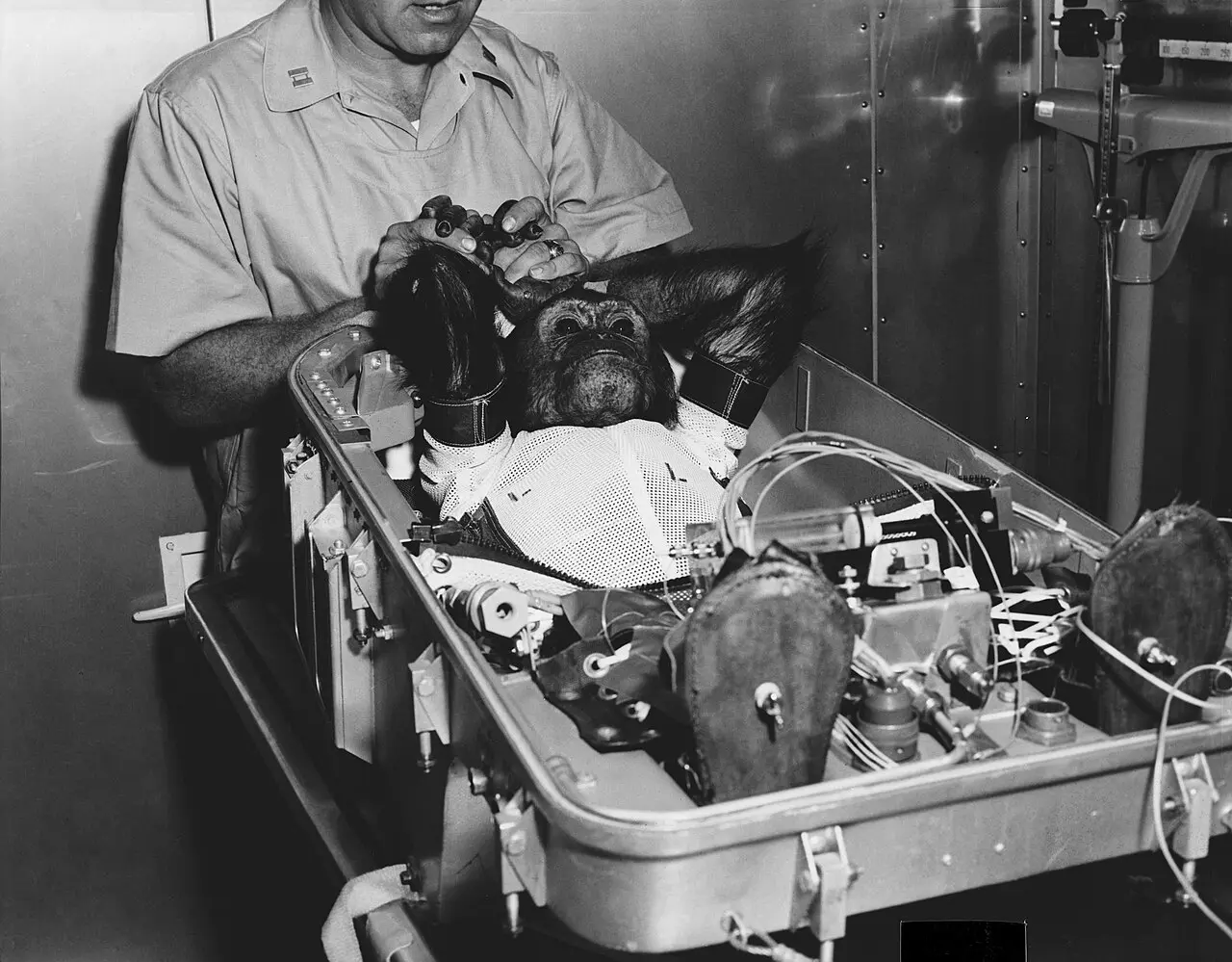
Before NASA would risk an astronaut on an orbital flight, it wanted a living test pilot. On November 29, 1961, that test pilot was a five-year-old chimpanzee named Enos, strapped into a Mercury capsule atop an Atlas rocket at Cape Canaveral for the Mercury-Atlas 5 mission.
Enos had earned the seat. Taken from the Miami Rare Bird Farm in 1960, he had logged more than 1,250 hours of training — psychomotor drills, weightlessness flights, centrifuge runs — at the University of Kentucky and Holloman Air Force Base, more intense preparation than his predecessor Ham had received. He was chosen for the flight only three days before launch. His name comes from the Hebrew word for "man."
The flight was supposed to last three orbits. Almost immediately, things went wrong: the capsule overheated, and a malfunctioning control lever delivered dozens of electric shocks — even when Enos pulled the correct lever. Yet he kept at his trained tasks, orbit after orbit, working exactly as taught despite the punishment. Shortly after liftoff, President John F. Kennedy drew laughs in the Senate by announcing that the just-launched Enos "reports that everything is perfect and working well." Flight controllers, worried about the overheating and the attitude-control system, cut the mission short after two orbits.
Enos splashed down in the Atlantic about 200 miles south of Bermuda after a flight of just over three hours — 3 hours and 21 minutes, covering about 81,000 kilometers across two full orbits. The destroyer USS Stormes recovered him about 75 minutes later; he was in good condition, if thoroughly annoyed at the long wait inside the capsule. NASA's Project Mercury chronology records that the flight qualified the Mercury capsule for John Glenn's orbital mission.
He had become the first chimpanzee — and only the third hominid, after Yuri Gagarin and Gherman Titov — to orbit the Earth, and to this day he remains the only chimpanzee ever to do so. His predecessor Ham had made a suborbital hop that January and become a celebrity; Enos, who actually went around the planet, was largely forgotten. But his mission qualified the Mercury capsule for human flight, and less than three months later, John Glenn rode the same kind of Atlas into orbit. Enos died of dysentery in November 1962, unrelated to his spaceflight; his capsule is displayed at the Museum of Life and Science in Durham, North Carolina.
Photo: NASA, public domain (via Wikimedia Commons).