Thirty-Three to Thirteen: The Vote That Drew Two States on One Map
On November 29, 1947, the United Nations General Assembly adopted Resolution 181 by a vote of 33 to 13, recommending that Palestine be divided into separate Jewish and Arab states.
Late on November 29, 1947, in the General Assembly hall at Flushing Meadows, New York, the president of the United Nations General Assembly called the roll on one of the most consequential questions the young organization had ever faced: what to do with Palestine. The result: 33 in favor, 13 against, with 10 abstentions and one absence — more than the two-thirds majority required. Resolution 181, the Partition Plan, was adopted.
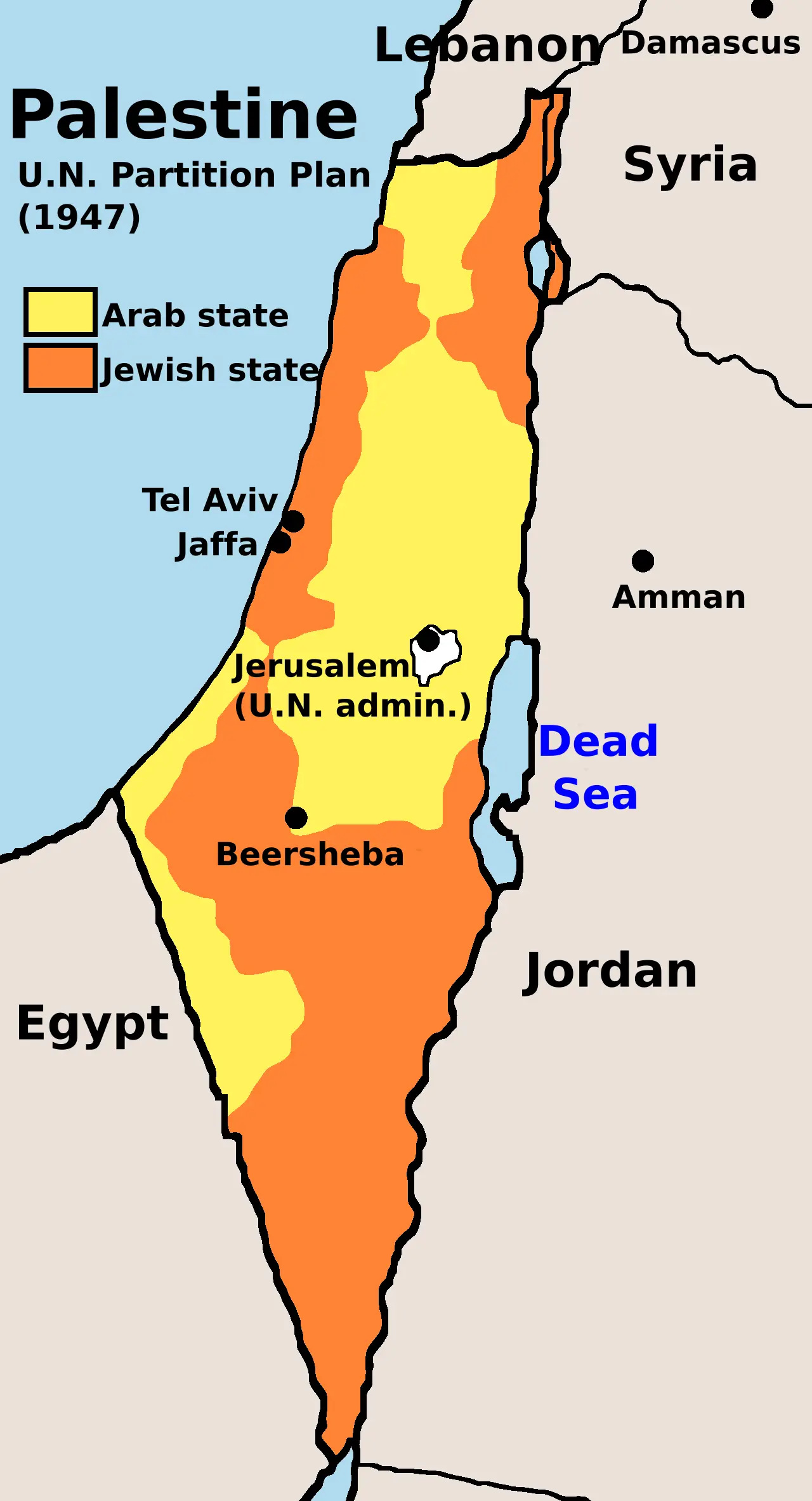
The plan recommended dividing the British-ruled Mandate of Palestine into two states — one Jewish, one Arab — linked by an economic union, with Jerusalem placed under international administration as a corpus separatum, a separate body. The proposed Jewish state would cover roughly 56 percent of the territory, the Arab state about 43 percent, with Jerusalem and its surroundings internationalized. A five-member commission was appointed to carry the plan out.
The vote itself was a small Cold War miracle: the United States and the Soviet Union voted the same way, both in favor — one of the rare moments of superpower agreement in the early Cold War. Britain, the mandatory power handing the problem over, abstained, as did China, Mexico, and seven others. The 13 votes against came mostly from the Arab and Muslim states, joined by Cuba, Greece, and Turkey.
The road to the vote had run through London's exhaustion. After years of communal violence, Britain handed the question of Palestine's future to the UN in February 1947. An eleven-nation investigating committee, UNSCOP, toured the territory and recommended partition by majority vote, while a minority report favored a single federal state shared by both peoples.
Reaction split the world. Jewish leaders accepted the compromise, and crowds danced in the streets of Tel Aviv at the news; Arab leaders and the Arab states rejected it outright. The Assembly's resolution was a recommendation, not an enforceable order — and events on the ground quickly outran it. The implementation commission proved powerless, and within months fighting engulfed the territory. Britain withdrew in May 1948, and the conflict that followed redrew the map the UN had drawn — the Gaza Strip falling under Egyptian control, the West Bank and East Jerusalem under Jordanian control, and no Palestinian state established.
Nearly eighty years on, the vote remains one of the UN's most fateful decisions — a single evening's roll call, 33 to 13, that still echoes in the Middle East today.
Map: Herr Ziffer, public domain (via Wikimedia Commons).