December 8, 1987: Reagan and Gorbachev Sign the INF Treaty
On December 8, 1987, the U.S. and Soviet leaders signed a treaty eliminating an entire class of nuclear weapons.
"Doveryai, no proveryai," the American president said. "Trust, but verify."
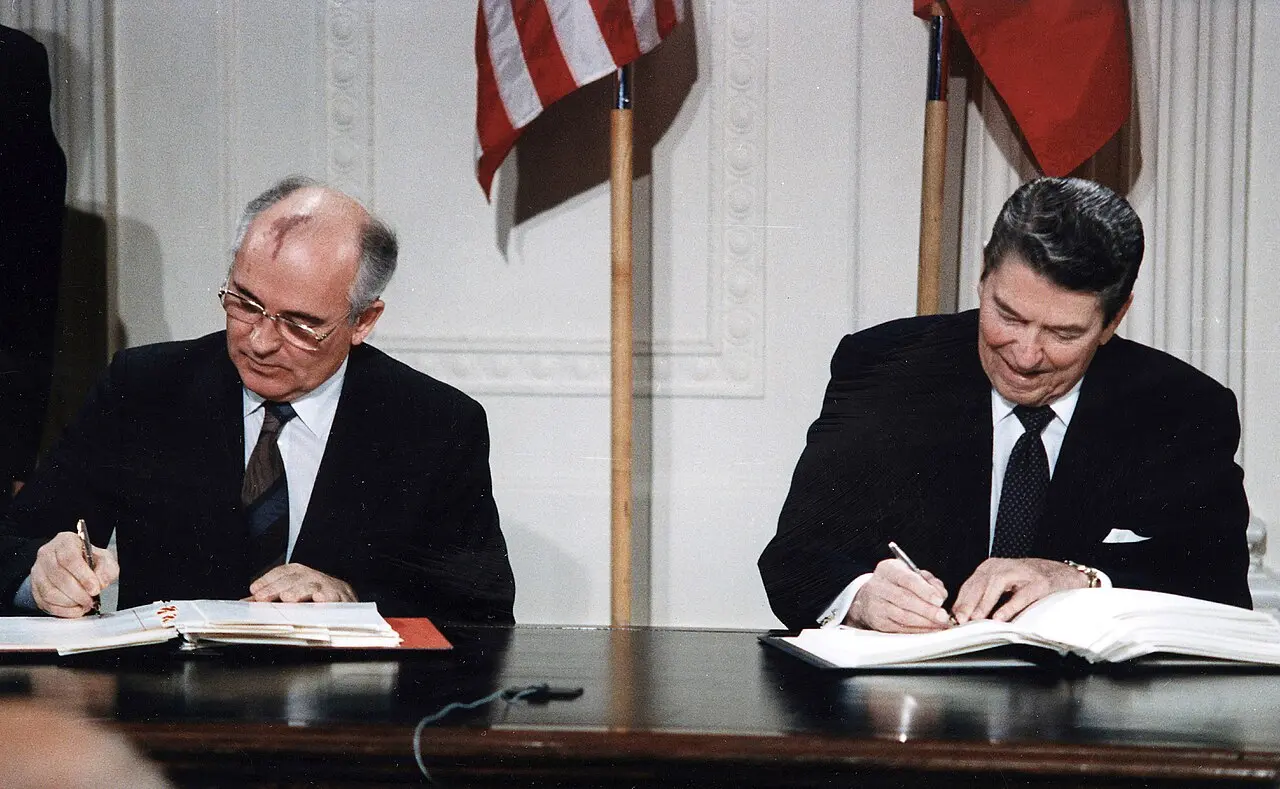
On December 8, 1987, at 1:45 in the afternoon, President Ronald Reagan and Soviet leader Mikhail Gorbachev sat down in the East Room of the White House and signed the Intermediate-Range Nuclear Forces Treaty -- the agreement that eliminated an entire class of nuclear weapons.
The road to that table ran through some of the Cold War's darkest years. Soviet SS-20 missiles aimed at Western Europe, answered by American Pershing II and cruise missiles, had put the continent minutes from catastrophe. Then came Reykjavik in 1986, where Reagan and Gorbachev stunned the world by nearly agreeing to abolish nuclear weapons outright. The talks that followed narrowed to the missiles of Europe -- and produced the INF Treaty.
Reagan had first proposed the "zero option" -- no intermediate missiles on either side -- years earlier, when few took the idea seriously. Gorbachev revived it at Reykjavik in 1986, and by the summer of 1987, after NATO's foreign ministers endorsed the plan, the last obstacles fell away. At the December summit in Washington, the two leaders spent days debating regional conflicts, human rights, and arms control before sitting down in the East Room with the treaty folders in front of them.
It was unlike any arms agreement before it. Earlier treaties had capped how many weapons each side could build. The INF Treaty banned a whole category -- all ground-launched ballistic and cruise missiles with ranges between 500 and 5,500 kilometers -- and ordered the ones already built to be destroyed. In the end, 2,692 missiles were scrapped: 1,846 Soviet and 846 American. And for the first time, the treaty demanded proof: teams of inspectors from each side would visit the other's bases and watch the missiles being cut apart.
At the signing, Reagan offered an old Russian maxim he had made his own: "We have listened to the wisdom of an old Russian maxim, doveryai, no proveryai -- trust, but verify." Gorbachev smiled: "You repeat that at every meeting." Reagan grinned back: "I like it."
The treaty took effect on June 1, 1988, and for three decades it kept intermediate-range missiles out of Europe. In 2019 the United States withdrew, accusing Russia of building a banned missile -- a reminder that arms control, like the weapons it restrains, needs constant tending. But on that December afternoon in the East Room, two rivals proved that even the most dangerous machines humans build can be unbuilt -- if both sides are willing to watch each other do it.
Photo: White House Photographic Office, public domain (via Wikimedia Commons).