December 8, 1953: Eisenhower's 'Atoms for Peace' Speech
On December 8, 1953, President Eisenhower proposed turning nuclear weapons material toward peaceful uses in a landmark UN speech.
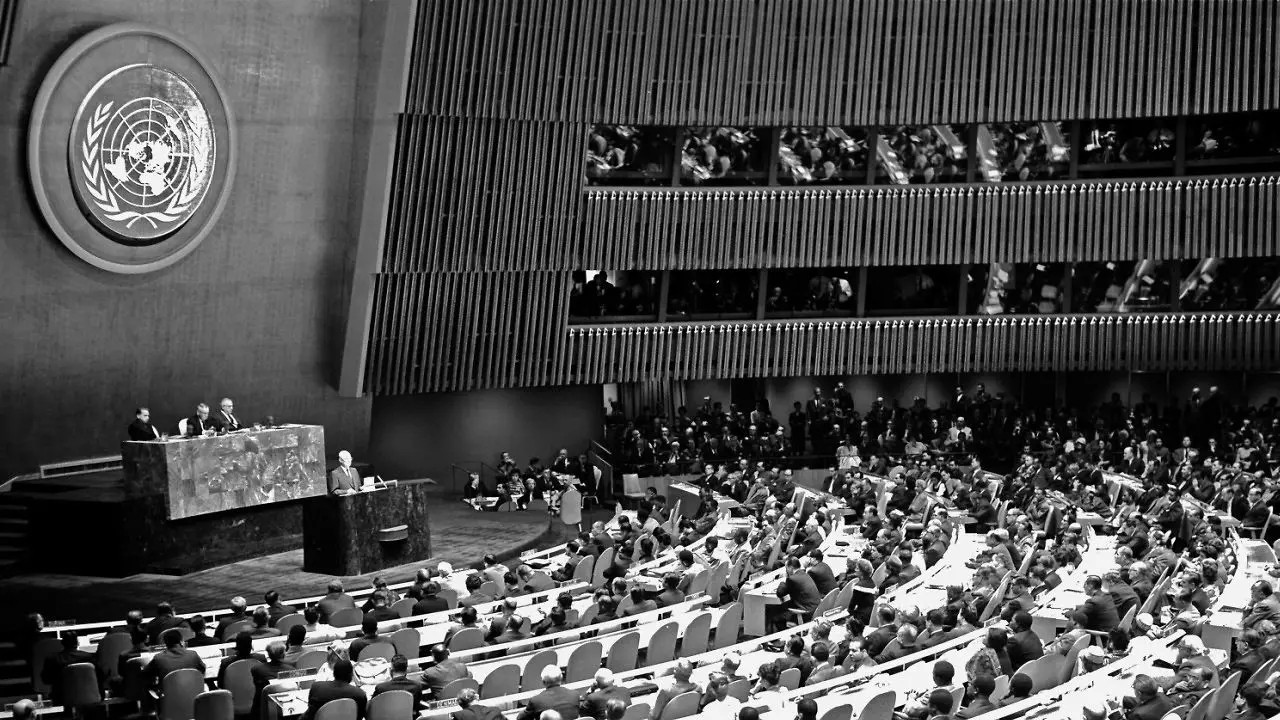
The general who had commanded the largest invasion in history came to the United Nations to talk about the language of atomic warfare.
On December 8, 1953, President Dwight D. Eisenhower stood before the United Nations General Assembly in New York and delivered one of the defining speeches of the nuclear age. "I feel impelled to speak today in a language that in a sense is new," he began -- "one which I, who have spent so much of my life in the military profession, would have preferred never to use. That new language is the language of atomic warfare."
The moment was heavy with context. The Soviet Union was developing its own atomic and thermonuclear weapons, ending America's nuclear monopoly. Joseph Stalin had died that March; the Korean War had ended in an armistice that July. Eisenhower had flown to New York straight from a summit in Bermuda with the leaders of Britain and France. The world was learning to live under a new and terrible arithmetic: for the first time, civilization itself could be destroyed in an afternoon.
Eisenhower's answer was a proposal as bold as it was unexpected. The United States, he said, would join with other nations possessing nuclear materials to contribute uranium and fissionable material to a new international atomic energy agency, operating under the United Nations. Instead of feeding weapons, the atom would be put to work -- in agriculture, in medicine, in scientific research, and in generating electricity, especially for countries starved of power.
He closed with the line the world would remember: America would "devote its entire heart and mind to find the way by which the miraculous inventiveness of man shall not be dedicated to his death, but consecrated to his life."
The speech changed the world's relationship with the atom. The agency Eisenhower proposed became the International Atomic Energy Agency, founded in 1957. The program opened nuclear research to universities, hospitals, and countries around the world -- the first nuclear reactors in Israel and Pakistan were built under it -- and laid the ideological groundwork for the treaty that would try to stop the spread of nuclear weapons. It also had a shadow: the same program that spread reactors spread know-how, even as the arsenals kept growing.
Atoms for Peace remains the clearest statement of the nuclear bargain -- that the most destructive force humans ever unleashed might also light their homes and heal their sick. More than seventy years later, the world is still trying to keep that promise.
Photo: U.S. Nuclear Regulatory Commission, public domain (via Wikimedia Commons).