Black Tuesday: The Day the Roaring Twenties Ended
On October 29, 1929, more than 16.4 million shares changed hands in a single panicked day, and the stock market collapse known as Black Tuesday lit the fuse of the Great Depression.
The ticker couldn't keep up. On October 29, 1929, so many sell orders flooded the New York Stock Exchange that the mechanical tickers — the machines that printed stock prices on long ribbons of paper — fell hours behind the actual trading. They were still clattering out prices at 7:45 that evening, long after the closing bell.
It was Black Tuesday, the worst day of the Wall Street crash of 1929. More than 16.4 million shares changed hands — a record that stood for decades. The Dow Jones Industrial Average fell nearly 12 percent in a single session, closing at 230.07. Across two days, the market had lost almost a quarter of its value, and some $14 billion in paper wealth — an almost unimaginable sum in 1929 — had simply vanished. For some stocks, there were no buyers at any price.
The panic had been building for a week. On Thursday, October 24 — Black Thursday — a record 12.9 million shares traded before a group of bankers, led by Richard Whitney of the Exchange, staged a dramatic intervention: Whitney strode onto the trading floor and placed a huge above-market bid for U.S. Steel, then did the same for other blue chips, in a deliberate echo of the tactic that had ended the Panic of 1907. It worked — for a day. By Monday the selling resumed, and by Tuesday no intervention could stop it. Financier William C. Durant and members of the Rockefeller family bought heavily to show confidence. The market fell anyway.
The crash didn't come from nowhere. The Roaring Twenties had been a fever of speculation: between 1921 and 1929, stock prices rose nearly fivefold, and ordinary Americans bought shares — often for the first time — with money borrowed from their brokers, sometimes covering two-thirds of the purchase price. When prices wobbled in September and early October, the margin calls began, forcing investors to sell into a falling market, which forced more selling.
Black Tuesday didn't single-handedly cause the Great Depression — historians stress that the crash was as much symptom as cause — but it lit the fuse. The market kept sliding for nearly three more years, bottoming in July 1932 at 41.22, an 89 percent collapse from the 1929 peak. Banks failed, businesses closed, and a quarter of American workers lost their jobs.
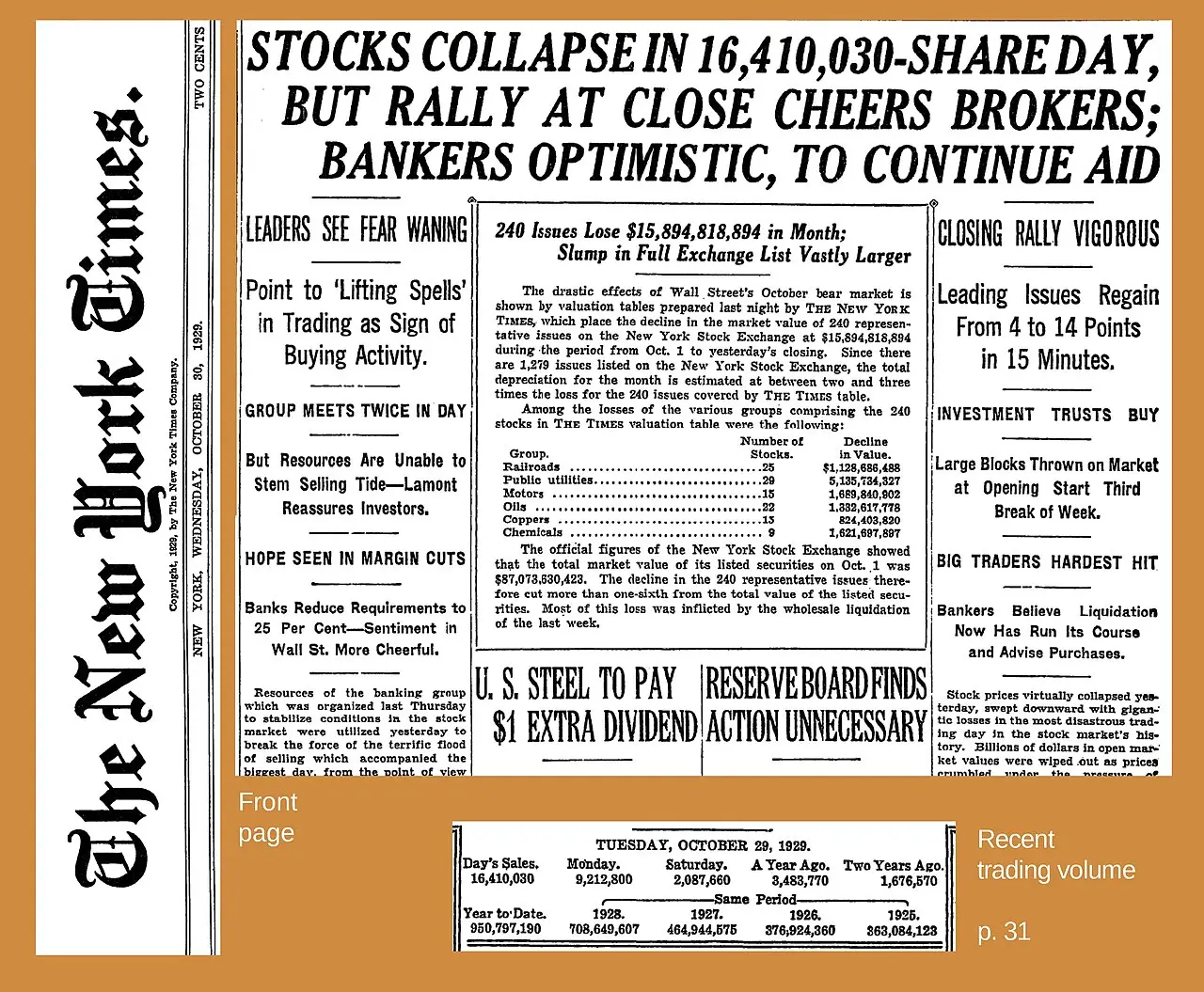
The next morning's New York Times tried to sound hopeful — its headline noted a closing rally that 'cheers brokers.' The cheer didn't last. But the wreckage eventually produced a new financial order: the crash discredited the unregulated speculation of the 1920s and led, within a few years, to federal oversight of the markets that still shapes Wall Street today.
Photo: The New York Times front page of October 30, 1929, reporting Black Tuesday's record 16,410,030-share collapse — public domain (via Wikimedia Commons).