
Twenty-Three Minutes Outside: America's First Spacewalk
On June 3, 1965, astronaut Ed White floated out of Gemini 4 and became the first American to walk in space — and called coming back 'the saddest moment of my life.'
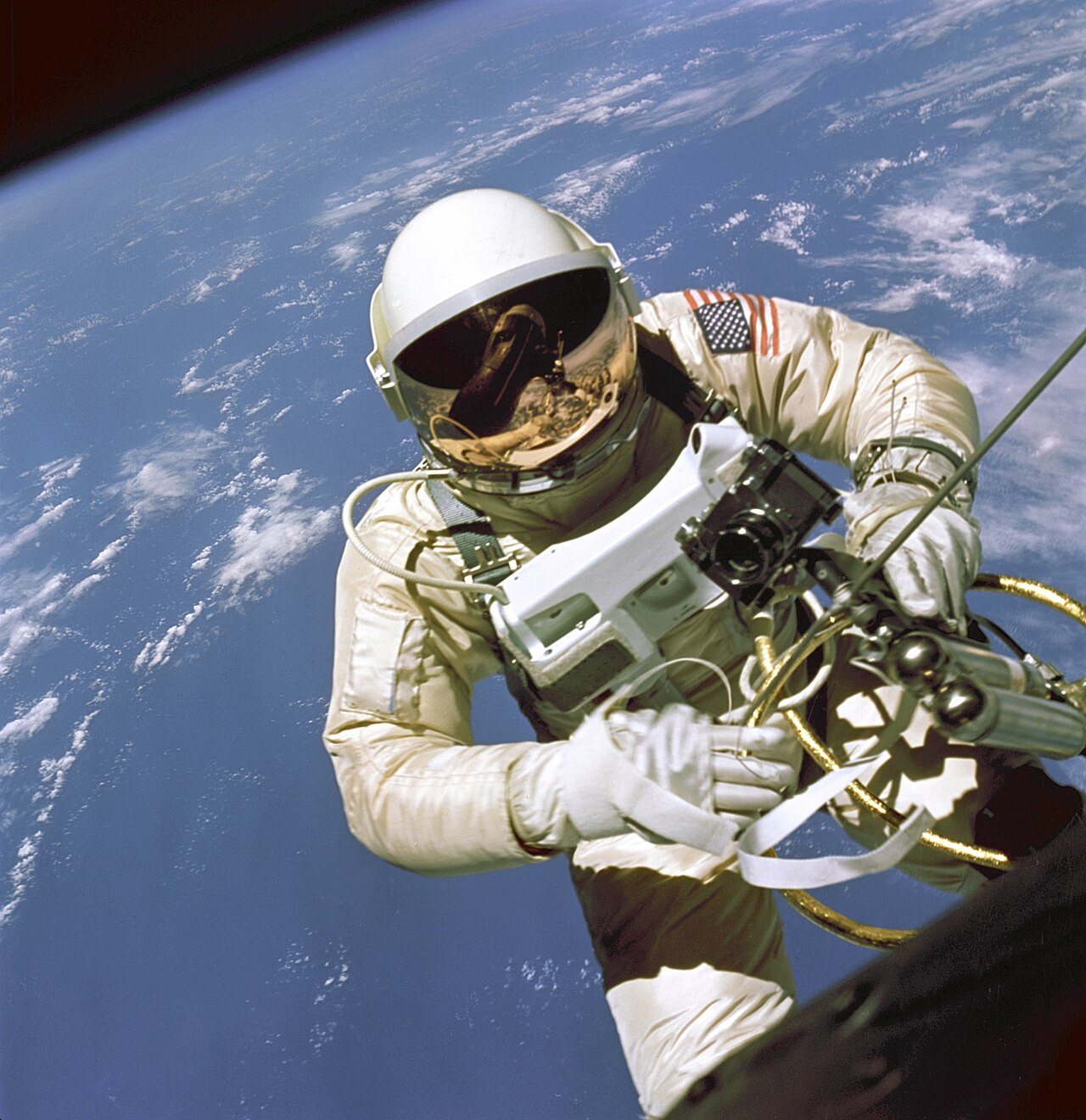
At 3:45 in the afternoon on June 3, 1965, a hatch opened more than a hundred miles above the Pacific Ocean, and a man stepped out into nothing.
Astronaut Ed White had ridden into orbit that morning aboard Gemini 4, launched from Cape Canaveral atop a Titan II rocket alongside commander Jim McDivitt. The flight was meant to prove America could keep astronauts in space for four days. But NASA had quietly added a daring extra: only about two months before launch, planners slipped a spacewalk into the mission.
White's job was to become the first American to float free in space — only the second human ever to do it, after Soviet cosmonaut Alexei Leonov a few months earlier. Getting out was the first battle: the hatch refused to unlatch until McDivitt wrestled its mechanism free. Then White pushed himself through, gripping a hand-held maneuvering gun — the astronauts called it the 'zip gun' — and drifted to the end of his tether and back.
What happened next was pure joy. 'I feel like a million dollars,' White radioed. 'This is the greatest experience. It's just tremendous.' The zip gun's gas ran out after about three minutes, so White improvised, twisting his body and pulling himself hand-over-hand along the 25-foot umbilical cord tying him to the capsule. McDivitt, still inside, photographed him against the curve of the Earth, the gold-plated visor of White's helmet gleaming in the unfiltered sun. They drifted from the Pacific near Hawaii all the way to the Gulf of Mexico: 23 minutes outside the spacecraft.
Mission Control finally ordered him back in, and White delivered one of the most famous lines of the space age: climbing back inside, he said, was 'the saddest moment of my life.'
The hatch fought them again on the way in — it would not seal properly, a failure that could have doomed them both on reentry. McDivitt got it latched, and Gemini 4 went on to circle the Earth 62 times over four days before splashing down in the Atlantic on June 7, where the aircraft carrier USS Wasp recovered the crew.
White never flew again. Less than two years later, on January 27, 1967, he died with Gus Grissom and Roger Chaffee in a flash fire during a ground test of the first Apollo spacecraft. He was 36.
Why it matters: White's 23 minutes proved that human beings could work outside a spacecraft — not just survive, but move, adapt, and even enjoy it. Every spacewalk since, from the repair of the Hubble telescope to the construction of the International Space Station, traces back to that hatch opening over the Pacific. For a few minutes on June 3, 1965, an American was simply a human being, floating free in the void — and he didn't want to come back.
Photo: Astronaut Ed White on his June 3, 1965 spacewalk, photographed by Jim McDivitt — NASA, public domain (via Wikimedia Commons).