There Is No Joy in Mudville: Baseball's Most Famous Poem
On June 3, 1888, the San Francisco Examiner printed Ernest Thayer's "Casey at the Bat," the most famous baseball poem ever written.
It is the most famous strikeout in history — and it never happened. On June 3, 1888, the San Francisco Examiner printed a 52-line poem about a baseball hero who failed at the moment of triumph, and America never forgot it. "Casey at the Bat" became, in the words of the late poet Donald Hall, the most popular poem in the country's history.
Its author was no professional poet. Ernest Lawrence Thayer was a 24-year-old Harvard graduate — he had studied philosophy under William James — and a college classmate of William Randolph Hearst, who had given him a humor column at the Examiner. Thayer dashed the poem off in a few hours and signed it with his college nickname, "Phin," as he did all his comic pieces. He never wrote anything else of note.
The poem is a small masterpiece of suspense. The Mudville Nine trail 4-2 in the final inning before 5,000 fans, and all hope rests on Casey, the mighty slugger due up fifth. The first two batters, Cooney and Barrows, fail. Then, miraculously, the weak-hitting Flynn singles and Blake doubles, and Casey strides to the plate with the winning run in scoring position. Too proud to swing at the first two pitches — both called strikes — Casey takes his mighty cut at the third. "But there is no joy in Mudville — mighty Casey has struck out."
The poem might have stayed a forgotten newspaper filler if not for DeWolf Hopper, a comic actor who recited it on a New York stage that August 1888, when the New York Giants and Chicago White Sox were in the audience. The performance was a sensation. Hopper went on to recite "Casey" an estimated 10,000 times over his career, recorded it on wax cylinder and film, and carried the poem into every corner of American popular culture. Thayer never copyrighted the poem and never collected a cent in royalties from its fame.
It matters because it is honest. Baseball, as the late commissioner Bart Giamatti once wrote, "is designed to break your heart," and Thayer's poem is the perfect expression of that truth: the hero fails, the crowd goes home silent, and we love him anyway. Generations of fans have quoted the ending without knowing where it came from — proof that a poem dashed off in an afternoon can outlive almost everything else printed that year.
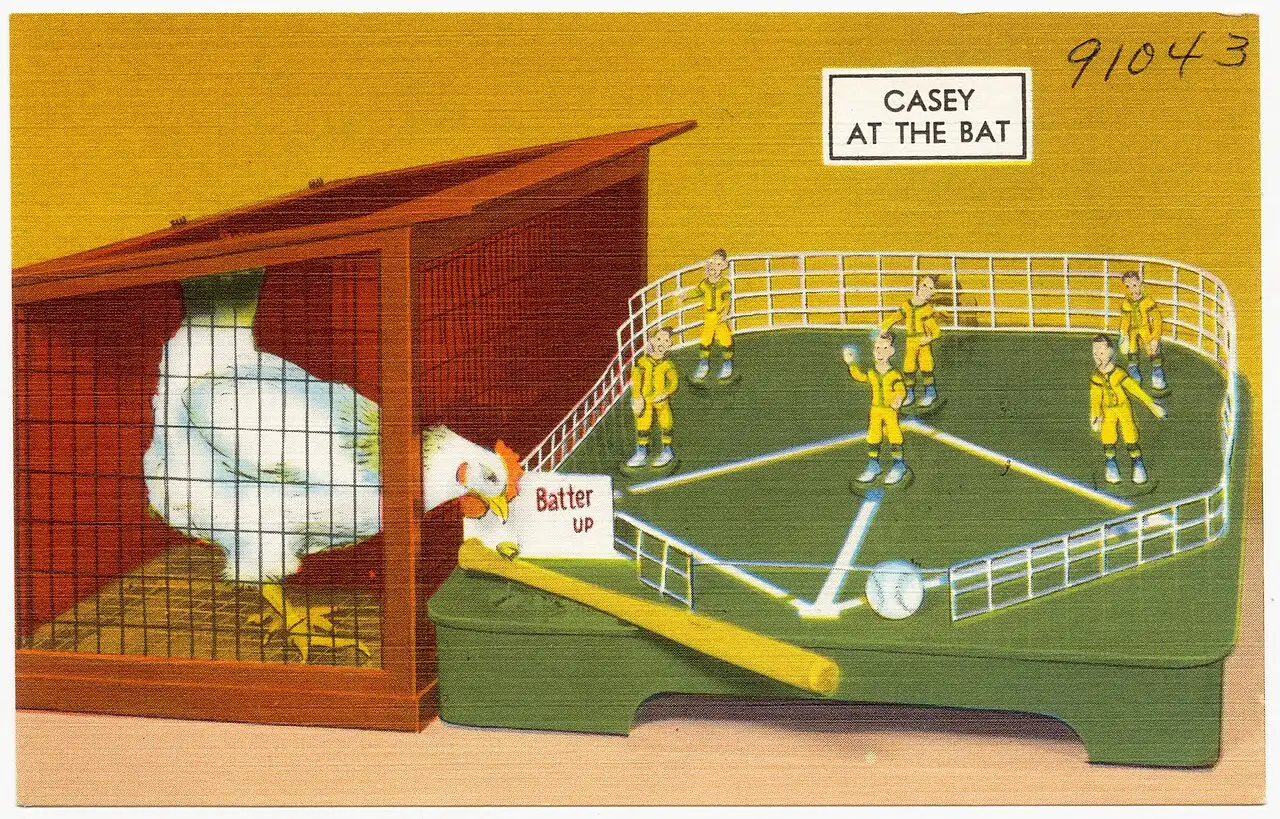
Photo: Tichnor Brothers, public domain (via Wikimedia Commons). A vintage novelty postcard playing on the poem's title: a chicken steps into a batting cage beside a miniature baseball diamond with a "Batter Up" sign, bat, and ball.