Three Years, One Ship: Drake Sails Home Around the World
On September 26, 1580, the Golden Hind limped into Plymouth, completing the first English circumnavigation of the globe.
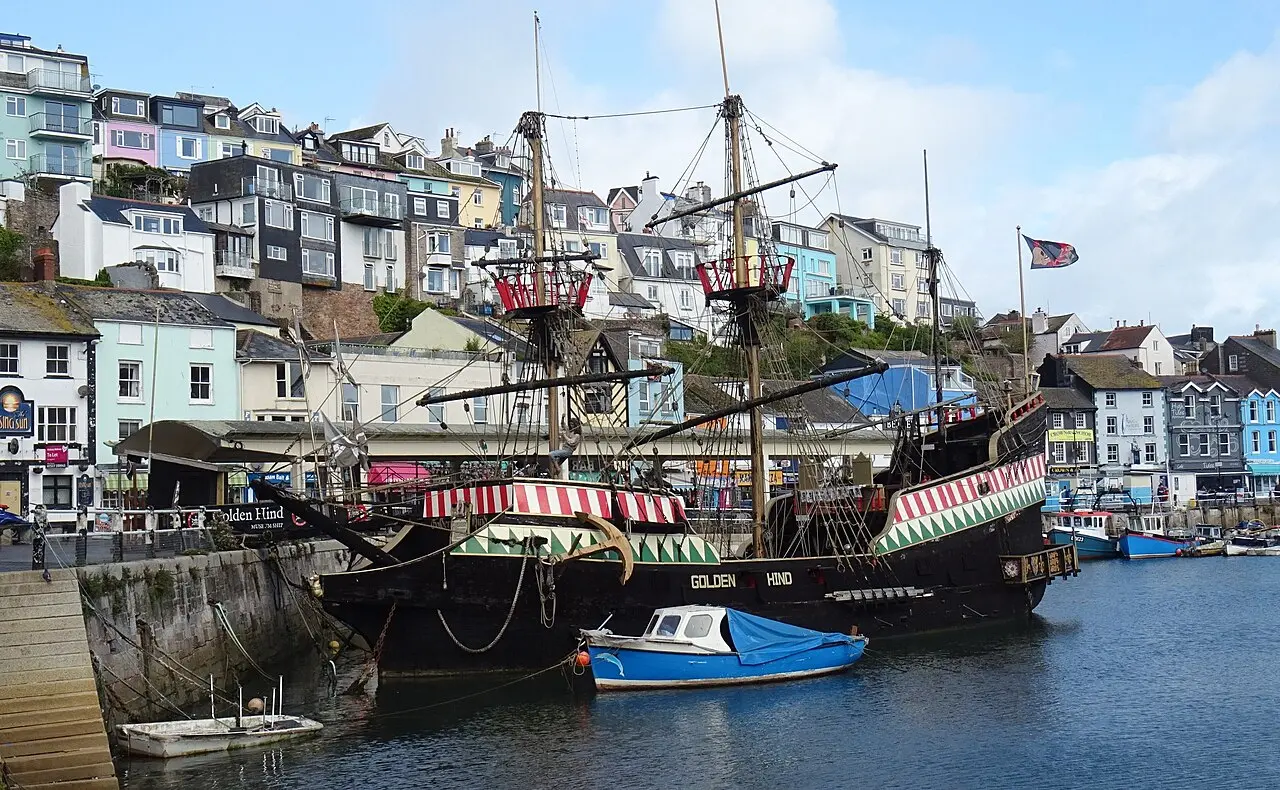
The crowd that gathered at Plymouth on September 26, 1580, had waited nearly three years for this sight. A single battered galleon, her hull patched and her sails worn thin, limped into the harbor with fewer than sixty men aboard. She had sailed with five ships and around 170 men. She was the Golden Hind — and she had just sailed all the way around the world.
Francis Drake had set out on December 13, 1577, on a voyage that was part exploration, part piracy, and entirely secret. His patron was Queen Elizabeth I herself, who had quietly invested in the expedition — and who stood to profit enormously from raiding Spain's treasure ports along the Pacific coast of South America, where the Spanish believed no English ship could ever reach them.
The voyage was brutal. Storms in the Strait of Magellan scattered the little fleet; one ship turned back and the others were lost. Off the coast of South America, Drake renamed his flagship from the Pelican to the Golden Hind. Then he did what no Englishman had done: he worked his way up the Pacific coast, seizing staggering quantities of Spanish silver, gold, and jewels, crossed the entire Pacific, and kept going west — across the Indian Ocean and around the Cape of Good Hope.
On the way, Drake also hunted for the Northwest Passage. After raiding up the South American coast — his richest prize was the treasure galleon Nuestra Señora de la Concepción, nicknamed the Cacafuego, taken off Ecuador in March 1579 with a fortune in Peruvian silver — he sailed far north along the coast of North America, searching for a strait back to the Atlantic. Finding none, he turned south, landed on the California coast in June 1579, and claimed the land for England as "Nova Albion."
When the Golden Hind dropped anchor at Plymouth, she completed only the second circumnavigation of the globe in history, nearly sixty years after Magellan's expedition (finished by Juan Sebastián Elcano in 1522) — and the first commanded by an Englishman from start to finish. By one famous account, the queen's share of the treasure was greater than the Crown's entire other income for that year.
Elizabeth was delighted. The following year, aboard the Golden Hind at Deptford, she knighted Drake — Sir Francis, privateer turned national hero. Spain was furious, but England had announced itself as a naval power to be reckoned with.
The Golden Hind herself was preserved for nearly a century as a floating monument, until she finally rotted away. What survives is the idea she carried home: that the world's oceans were not Spain's private lake, and that a small island nation could reach around the entire planet and come back rich.
Photo: BWard 1997, CC BY, via Wikimedia Commons.